

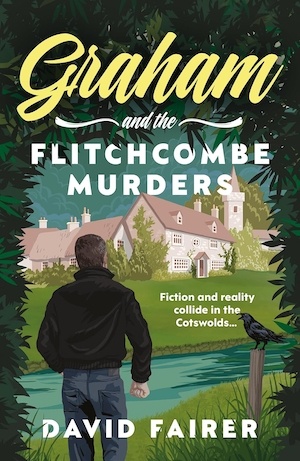
Plenty of crime novels poke affectionate fun at the genre, but few manage it so well as Graham and the Flitchcombe Murders. David Fairer’s first cosy crime novel is simultaneously an engaging village mystery, a sharp satire of modern publishing and an insightful meditation on the craft of writing crime fiction.
Graham Tomlinson has built a moderately successful writing career around fast-paced thrillers, but sales are in the toilet. His literary agent decides that what the market really wants is cosy crime, so Graham is reinvented as Tamara Wilde, a supposedly female author whose quaint village mysteries are expected to capture readers’ imaginations.
Reluctantly abandoning the urban violence of northern hardman Jim Striker’s established adventures for honey-stoned cottages and cream teas, Graham travels to the idyllic Cotswolds village of Flitchcombe-on-the-Water to immerse himself in the conventions of a genre he has previously dismissed.
Naturally, the village proves to be anything but idyllic.
Graham finds himself surrounded by eccentric residents, simmering rivalries, literary feuds, long-buried grudges and enough suspicious behaviour to fuel several novels. Then the line between invention and reality disappears altogether when the victim Graham had selected for his fictional murder plot actually turns up dead.
Suddenly Graham is no longer merely researching a mystery… he is trapped inside one.
It is a great set-up for sure, but what makes Graham and the Flitchcombe Murders work so well is that Fairer refuses to settle for a straightforward comic mystery. Instead, he uses the premise to explore why cosy crime has become such a publishing phenomenon while also celebrating everything that makes the genre endure.
Crime Fiction Lover is no stranger to the explosion of cosy mysteries over the past decade, and fellow aficionados will recognise many of the nods to the genre. There are book clubs, quirky villagers, mysterious local traditions, suspicious newcomers, amateur sleuths and more than one apparently harmless elderly resident with unexpectedly sharp intelligence.
Fairer clearly knows the genre inside out, both the good and the bad, but the humour never feels mean-spirited. Rather than mocking cosy crime, he highlights and gently ribs its familiar conventions while demonstrating exactly why those conventions continue to entertain readers.
The satire of the publishing industry is equally enjoyable. Graham’s forced transformation into Tamara Wilde reflects the increasingly commercial realities of modern publishing, where branding can become almost as important as writing itself. With his chosen genre having fallen out of favour, Graham has to become someone entirely different to maintain his career.
In particular, Fairer has considerable fun with marketing departments, reader expectations and the uneasy compromises authors sometimes have to make in pursuit of commercial success. Yet beneath the comedy lies an interesting question: How much of an author’s identity is genuine and how much is performance?
Initially cynical about cosy crime, Graham gradually discovers that constructing a gentle mystery demands every bit as much ingenuity as writing an action-packed thriller. While he occasionally veers towards self-pity, his humour and self-deprecation make him consistently likeable, and his evolving appreciation of the genre feels real.
He encounters exactly the sort of colourful personalities who should be found in a village mystery, but none feel like simple caricatures. Every conversation hints at hidden motives. Every eccentricity conceals potential significance. Fairer understands one of the oldest principles of detective fiction: memorable suspects make for memorable mysteries.
And the village setting itself deserves almost equal billing with its residents. Flitchcombe-on-the-Water becomes a character in its own right, complete with local folklore, ancient traditions, hidden tensions and an atmosphere in which centuries of history seem to weigh upon every lane and cottage.
The contrast between picture postcard beauty and underlying menace has long been a staple of British crime fiction, stretching back to Agatha Christie and the Golden Age and extending to LJ Ross, Elly Griffiths and more, and Fairer employs it with obvious affection while giving it a distinct twist.
As for the mystery facing Graham, it is both fair and inventive. The clues are carefully distributed, red herrings emerge naturally and the investigation develops at a brisk pace. Fairer avoids relying on outrageous coincidence, allowing the solution to emerge logically from the relationships among his characters.
The novel frequently reflects on narrative, character creation and the strange association between authors and their fictional worlds, without ever interrupting the momentum of the mystery. These metafictional touches could easily have become self-indulgent in less capable hands. Here, they simply add another layer of interest.
The pacing deserves praise too. Comic mysteries sometimes lose momentum as jokes begin to outweigh suspense, but Fairer maintains a good balance throughout. The humour never undermines the stakes, while the murders never become so grim that they overwhelm the novel’s playful spirit. Instead, these elements strengthen each other.
Perhaps most impressively, Fairer provides a timely reminder that the term ‘cosy’ does not necessarily mean ‘slight’ or ‘simple’, certainly no more than the term ‘noir’ is inherently tacked onto a title in an effort polish a (literary) turd. (And seriously, don’t get me started on the rampant misuse of ‘locked-room mystery’.)
In chronicling Graham’s struggles with both the genre and the killer at large in Flitchcombe, Fairer suggests that the best detective fiction has always been about far more than simply identifying a murderer. It is about understanding individuals, communities and the stories people tell themselves.
In an era when crime fiction is increasingly divided into either relentlessly dark psychological thrillers or comforting village mysteries, Graham and the Flitchcombe Murders occupies a space between the two. It embraces the conventions of classic detective fiction while acknowledging contemporary publishing trends and interrogating assumptions about both.
Beneath the humour lies an exploration of creativity, identity, reinvention and authenticity, as well as a perceptive examination of why stories matter to both writers and readers. The novel is a tribute to detective fiction disguised as a whodunnit as well as a whodunnit disguised as a comedy. Happily, it succeeds at being all three.
For more crime in the countryside, try Pork Pie Pandemonium by Steve Higgs and The Book Club Murders by Maggie Allswell.
The Book Guild
Print/Kindle
£4.99
CFL Rating: 5 Stars