


Originally from Hull and now based in Leeds, David Fairer was a Professor of English at Leeds University before he retired. After a career teaching about some of the greatest novels in the English language he started writing historical mysteries. Now, he’s taken up the challenge of penning a cosy crime novel and has set himself the goal of coming up with something a bit different.
Graham and the Flitchcombe Murders takes us to the fictional village of Flitchcombe-on-the-Water where Graham Tomlinson has arrived to do a little bit of what you might call method writing. Previously, he wrote gritty crime novels set in the North of England, but now his agent wants him to write cosy crime novels under the pseudonym Tamara Wilde. To help ensure that art imitates life, Graham’s in the Cotswolds to see what makes the area tick, and soon finds inspiration.
But the cosy vibe he’s seeking is deadened when a local person who was going to be the victim in his story is found dead. Then all sorts of other storylines come bubbling to the surface. Rivalries, romance, buried secrets – David has had a field day playing with the tropes of cosy crime and village life in the South West.
It is with great delight that we welcome David to our beloved genre and we can’t wait to introduce him to you in our interview below…
What are crime fiction lovers going to love about Graham and the Flitchcombe Murders?
I hope readers will first of all love the classic whodunnit plot, which builds from scene to scene to a dramatic climax. But also be fascinated by the way the book is playing with the conventions of crime fiction – what kind of murder is this? What kind of fiction is this? I think connoisseurs of crime fiction will find this intriguing.
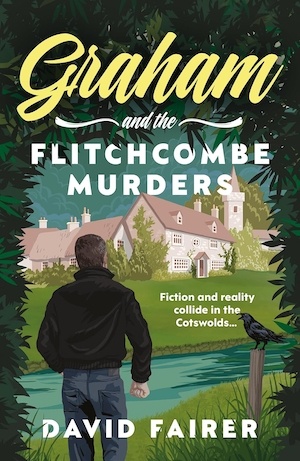
Who is your protagonist, Graham Tomlinson, and what was the inspiration behind this character?
Graham is Tom Stone, a writer of noir northern thrillers who finds himself facing the ultimate challenge. Re-branded by his agent as Tamara Wilde, Mistress of Cosy Crime, he realises this is more than just a literary challenge. In Flitchcombe, an idyllic Cotswold village, he finds perfect material for his murder mystery – too perfect? Are the villagers auditioning for parts in his novel? And are the members of the local book group using him in a fiendish plot of their own? I’m inspired by the thought of bringing Ian Rankin to Midsomer.
What’s he up against?
As a noir author, Tom Stone is used to thinking of good guys and bad guys, and certainly the Cotswold media mafia fit that description, as do the London drugs gang. But perhaps the real villains are Graham’s friends in the book group? His little old landlady? The local gamekeeper, or the formidable Lady of the Manor? Graham finally understands what he’s up against when he finds himself on a murder charge…
You’re based in the north, so what made you want to set a story in the Cotswolds?
I wanted to introduce my warm-hearted, sexy, innocent Yorkshire hero to a world that he’s not experienced before – the archetypal idyllic Cotswold village. A young man with rough edges and a no-nonsense outlook finds himself in a place that seems already in fiction… As Tamara Wilde he begins to fall in love with the place – and, without realising it, with one of its inhabitants…
You’ve previously written three historical crime novels, and the past plays a role here too, but in different ways. What was different or challenging about switching to the cosy crime format?
Yes, in the Chocolate House Mysteries I’ve tried to recreate the world of Queen Anne’s London as authentically as possible, and the novels combine historical and fictional characters and track closely the events of the year 1708. The world of Flitchcombe-on-the-Water couldn’t be more different. Here I’ve been able to invent everything and weave comic elements in with the serious themes of the book. It’s an opportunity that cosy crime offers, and I’ve been happy to seize it. But the village’s history, as readers will see, does find a way in – big time!
How has teaching classic English fiction helped you as a writer?
I’ve learnt this from teaching the great English novels –Austen, Dickens, George Eliot. Too many modern novelists are thinking about themselves rather than the person they’re talking to. My motto is: Keep your reader close. Remember whom you’re talking to – it’s someone who is giving time and thought to your words, so make it worth their trouble. Entertain, provoke and intrigue your reader. It’s the most important relationship in the book.
There are some interesting and eccentric characters here. Who should we be looking out for and why?
I’d watch out for the women especially. Village ladies can be highly dangerous, and Flitchombe turns out to be something of a matriarchy. In particular, be wary of Lady Aylmer, the village dictator who makes Lady Bracknell look like Miss Muffet; also Graham’s ageing-hippy landlady; the two activists Beth and Kate who enjoy fictionalising village gossip? And what about Daisy and Mabel, pillars of the Church Militant? Those slick media men who want to exploit Graham’s noir novels can’t be trusted either. There’s a wide choice… Even the Cheltenham DI with a Poirot obsession has his own fiction in mind. And surely when Eve leads Graham into the shrubbery it can’t be to admire the buddleias?
What were the bigger themes and topics you wanted to explore?
In writing the book I became fascinated by crime fiction writing itself. How it can cheat and betray, and play with lives. Comedy, especially when touched with the satirical, is a great vehicle for handling serious themes. Graham and the Flitchcombe Murders develops thoughts about masculine identity, and how a prose (prosaic?) writer can finally discover poetry. The novel ends up making Graham Tomlinson a better writer, and one who realises there’s so much more to be done with crime fiction.
Which books and/or authors have inspired you?
I enjoy both noir and cosy. Since my student days I’ve loved crime novels that take me into distant or unvisited worlds – I read all of Ellis Peters’ Brother Cadfael mysteries which transported me to 12th-century Shrewsbury, and all of Lindsey Davis’s Falco novels set in Imperial Rome. More recently I’ve become hooked on Donna Leon’s Inspector Brunetti Venetian police procedurals.
All of these are fascinating. But CJ Sansom, Ian Rankin and Michael Dibdin have a crucial hard-edged quality that even cosy crime writers mustn’t neglect. What a great tradition we have! I’ve just started on Rankin’s The Complaints – branching out after Rebus. Brilliant.
What’s next for Graham Tomlinson and what’s next for David Fairer?
I’m working on a sequel set two years later. Graham has become hot property for the media and is now settled in Flitchcombe-on-the-Water, where he finds himself involved in a national cookery competition that has come to the village. Once again, Flitchcombe’s dark secrets are in danger of being revealed, and the TV crew, the producer and the celebrity chef have brought their own dangerous drama along with them…
Graham and the Flitchombe Murders is out now. Use the button below to get your copy.