

Crime fiction is a genre built on familiar tropes: the suspicious death, the damaged investigator, the institution that prefers easy answers over difficult truths. What makes a mystery novel memorable is not whether it uses these conventions but what it does with them.
In Collateral Death, J Kushley delivers a crime novel that manages to feel both comfortingly recognisable and strikingly original: a noir-tinged mystery that blends detective fiction, speculative worldbuilding, dark comedy and surprisingly sharp social commentary into something far more ambitious than its premise initially suggests.
And that premise, admittedly, requires a moment of adjustment.
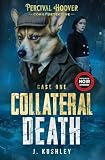
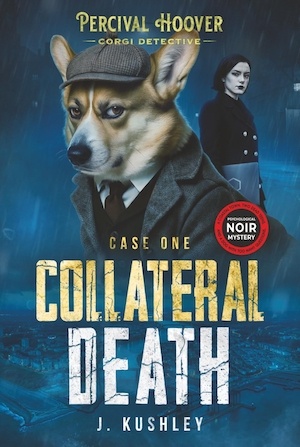
The novel’s protagonist, Percival Hoover, is a talking Pembroke Welsh Corgi who works as a private detective in the bleak coastal town of Bellwick. On paper, the setup sounds perilously close to novelty fiction – the kind of eccentric hook that risks overshadowing everything around it.
But Kushley quickly overcomes the potential absurdity of the concept. Hoover is not a gimmick. He emerges almost immediately as a fully realised and unexpectedly compelling sleuth: cynical, intelligent, emotionally burdened and carrying enough existential frustration to rival many of crime fiction’s most celebrated defective detectives.
There are obvious literary echoes here. Hoover’s sharp observational instincts and meticulous habits invite comparisons to Sherlock Holmes, although Kushley avoids reducing him to homage. Instead, Hoover feels distinct: equal parts classic detective and tragic outsider figure, navigating a world that both tolerates and marginalises his existence.
The case begins when two teenagers, Chloe and Julian, residents of Bellwick Children’s Home, are found dead near the industrial docks. The authorities waste little time concluding that the deaths were the result of reckless drinking and youthful irresponsibility. Hoover, however, knew Chloe and immediately suspects that the official narrative is far too convenient.
Bellwick is rendered with exceptional care: a weather-beaten, economically declining coastal town steeped in dampness, stagnation and neglect. The setting becomes far more than backdrop. It carries emotional and thematic weight throughout, reinforcing the story’s larger concerns about communities that abandon their most vulnerable members.
The descriptions are layered and atmospheric without becoming indulgent, and the writing shifts between melancholy, satire and genuine emotion with impressive control. Kushley demonstrates a clear understanding that atmosphere is not decorative but structural. The environment helps to shape understanding of the mystery unfolding within it.
It becomes clear that Collateral Death is not simply interested in finding a solution to the teenagers’ suspicious deaths. Beneath the investigative framework lies a deeply critical examination of institutions and the ways society routinely fails those who lack power or visibility.
This is particularly evident in the portrayal of Bellwick Children’s Home, overseen by the unsettling Martha Kelmor. Kushley wisely avoids making her overtly monstrous. Instead, she embodies something far colder: bureaucratic indifference calcified into habit. Her emotional detachment becomes emblematic of the idea that systems often cause harm not through overt cruelty but through routine apathy.
The same criticism is extended to local law enforcement, whose eagerness to close the case reflects a broader social hierarchy of whose lives (and deaths) are considered worthy of serious investigation. Kushley exposes the uncomfortable reality that some tragedies are simply easier for institutions to ignore than others.
Hoover’s frustration simmers throughout as these institutions repeatedly demonstrate that two dead orphans simply do not warrant serious attention. The strength of his feeling seems to, at least in part, stem from his own mysterious background, although Kushley leaves much of that detail and the associated demons for future cases.
Yet for all its darkness, Collateral Death is frequently very funny.
Much of the humour comes from Hoover and the reality of being a sentient dog within an overwhelmingly human bureaucratic system. Scenes involving species compliance hearings and institutional attempts to categorise his existence introduce a distinctly absurdist tone that feels almost like The Trial by way of Wycliffe.
Kushley balances these moments well, allowing humour to coexist alongside grief and anger rather than undermining them. Hoover is a weary, sharp-minded, emotionally burdened investigator whose species is simultaneously incidental and central to the novel’s broader thematic concerns. The citizens of Bellwick seem to accept his presence without question.
Similarly, by the novel’s midpoint it becomes impossible to imagine the story working with any other protagonist than Hoover. Beneath his tweed coat, dry sarcasm and eccentric investigative habits lies a genuinely affecting portrait of loneliness, grief, moral conviction and resilience.
Another particularly inventive element of the novel is Hoover’s unusual sensory perception, which allows him to associate scents with colours as part of his investigative process. It is an innovative piece of worldbuilding that lends the detective work a genuinely original dimension.
Collateral Death is clearly not a conventional thriller. Kushley prioritises atmosphere, character psychology and thematic development over plot acceleration. Rather than rapid-fire twists, the mystery unfolds in a measured manner, which can seem ponderous at times. However, the slower pace allows plenty of room for (canine) character development.
As a debut crime novelist, Kushley has taken plenty of risks – stylistically, structurally and conceptually – and doing so has really paid off. The book manages to be inventive without ever feeling self-consciously quirky. Most crime novels ask whether justice will prevail. Collateral Death asks a far more uncomfortable question: Who is denied justice and why?
Against all conventional wisdom, Kushley has somehow written a detective novel starring a talking corgi that feels sharper, darker and more emotionally sophisticated than many contemporary crime thrillers. If anyone still insists that crime fiction has exhausted its capacity to surprise, Collateral Death offers compelling evidence to the contrary.
After all, as the novel rather convincingly proves, you really can teach an old dog new tricks.
For more dog(ged) detectives, try Pork Pie Pandemonium by Steve Higgs.
Self-published
Print/Kindle
£4.49
CFL Rating: 4 Stars