


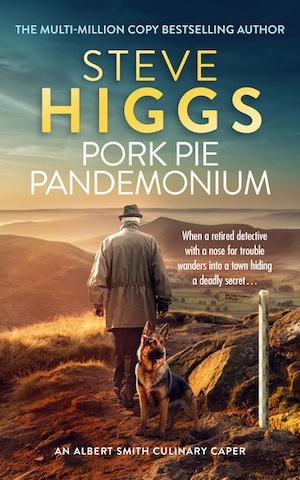
Growler. Grosvenor. Tourtière. However you frame it, the pork pie has become a symbol of classic British cuisine. That’s why retired Detective Superintendent Albert Smith chooses Melton Mowbray – Rural Capital of Food and Town of Pies – as the first stop on his culinary tour of the nation.
And he doesn’t intend to travel alone.
Accompanying Albert on his gastronomic odyssey is Rex Harrison, an oversized and overopinionated German Shepherd. Having flunked out of the Metropolitan Police’s Dog Support Unit due to his bad attitude, Rex now serves as Albert’s assistance dog – he’s got the proper outfit and everything.
After arriving in Melton Mowbray and getting comfortably ensconced at a B&B, Albert signs up for a pork-pie-making class at Agnew’s Pork Pie Emporium. As food safety regulations don’t forbid the presence of assistance dogs in culinary establishments, Rex goes along too, although Albert does insist that both of them wear hairnets.
Sadly, before any pastry can be crimped, the class is disrupted by the discovery of a severed thumb in a pile of minced pork. After being dismissed by the local police, but not before spotting a distinctive tattoo on the offending digit, Albert decides to extend his stay in Melton Mowbray until he can determine what happened to the thumb’s owner.
Pork Pie Pandemonium is the first book in Steve Higgs’ Albert Smith’s Culinary Capers series, which tracks Albert and Rex to and fro across the British Isles in search of good eats and nefarious killers. A hit in eBook format, now published in print by Vinci, it’s a humorous cosy mystery featuring an unconventional detective duo who can thwart any criminal, provided their joints don’t seize up anyway.
While long retired and suffering from the odd memory lapse, 78-year-old Albert still has the instincts of a seasoned detective. His sharp eye for irregularities soon spots that the bizarre discovery of the thumb is connected to criminal activity lurking beneath the surface of the picturesque Leicestershire town.
Being a retired police officer clearly aids in his investigation, as does the fact that he can call upon the assistance of three concerned offspring who are all serving officers, but it also marks an intriguing point of difference from the standard cosy crime novel. Albert is no plucky amateur sleuth who happens to stumble into a mystery. After decades in the police force, he knows how criminals think and how investigations unfold. Yet retirement has placed him in an unfamiliar position: he no longer has official authority, so he must rely on observation, improvisation and persuasion rather than institutional power.
Albert’s personality is deliberately understated. He presents himself as a quietly competent observer of human behaviour. People tend to underestimate him because of his age and unassuming manner, a mistake that allows him to gather information without attracting suspicion. This understated intelligence is one of his key strengths.
Yet Albert is only half of the investigative duo. His canine companion Rex possesses a far sharper nose than the humans around him and often realises the truth long before they do. Pork Pie Pandemonium frequently shifts into Rex’s perspective, presenting the meat of the mystery through the dog’s wry observations.
This approach provides considerable comedic energy. Rex understands the situation perfectly well, but communicating his discoveries to Albert often proves frustrating. While Albert slowly pieces together clues, Rex often watches with exasperation, aware that the solution is practically obvious – at least to someone with a dog’s sense of smell.
The pair’s investigation unfolds in and around Melton Mowbray, which really is famous for its pork pies. The culinary theme shapes both the atmosphere and the structure of the mystery. By grounding the plot in such a distinctly British place and associated culinary tradition, Higgs creates a setting that feels both specific and comfortably familiar.
Beneath the town’s pleasant surface lies a network of hidden relationships, rivalries and confidences. Albert and Rex’s investigation gradually exposes these concealed tensions, revealing that the apparently harmless pie-making world conceals motives far more dangerous than anyone expected.
Local shopkeepers, rival piemakers and curious townspeople all put in an appearance, each with their own quirks and secrets. Among them is Donna Agnew, a teenager left in charge of the pie shop while her mum’s in hospital. She becomes an unexpected ally to Albert and Rex as they attempt to unravel the strange events threatening the business.
As the inquiry progresses, suspicious incidents accumulate, suspects emerge and clues slowly build. Pork pies also begin to regain their inherent palatability. The mystery itself is perhaps not the most complex, but the fun lies in the Albert and Rex’s journey towards the truth rather than the difficulty of the puzzle.
Events are narrated in a straightforward and conversational style, with Higgs favouring dialogue and short scenes rather than elaborate description. The humour, often driven by Rex’s commentary and Albert’s dry reactions, ensures that the darker aspects of the crime – the ripping off of the telltale thumb – never become overwhelming.
Pork Pie Pandemonium offers a window into a cosily crime-riddled world that can happily be revisited during 16 more culinary capers. Albert provides the steady detective logic, Rex supplies the comic commentary and the setting delivers a distinctly British flavour. The mystery of the thumb may be resolved, but other fiendish crimes are firmly on the menu.
For more canine-centric cosy crime, try The Dog Sitter Detective by Antony Johnston and Helle’s Hound by Oskar Jensen.
Vinci Books
Print/Kindle
£4.99
CFL Rating: 5 Stars