

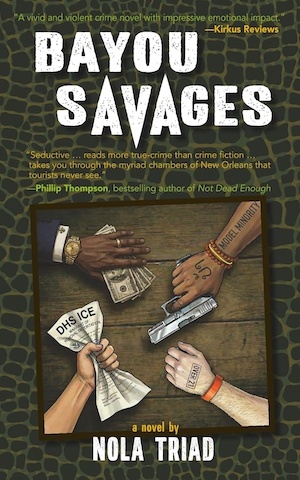
Today I want to introduce you to the new voice of crime fiction from the New Orleans underground. And, in this interview we bring you a three-for-one, because Nola Triad is a trio of writers from that great city, who reflect both its diversity and its thrills in so many ways. Their first novel, Bayou Savages, is out now and it features a gang of four misfits (a bit like the authors themselves, some might say) who come upon a priceless painting that was taken during a mafia heist.
Oh, yes. A classic noir setup. This is what we love!
We’ll get into that some more in the interview, but first a little more about these three authors. They’re multicultural, of varying age, they’ve clocked up quite a few years of writing experience and each is already well known for other types of writing. They don’t want their existing reputations to colour the Nola project, so they’re keeping it anonymous under the Triad umbrella.
The important thing is they all love crime fiction and want to create New Orleans crime thrillers that go against the grain, with plenty of spice and not much cosy at all. They call it crime fiction gumbo – and, hey, that sounds like the perfect label for a new crime genre!
So let’s have a chat with the Nolas…
What are crime fiction lovers going to love about Bayou Savages?
Bayou Savages fires on classic crime fiction cylinders – massive heist, characters dying violent deaths – while still being radically different from everything else out there. One of our agents said, “This space doesn’t exist in the marketplace, but it needs to.”
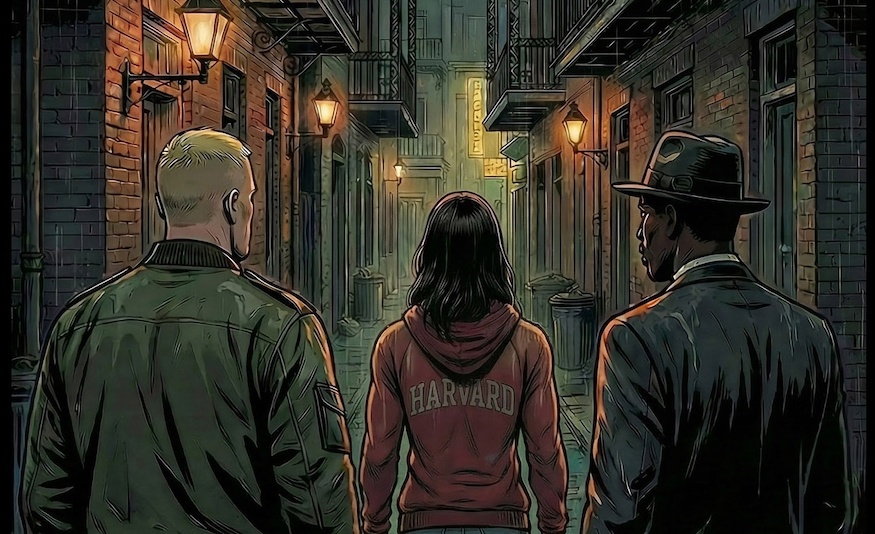
Who are your misfit protagonists, and how have you formed, developed and realised these characters?
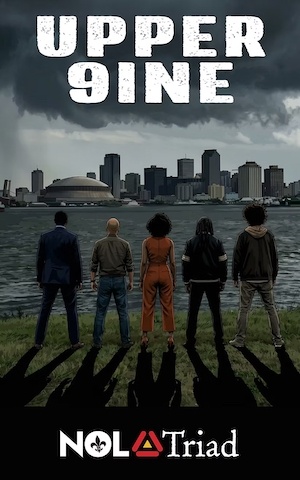
Because New Orleans is this shaken can of different cultures, we have the advantage of presenting diverse characters organically. In Bayou Savages’ protagonist quartet, the mastermind, Carter Champagne, is Black; the Asian males, Jimmy Nguyen and Manivong, are the sex appeal and street muscle; our white narrator, Ray, gets pulled into the team after a single brave act. There’s not a single false thread in any of that.
What are they up against?
Well, they come across a priceless painting the mafia originally stole, and the mafia take that kind of thing personally. Plus one mobster had promised the painting to the DA in a crooked deal to secure his freedom—also inauspicious. On top of all that, Jimmy Nguyen and Manivong have deportation warrants that keep ICE within striking distance at all times. Those are the obvious forces at play, but in fact this story takes place in New Orleans East, where our protagonists grew up, and their most formidable obstacles come from this setting.
Tell us about the bad guys, their characters and the kind of peril they bring to the story?
Our “good guys” and “bad guys” are all shaded. No white hats or black hats to be found in Bayou Savages: only a team that you find yourself pulling for, even though they’re at least as savage as the folks coming after them.
New Orleans, with its heat, music and blend of peoples and cultures is key here. It’s part of your very essence. What kind of role does it play in the story and what kind of atmosphere do you evoke for the city?
For sure the atmosphere blazes through in every scene, but the most uniquely New Orleans aspect of Bayou Savages is in the writing itself. The rhythm, the pace: it’s relaxed, but it moves.
What are some of the wider themes you wanted to explore here?
We can go back to your bad guys question and this time answer it differently: The obvious bad guys in Bayou Savages get scant word count because they’re the powers that be – the political and business leadership who abandon communities like New Orleans East and leave the residents to fend for themselves. Carter Champagne reminds his team that they are themselves the best hope their people have; no one else is coming to help.
I think this is one of the first novels I’ve seen where ICE comes into play. How is this body viewed by yourselves and what role do they have in the story?
People will have differing views of the agency, but in America right now, there is a widely shared sense that ICE has lost its containment. Whether you want it abolished or see a purpose for ICE, we share common ground in not wanting underqualified and inadequately trained agents performing a very consequential job, with people’s lives and livelihoods hinging on what those agents do. Jimmy Nguyen mentions that smart and upstanding agents nailed him years ago, but the two deportation officers who are after him now are anything but. These are buffoons – they’re dangerous, not in a good way, and they’re yet another element most of us are blessed not to have to contend with, but who remain a constant menace to our protagonists in New Orleans East.
How does the creative process work across three authors collaborating together? Do you each take turns writing chapters or does one of you lead and the others follow up with rewriting and finessing? How are creative decisions taken?
It is really fun because we’ve approached Bayou Savages in all the ways you describe, and what it comes down to is no hard feelings. We each take turns tearing into the novel and revising it as we see fit. We find a single voice in the process; there are no sacred passages, anything can be altered, and you can wake up and find your darlings have disappeared. Disagreements are rare, but they are settled by the writer we designated the tiebreaker of our team. Our novels are at their foundation Black stories rooted in a Black city, and our tiebreaker is Black.
What made you choose a Neo noir approach over, say, cosy crime fiction? You’ve kind of coined the phrase ‘un-cosy’, haven’t you?
We love the cosy surge. A reading upswing in any fiction category is to be celebrated, and we’re pulling for the continued success of cosy.
However, in Bayou Savages’ presentation of Black and Asian characters, particularly from those of us Black and Asian writers, we feel a moral obligation to avoid making our territory more palatable. The major publishers would prefer we write these full Black and Asian characters in approved lanes – beyond cosy, there’s magical realism, speculative fiction, generational-trauma social commentary. The majors are comfortable with that kind of award bait, but we’re going to buck that. Black and Asian voices have more than those kinds of stories to tell, and Black and Asian characters should star in them, so we’re grateful that there’s an audience for our brand of rough reality.
Who are some of the other authors that have interested or inspired you, and what are you reading right now?
SA Cosby kicked the door down for Nola Triad and we’re eternally in his debt. We could list other inspirations and have on social media, but we’ll let Cosby sit here undiluted. As for what’s in our hands right now, one of us is setting down a TC Boyle beauty and starting a Percival Everett, that true American treasure, one of us is rereading some Bret Easton Ellis while writing a book of her own under her real name, and one of us just cracked Stone Cold Trouble by Amer Anwar, to whom we were introduced by Crime Fiction Lover, so thank you for that!
What’s next for Nola Triad and what’s next for the ‘bayou savages’?
Without revealing who makes it out of Bayou Savages alive – because you never know in a Nola Triad book – let’s call it an origin story for the mastermind Carter Champagne. Carter is committed to the people of New Orleans East, and he will lead the best team he can assemble, the Rulers of the Ninth Ward, for whatever Robin Hood heist his brain can hatch to help his community. Next up, it’s hurricane season, and Carter is going after crooked insurance executive Frank Ferguson whose plan is to skip town with hundreds of millions of dollars meant for survivors.
Is there anything I’ve missed that is important to mention?
One of Bayou Savages’ early Amazon reviews came from a UK reader who says, of our protagonists, “At first glance, one might imagine they are no different from the forgotten souls of East London, and that is precisely what makes this crime thriller get under your skin.”
We take particular pride in that reaction, because Bayou Savages is the most hardcore street-level New Orleans novel out there – we write with love for our city – and it’s also universal; people around the world see their neighbourhood in ours. New Orleans can be a rough place, but it’s welcoming. We want everyone who’s up for it to come enjoy themselves in our town and in our writing, and to make memories for life.
Grab a copy of Bayou Savages using the buttons below.