

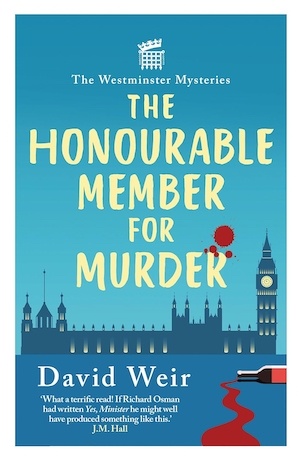
Politics and murder. Both involve secrets, competing agendas, carefully managed public appearances and, occasionally, people prepared to do almost anything to get what they want. In The Honourable Member for Murder, David Weir brings the two together in a debut that combines Westminster intrigue and satire with a traditional mystery.
And it is an especially appropriate setting for Weir to choose.
He spent decades labouring behind the scenes in the House of Commons, where he worked across its procedural offices and managed Select Committees. That experience gives his first crime novel a sense of authority when it comes to the peculiar machinery of parliamentary life.
The most prominent government figure, however, is hardly the sort of politician you might expect to find at the centre of a murder investigation. Eliot Oakcroft, MP for Middlebury-Mid, is ambitious, self-important and spectacularly dependent on the people around him. Fortunately, his chief of staff, Maxwell Murray, is considerably more competent.
As should be expected, Max’s responsibilities extend well beyond the conventional duties of a parliamentary aide: keeping Oakcroft organised, steering him away from embarrassment and romantic entanglement, and generally preventing his employer’s weaknesses from becoming tomorrow’s headlines.
But when Miranda Cley approaches Oakcroft with a request for help, Max’s carefully controlled working life becomes considerably more complicated. Miranda’s mother is in prison for murdering her husband, Charlie. The problem is that Miranda has recently seen her father alive, enjoying an ice cream on Cromer Pier.
It is an irresistible premise for an MP looking for a way to raise his profile. A possible miscarriage of justice offers Oakcroft the opportunity to present himself as a serious parliamentarian, and he promptly takes an interest in the case. Naturally, it is Max who ends up doing the actual work, assisted by his capable colleague Diana Burton.
What initially appears to be a straightforward– if sparse on the practical details – case of deliberate disappearance and wrongful conviction soon develops into something considerably murkier, involving concealed motives, financial wrongdoing, corruption and people who have very good reasons for not wanting old secrets examined too closely.
The Westminster setting is one of the novel’s greatest strengths. As Yes Minister proved, parliament is a ready-made comic environment. There are committees, whips, parliamentary manoeuvring, constituency concerns, political ambition and the endless business of ensuring that politicians are in the right place at the right time.
For someone like Max, every minor crisis becomes another problem to solve as quickly and quietly as possible. For someone like Oakcroft, every problem is potentially an opportunity for self-promotion and a chance for self-humiliation. That contrast supplies much of the story’s humour.
Oakcroft is not an evil politician so much as an exasperatingly self-centred one, and his capacity to stumble into situations that Max must then resolve provides a pleasingly old-fashioned comic rhythm. There is something of the political sitcom about the premise, but Weir wisely allows the murder investigation to develop into a proper crime story.
Max makes an appealing protagonist precisely because he is not a conventional detective. He is a parliamentary fixer who finds himself having to investigate because somebody has to establish what is really going on. His practical approach to the investigation also provides an effective counterpoint to Oakcroft’s grandstanding.
Diana is equally important, bringing intelligence and determination to the investigation and helping to ensure that Max does not become merely the long-suffering straight man forced to react to his employer’s antics. She also takes on the Watson role, giving Max a reason to explain various elements of the Westminster milieu.
The supporting cast add further colour. Weir has fun with the people orbiting Westminster, while the investigation also takes Max and Diana outside the parliamentary bubble. Ronni, Max’s journalist sister, proves particularly useful as the investigation gathers momentum, bringing another perspective to the increasingly tangled affair.
And it’s just as well there are so many amateurs on the case, given that the official approach to the case leaves a lot to be desired. Somehow, Rebecca Cley is in prison for murdering her husband, but the family can’t claim on his life insurance because there’s no proof that he’s dead. It’s as unlikely as Inspector Adrian’s detective work.
The mystery is constructed around a deceptively simple question: If Charlie Cley is dead, how can Miranda have seen him out and about? It is the kind of conundrum that immediately invites speculation about duplicity, and Weir makes good use of the gap between what the characters believe has happened and what the evidence might actually mean.
Importantly, he does not rely on the initial puzzle. As Max and Diana dig deeper, the case expands, and what first looks like an isolated crime begins to expose a wider network of deception. Each discovery creates new possibilities rather than simply ticking another box on the journey to the solution.
The result is perhaps best described as cosy crime with a sharper political edge. There is real jeopardy as the investigation develops, but the overall atmosphere remains accessible and good-humoured. Weir is clearly more interested in satirising the absurdities of political life than in delivering an especially bleak portrait of murder and corruption.
That balance is not always easy to achieve.
A crime novel that is too whimsical can leave the mystery feeling inconsequential, while a political thriller can easily become bogged down by procedural detail. Weir largely avoids both pitfalls. His parliamentary knowledge adds texture rather than offering a manual on how Westminster works, and the humour complements rather than overwhelms the investigation.
As a debut, The Honourable Member for Murder is impressive. Weir writes with the confidence of someone who knows his setting intimately, and his experience as a playwright is apparent in the brisk exchanges and strong sense of character. As a result, the novel moves comfortably between political comedy and traditional whodunnit territory.
It is also the first instalment in the planned Westminster Mysteries series, which means Max, Diana and their troublesome employer have plenty of scope for further adventures. In fact, it seems that the unlikely investigative team will be thrown into another Westminster-shaped mess sooner rather than later.
For more politically minded murder, try The Blockchain Syndicate by Robbie Bach and The Day of the Jackal by Frederick Forsyth.
Allison & Busby
Print/Kindle/iBook
£5.99
CFL Rating: 4 Stars