

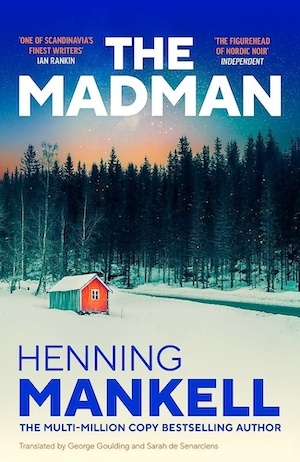
Translated by George Goulding and Sarah de Senarclens — Swedish crime writer Henning Mankell has had a substantial influence on us here at Crime Fiction Lover and his death in 2015 left a glaring gap in the crime fiction landscape. We were thrilled by the unexpected announcement that Mountain Leopard Press would be publishing a Mankell lost classic, Vettvillingen, first published in 1977 and posted this preview of the book on YouTube.
Written long before Wallander came into the author’s imagination, this is not your usual police procedural-style Wallander novel but a melancholic, political novel told by an unidentified first-person narrator.
The Madman is set in a market town in the remote Norrland region, against the backdrop of a small Swedish community shortly after World War II, before Sweden began building its democratic welfare state. The remnants of the War linger, particularly the now defunct labour camp on the edge of the forest. The end of the War did not bring the result the pro-Nazi townsfolk would have preferred, while those in the communist camp want accountability for what happened in the camp.
This quiet town is on the verge of exploding; it just needs something to ignite the spark.
When Bertil Kras arrives in town one autumn Sunday, he quickly becomes a scapegoat and continuous target. Bertil left his life in Stockholm, swapping his work as a bicycle courier for a job in the sawmill to fulfil his dream of being in the far north of the country. Immediately after signing his contract, he comments to the personnel manager, Nilsson, that it is wrong for one family to have so much money and power over so many people. The sawmill is owned by Gustav Rader, who was resolutely pro-German and Bertil is instantly branded not only an outsider but also a communist.
He’s not the only communist in town. Svante Eriksson and Nils-Erik Erlandsson were both imprisoned in the labour camp and have now decided to join forces and bring those who wronged them to justice. Senior Constable Lönngren, the man responsible for their imprisonment, is still the head of police in town.
In a late afternoon in October 1940, Lönngren received an unexpected order from military command to carry out the arrests of a group of men who had done nothing illegal. Lönngren did not question the order. Different opinions were viewed as dangerous and had to be neutralised, leading to the unlawful internment of communists, syndicalists, anarchists and other political elements deemed a threat to national safety by a government claiming neutrality but kowtowing to the Nazis.
Eriksson, with the support of Erlandsson and other men who were imprisoned, writes a letter to the local paper. Those accused, in return, claim that a newcomer has been making trouble for political purposes. Bertil isn’t mentioned, but everyone suspects him.
One cold January night, the sawmill burns down. The fact that multiple fires started everywhere at once indicates arson. Gustav Rader is also found dead close to the sawmill factory in a clump of trees. Many people held grudges against Rader, so the motive could be revenge. But what if it was for financial gain and Rader caused the fire himself?
Once again, all eyes turn to Bertil and he is accused of being an arsonist. He has just started to build a life with Margot and her baby daughter, Kristina, aka The Ruby, and now he is left without a job or a future. The townspeople believe they have to eliminate him because he is a communist, leading to violence against him including an incident at a dance hall, an attack in the cemetery and being shot at during a hunting expedition. Despite evidence pointing to Bertil being targeted, the police side with his persecutors.
Senior Constable Lönngren is a despicable policeman who acts as “a bridled horse with no right to any ethics other than loyalty”. Aware that he is a bad investigator and a useless policeman, he mostly wishes to avoid finding the guilty party. He feels no shame or guilt. Instead of exposing crimes or pursuing criminals, Lönngren fights against those who seek truth and clarity.
The Madman clocks in at a hefty 528 pages and proves to be a rather slow, meandering read with almost a stream-of-consciousness mode of storytelling. While it is bulked up by occasional unnecessary information and repetition, Mankell nevertheless created a wonderfully atmospheric novel. There is more emotional depth here than in his later novels and the focus remains firmly on the characters and their tragic, inevitable fates.
Likewise, the themes of fear of outsiders and judgement and persecuting people based on their opinions or beliefs are, sadly, 50 years later, more relevant than ever.
The book arrives with interesting timing as a new adaptation of Wallander starring Gustav Skarsgård is currently being made for Netflix.
Mountain Leopard Press
Print/Kindle
£12.99
CFL Rating: 4 Stars