

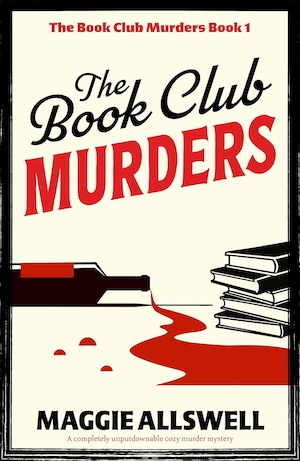
There is a distinguished tradition of amateur sleuths solving crimes over cups of tea, but Maggie Allswell’s The Book Club Murders brings a welcome twist to the formula. Rather than centring on a retired detective, an inquisitive vicar or an improbably gifted baker, Allswell hands the magnifying glass to a group of dedicated crime fiction readers.
The six members of the Matlock-based Serial Killer Book Club have spent years debating motives, spotting clues and second-guessing fictional killers. As a consequence, when a real death occurs practically on their doorstep, it seems only natural that they decide to investigate for themselves.
The off-the-page murder mystery begins when local librarian Wendy uncharacteristically fails to turn up for a shift. Perplexed to find that Wendy is not present at the library to hand over a bundle of reserved books – and disgusted that her coworkers have not thought to find out why – book club organiser Judy takes matters into her own hands.
After manoeuvring onto her mobility scooter and zooming round to Wendy’s end-of-terrace on the outskirts of Matlock, only to receive no response to her frantic door knocking, Judy feels she has no choice but to break into the house. Once inside, she discovers the librarian’s body on the floor next to an open bottle of pills and a copy of Romeo and Juliet.
While the police are quick to dismiss Wendy’s death as accidental, Judy is unconvinced. Knowing Wendy’s hatred of Shakespeare, she finds details of the death troubling and begins to suspect that something sinister has occurred. Her decision to investigate, and to rope fellow book club members into helping, gives new meaning to the idea of true crime.
The Book Club Murders offers exactly what fans of contemporary cosy crime expect: a picturesque English setting, a cast of eccentric locals, a number of oddly suspicious incomers, plenty of humour and a mystery that unfolds through gossip, speculation and determined amateur detective work.
Judy makes for an appealing protagonist precisely because she is not a conventional detective. While elderly sleuths are now well-established contributors to the genre, her disability and her work as a grief doula set her apart. For all her good intentions, she is observant but fallible, determined but often uncertain.
What’s more, Judy’s enthusiasm for crime fiction frequently colours her assumptions, leading to moments of humour while also raising interesting questions about the difference between fictional mysteries and real-life tragedies. It also means that there are plenty of in-jokes and classic crime references to enjoy.
The other members of the book club are equally relatable, particularly Judy’s daughter Sarah, each contributing different perspectives and personalities to the investigation. Their professional lives intersect and aid with the investigation in various ways, while their personal lives open up various avenues for hijinks and peril.
Anyone who has spent hours discussing suspects, arguing over endings or recommending mystery novels to friends will recognise something of themselves in Judy and her fellow club members. Their passion for detective fiction is treated with warmth rather than mockery, and their shared love of books forms the emotional heart of the story.
Allswell’s background as a successful comic novelist (under her real name, Tracy Bloom) is evident throughout. The dialogue is witty, and many of the book’s funniest moments arise from the contrast between the club members’ enthusiasm for fictional murder and their discomfort when confronted with genuine danger.
Yet what elevates The Book Club Murders above many cosy mysteries is its willingness to challenge expectations. Beneath the jokes and community gossip lies a more complicated exploration of justice, loyalty and moral responsibility. The novel repeatedly asks whether doing the right thing is always as simple as following the rules.
This darker undercurrent distinguishes the book. While it is certainly accessible and funny, there are moments when the story edges into unexpectedly uncomfortable territory. Allswell seems less interested in restoring order than in examining what happens when ordinary people become convinced that traditional systems have failed.
That said, the tonal shifts are occasionally jarring. The novel regularly moves between comedy, community drama and darker crime elements, but not every transition is seamless. Plus, cosy mystery aficionados may be taken aback by some of the story’s later developments.
The mystery itself unfolds at a steady pace, with new revelations arriving frequently enough to maintain momentum without overwhelming. Potential suspects emerge naturally from the Matlock setting, and the investigation feels rooted in character rather than relying solely on elaborate puzzle mechanics.
As the opening instalment in a series, The Book Club Murders performs another important task successfully: it leaves you wanting more. The characters are engaging enough to sustain future adventures, while the novel establishes a framework that could support numerous mysteries. There is a sense that Judy and her companions are only just getting started.
For more bookish crime fiction, try A Deadly Episode by Anthony Horowitz.
Bookouture
Kindle/Print
£1.99
CFL Rating: 4 Stars