

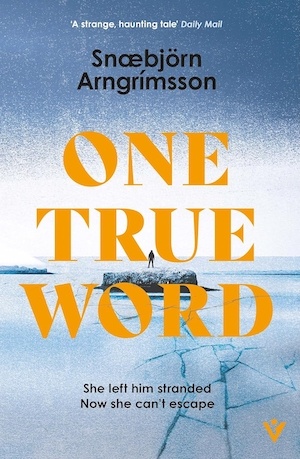
Translated by Larissa Kyzer — Icelandic children’s author Snæbjörn Arngrímsson makes a complete genre U-turn with his first crime novel, a psychological thriller with a unique premise and a distinctly unsettling perspective.
Júlía, a freelance writer, is in a bit of a fix. During a research trip to an uninhabited islet in Hvalfjörður, she loses her patience with her husband, Gíó. In a moment of anger, she takes the small boat back to the mainland, leaving him stranded in the freezing winter weather. Although she soon regrets her impulsive decision, Gíó is nowhere to be found when she returns. Did he drown while attempting to swim to safety? More importantly, is it a crime to abandon your husband and leave him to face the elements? Or is he doing this to punish her so that she will be plagued by doubt, guilt and misery for the rest of her life?
But in that noir tradition, Júlía digs herself into an even deeper hole. She reports her husband missing, but only after staging a break-in by toppling a plant pot on a windowsill. Conveniently, her overbearing elderly neighbour, Finna, claims to have seen a suspicious man with a rucksack in the garden providing a perfect story for the police. Júlía tells the authorities that after an argument, Gíó stormed off, claiming he was going to her sister Maria’s.
Júlia and Maria had a strained relationship since childhood. Maria was the brightest star, the child her parents worshipped, and she went out of her way to keep Júlía in her shadow. But there’s more to it. A week before Gíó’s disappearance, Júlía found a notebook in the kitchen containing explicit sexual details, including dalliances with a woman called Maria. Convinced the notebook belonged to Gíó, she goes so far as to send a fake message from his phone to Maria before discarding the device.
As the investigation proceeds, Júlía becomes increasingly entangled in her own lies, as the book’s title suggests. Initially, the police are not convinced her husband has truly disappeared. Detectives Haraldur and Sigurdur Jón quip that he likely just needed a break from his wife and will eventually come crawling back with his tail between his legs. However, Gíó’s trench coat is discovered near the islet with a note in the pocket, alongside damning evidence that points directly at Júlía.
The problem for the police is that without a body, there is no crime, so Júlía remains in the clear for now. Yet the heart of the story is not Gíó’s disappearance, the sightings of him at a nearby hotel, or the threatening texts Júlía receives; it is the inner workings of her mind.
Unlike many crime novels, the detective is not the protagonist. Instead, we are presented with an unreliable narrator who admits to having a fluid relationship with the truth because it makes her feel more interesting. Eventually, even the police find her explanations unbelievable. Because the story is told entirely from Júlía’s perspective, we get anybody else’s take on things. There is no option but to rely on her version of events.
At one point, she refers to Knausgaard as one of her favourite authors. Knausgaard is known for autofiction – writing about mundane day-to-day events – but has also been criticised for twisting the truth for his own benefit. The reference raises the question: could Júlía be doing the same?
Despite the slow unravelling of Júlía’s mental state, the prose offers moments of wry humour and astute observation. We are also shown Júlía and Gíó’s relationship over the years, which sheds light on her seemingly impulsive behaviour.
The book balances elements of police procedural with a dark character study, exploring whether Júlía is intentionally deceptive or truly losing her grip. One True Word is a slow burn that may test your patience regarding both its protagonist and its pace. The inclusion of three specific characters – the angry cyclist, the artist and the erotic fiction writer – is perplexing and the end leaves significant ambiguity and many unanswered questions.
Also see The Flatey Enigma, which also begins with a man left stranded on an Icelandic isle.
Pushkin Vertigo
Paperback
£9.75
CFL Rating: 4 Stars