

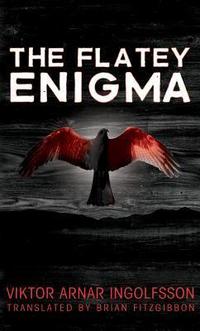
Translated by Brian Fitzgibbon — Fortunately for us, two of the 10 Icelandic books selected for English translation by the new AmazonCrossing publishing initiative happen to be crime novels. One of them, The Flatey Enigma by Viktor Arnar Ingolfsson, was a welcome blip on the CFL radar.
The year is 1960. Kjartan, a rather green functionary from the local magistrate’s office, reluctantly steps off the boat on the tiny Icelandic island of Ketilsey to file a report about a dead body found by local seal hunters. Not used to field work, he hopes to endure the local food and the somewhat odd but helpful inhabitants until the authorities can claim the body.
Things get complicated when Kjartan finds a mysterious message near the body. Before dying of exposure, the unidentified man used stones to spell out ‘lucky’ in the sand. Kjartan also discovers a cryptic note in the man’s pocket which he soon learns relates to a notorious medieval manuscript called the Flatey Book, which contains a riddle known to inflict a curse on anyone who attempts to solve its mysteries.
Readers become familiar with this manuscript early on, as it is introduced and each of its 40 riddles is treated in chapters that alternate with those describing the investigation. These asides are accompanied by text from the Flatey Book’s ancient stories of the violent exploits of the Norse Kings. But Ingolfsson adds yet another layer of mystery: these tales are pondered by two as yet unknown readers who seek in them the key to the famous riddle.
When the body is identified as Gaston Lund, a noted Danish scholar of Icelandic antiquities known to be obsessed with the Flatey enigma, the investigation suddenly expands. An investigator from the Reykjavik police and a charismatic reporter launch parallel investigations and political pressures from Denmark also come into play on the tiny island.
Now in it for the long haul, Kjartan is aided by a colourful cast of characters including Grimur the district officer/seal hunter, the local priest Thormodur Krakur, and the alluring doctor Johanna, who acts as coroner. While he waits for backup, he tries to make sense of the murder, the book, and the local culture of the island, all of which seem to be very strongly linked.
Although The Flatey Enigma at first seems to be a traditional whodunit, another brutal killing two-thirds into the book steers it firmly into noir territory, while keeping us guessing until the end. One of the main characters is killed and mutilated according to a horrific Viking tradition called the ‘blood eagle’ – straight out of the Flatey Book’s pages. Google ‘blood eagle’ and you’ll see – it’s not safe for lunch.
When the big-gun investigators are finally brought in from Reykjavik to grill every inhabitant of the island, possible motives begin to emerge, as do the true identities of the characters involved, and Kjartan himself becomes one of the prime suspects. While the locals are all found to have enduring connections to the book, we learn that the outsiders too have links from the past, and all of these factors have a bearing on the mystery of the deaths and the destiny of the manuscript. The complex narrative weaves in interesting elements of national identity and political intrigue.
The charm of the Flatey Enigma lies in its patient exposition of characters, clever plot construction, and the surprising solution to the entire set of mysteries. But special mention goes to the authentic atmosphere that imbues the narrative, informed by the author’s own experiences there as a child. The mystery’s slow unfolding reflects the peaceful and methodical existence of the Icelandic coastal folk, whom Ingolfsson vividly renders. As with certain other Icelandic examples of Nordic Noir, you must at times suspend your disbelief in curses, elves, and Norse superstitions that are remnants from the time of the Sagas. Fans of murder mysteries, ancient incunabula, Scandinavian history, not to mention anthropological bonuses like regional cuisine and survival techniques, will savour the novel’s languid style, local colour, and even some mystical moments.
AmazonCrossing
Print/Kindle
£3.99
CFL Rating: 5 Stars