

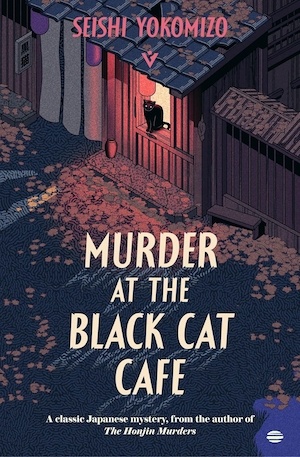
Translated by Bryan Karetnyk — Murder at the Black Cat Cafe serves up two sinisterly cerebral cases cracked by Kosuke Kindaichi, Seishi Yokomizo’s sublime series detective. While the motive, means and opportunity differ quite considerably, the nefariousness at the heart of both novellas is firmly of the impossible crime kind, showcasing Yokomizo’s talent for atmospheric mysteries, multilayered puzzles and brilliant deductive leaps.
And in contrast to the apparent impossibility, the two novellas are also united by the unflinching realism of their settings. Both stories take place in the early post-war period in Japan, where the urban sprawl and the bucolic countryside are similarly marred by material devastation and haunted by the trauma of World War II. This bleak setting establishes a tone of uncertainty and dislocation that permeates both narratives.
In Murder at the Black Cat Cafe, a policeman on night patrol in the Pink Labyrinth, a particularly dubious area of outer Tokyo still awaiting restoration in 1947, stumbles upon a monk disinterring a disfigured female corpse from a shallow grave in the garden of the eponymous cafe. And that’s not the only body he discovers – some fiend has also killed and disposed of a black cat.
The abandoned cafe was previously one of the neighbourhood’s most prosperous brothels. Its former owners – the distinctive Daigo and Oshige Itojima – are thought to have sold up and moved on to parts unknown, although the police quickly discover that their black cat, which gave the cafe its name, is still very much alive and on the premises. Who is the dead woman? Who killed her? And where did the extra cat spring from?
The grisly nighttime discovery of the corpses immediately establishes the ominous tone of the story. There’s a nightmarish quality to events that extends beyond the fact of murder, which fosters the almost supernatural atmosphere that Yokomizo’s mysteries are characterised by. It’s fortunate that the unflappable and deceptively logical Kosuke Kindaichi has reason to insert himself into the investigation.
While Yokomizo’s signature expertise in the Golden Age of Murder is evident from the early discourse on the ‘double role’ versus ‘locked room’ versus ‘faceless corpse’ mystery, he also takes the step of inserting himself into the case as the – first unofficial and later approved – chronicler of Kindaichi’s exploits. Through the letters and reports he purports to receive from the detective, he slowly teases out the truth of the Black Cat Cafe.
This approach adds some unexpected levity to the story, allowing Kindaichi to rib both Yokomizo and readers, sending them down many a blind alley. The notion that Kindaichi is having fun with others’ attempts to solve the case is augmented by the fact that he doesn’t appear in person until quite late in the story. This also frames him as the ‘great detective’, swooping in at the last minute with the solution to the mystery.
And the mystery certainly requires the involvement of an almost preternatural sleuth. The corpse’s disfigurement means that the victim’s identity is unknown, as is the likely motive for the crime. Every new potential victim and possible killer that the police identify introduces new twists, turns and obfuscations, while the clues and red herrings they uncover complicate the mystery to the point of bamboozlement.
The cafe itself is equally intriguing and confusing. It’s not just a setting for murder but also a symbol of post-war Japanese society – gritty, morally ambiguous and scarred by recent history. The Itojimas returned from China to start a new life in the brothel-keeping business, bringing with them secrets and lies. The war’s shadow hangs over everything, creating a disturbing background to the mystery.
The second novella, Why Did the Well Wheel Creak?, explores the (mis)fortunes of several generations of the Honiden family and their neighbours. Following demobilisation in 1946, Daisuke Honiden returns home to the village of K – after having lost his eyes in combat. He bears more than the physical scars of war, and his return triggers a series of inexplicable events and tragedies.
Told primarily through letters and newspaper clippings, the story marks another shift in tone and structure for Yokomizo. The haunting puzzle surrounding the wealthy Honiden family represents a further twist on the faceless corpse mystery – a deeply unsettling one at that. The narrative style creates distance from the immediate action but offers a rich view of the family dynamics, long-held secrets and deep-seated resentments.
Kosuke Kindaichi again appears only in the later stages of the intrigue, stepping in to solve a crime that seems destined to become a cold case. His insights cut through the deceit and deliberate misdirection with clarity, while the epistolary elements allow for the almost real-time reveal of clues, statements and alibis. The spooky aspects are again strong, as is the burden of family history.
Yokomizo’s plotting in both novellas is ingenious, being carefully calibrated to deliver surprises that never feel contrived. The post-war setting is not merely background but a living, breathing force that shapes every motive, every action and every cover-up. The dual structure of the book also enhances its impact: the first story is visceral, urban and raw, while the second is more cerebral, rural and reflective.
Both stories balance traditional mystery elements with subtle innovations. The crimes are gruesome, the characters flawed and the motives complex, but nothing feels gratuitous. As ever, Kosuke Kindaichi is quirky and infuriating but razor-sharp when it comes to cracking an uncrackable case.
For more sinister Japanese crime fiction, try Strange Houses and Strange Pictures by Uketsu.
Pushkin Vertigo
Print/Kindle/iBook
£6.39
CFL Rating: 5 Stars