

Whodunnit. It’s a word we use to describe mystery novels. It’s also a question. However, the Hungarian author Daniel Laz approaches things slightly differently. In his Frankie Voss Investigations series the question isn’t ‘who did it?’ but ‘what does the evidence actually tell us?’ Then, logically, his protagonist Frankie Voss can go on to determine whether the how events are being explained is supported by the evidence.
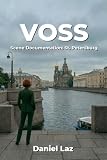
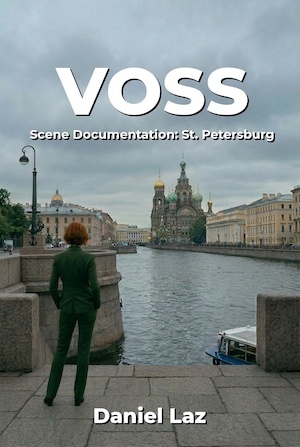
In June 2026, the fifth and latest novel in the series came out, entitled VOSS: Scene Documentation: Saint Petersburg. Here, Frankie heads to Russia after receiving a mysterious envelope. On it are written eight lines in Russian, and one in English, which reads: “You were looking in the wrong decade.” Inside, a photo of seven people on a wet pavement in Leningrad from 1958.” The name Volkov is included with this cryptic message. Having just finished her investigation in New York (book four), a new adventure awaits.
From Quincy to CSI to Silent Witness, we know there are crime fiction lovers who fall head over heels for forensic mysteries, so we decided to invite Daniel to join us on the site to talk about his unique focus on this area of the genre, the new novel and the series in general.
It’s great to have you, Daniel. Let’s start with why you got into writing crime fiction?
I was drawn to crime fiction because it offers a powerful way to explore the gap between official records and lived reality. The series grew from that interest, combined with my fascination with forensic observation and cities that preserve layers of history beneath their modern surfaces.
What are crime fiction lovers going to love about the latest release, VOSS: Scene Documentation: Saint Petersburg?
Saint Petersburg is a slow-burn forensic novel built around atmosphere, memory and the interpretation of evidence. Readers who enjoy detailed investigations, moral complexity and mysteries that unfold through accumulation rather than sudden revelation will find a case that asks them to look closely at what has survived – and why.
The city is not simply a backdrop. Its archives, streets, rivers and layered history become part of the investigation as Frankie follows a trail that has been moving quietly towards her for 66 years.
Who is Frankie Voss, your protagonist, and how have you developed her over the series?
Francesca ‘Frankie’ Voss is a forensic consultant whose first instinct is not to pursue suspects or construct theories, but to document what is physically present. She photographs, records and reconstructs, allowing the evidence to stand on its own before deciding what it means.
Across the series, that discipline is both her greatest strength and a form of self-protection. Each investigation forces her to confront the fact that accurate documentation cannot completely separate her from the human consequences of what she discovers.
What is she up against in Saint Petersburg?
Frankie is drawn to Saint Petersburg by a letter, a black-and-white photograph taken in Leningrad in 1958, and the name of a Hungarian photographer who has been dead for decades. What begins as an attempt to understand why the photograph survived becomes an investigation into a chain of people who preserved records across war, political change and institutional silence.
The central conflict is not a conventional pursuit of a killer. Frankie is trying to understand why certain documents continued to pass from one custodian to another for 66 years, who decided they were worth preserving, and what happens when personal memory and the official archive no longer tell the same story.
Can you tell us about some of the forensic aspects of the story and the role evidence plays?
Evidence is not simply a collection of clues in the VOSS novels; it is the language through which the investigations unfold. Frankie pays attention to environmental conditions, trace materials, spatial relationships, transfer evidence and the small inconsistencies that reveal whether a scene is being interpreted correctly.
I followed one central principle throughout the series: the evidence itself should not deceive the reader. What changes is its meaning as more context becomes available.
There are four previous novels. What cases has Frankie faced, and how have they shaped her and the series?
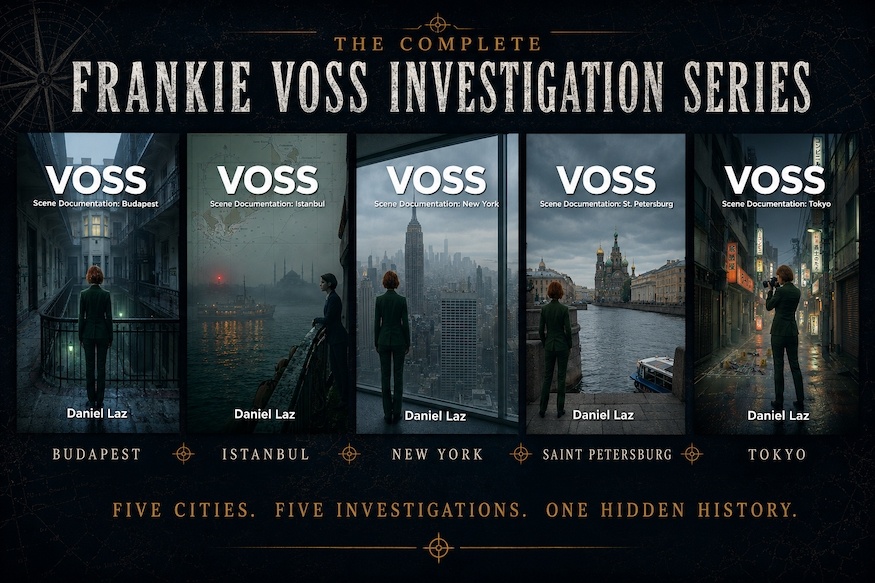
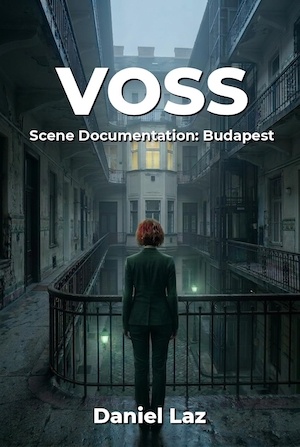
Before Saint Petersburg, Frankie’s investigations take her through Budapest, Tokyo, Istanbul and New York. Each city presents an independent case shaped by its own history, institutions and hidden tensions, while also revealing another fragment of a much older mystery.
The cases gradually change Frankie’s relationship with her work. She begins the series believing that documentation creates distance and control, but she comes to understand that recording the truth also creates responsibility.
Is there an overarching storyline, and what drives Frankie?
Each investigation stands alone, but the five novels form a connected narrative. Beneath the individual cases is a hidden history stretching back in time, involving incomplete records, concealed decisions and consequences that have crossed borders and generations.
Frankie is driven by an inability to leave contradictions unresolved. She does not assume that truth will automatically produce justice, but she believes the record should at least reflect what genuinely happened.
Who are some of the other interesting characters we will meet in Saint Petersburg and in the series?
In Saint Petersburg, Frankie is guided by Alekszandr Volkov, a retired archivist who has spent decades studying unexplained notes in the historical record, and Natasha Sokolova, a former UNESCO interpreter whose connection to the investigation becomes increasingly personal. Viktor Zelman, a cultural historian from Odessa, brings a different understanding of how memory survives outside formal institutions.
The novel also introduces Olga Petrovskaja, who carries the memories of a woman Frankie can no longer meet, and Pavel Dmitrievich Korolev, who preserved a crucial record for 30 years without knowing whether anyone would ever find it. Together, these characters show that history is not kept by institutions alone, but by individuals who refuse to let certain things disappear.
What are some of the wider themes you wanted to explore through these novels?
The series explores the difference between official history and lived reality. I’m interested in who creates records, what is excluded from them, and how one version of events can become accepted simply because it has been preserved by an institution.
The novels also examine memory, moral responsibility and the human cost of pursuing truth. A fact may be objectively correct, but revealing it can still have consequences that are neither simple nor just. Across all five books, the recurring question is: who has the right to decide what survives?
Who are some of the other authors who have interested or inspired you recently, and what are you reading right now?
I’m drawn to writers such as Tana French, Kate Atkinson and John le Carré because their mysteries are inseparable from character, atmosphere and institutional pressure. Their work demonstrates that crime fiction can examine society, memory and power as seriously as it investigates a crime.
At the moment, I’m reading Fyodor Dostoevsky’s Crime and Punishment. It remains extraordinary in the way it examines guilt, conscience and the psychological consequences of crossing a moral line.
What’s next for Frankie Voss and what’s next for Daniel Laz?
I spent roughly two years writing the five novels and released them within a relatively short period after the editorial work was completed. For now, I’m not actively planning another Frankie Voss novel because I want to give the existing series time to find its readers.
That said, I would never rule out returning to Frankie if the right story emerged. I also have other novel ideas, including one inspired in part by my own life, so there are several possible directions I may explore next.
You can explore the entire series here on Amazon, or head to Daniel’s author website to find out more. Order the latest novel, VOSS: Scene Documentation: Saint Petersburg, using the buttons below.