

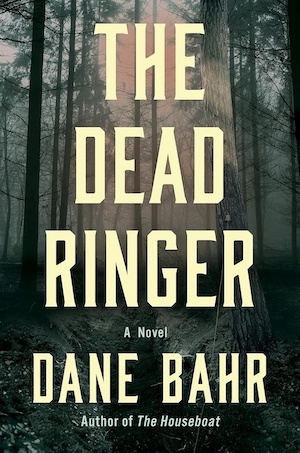
In 2024, Stag put Dane Bahr firmly on the radar of crime fiction lovers – a retro serial killer thriller that mixed violence and dread with a poignant relationship between the two older protagonists assigned to investigate the murders. It was Bahr’s second novel and put him on my personal list of favourites and I couldn’t wait what the author would come up with next. I had high hopes for The Dead Ringer, and I’m glad to say it’s a great read that succeeds on its own merits.
Like Stag, The Dead Ringer takes us back in time. The book is set in rural Montana and Minnesota in 1935, and tells the story of Benjamin Kilt, a bank robber. The book is split into three parts and bookended by the recollections of Bonnie Grace at the end of her life, an indigenous girl that Kilt rescues from slavery towards the end of his own short life.
The first section begins in dramatic fashion with Kilt’s resurrection. After being double-crossed by his bank-robbing partner, Sidney Bosco, also his half brother, he was buried alive. He survives only by pure chance, and is rescued by Bonnie, who found him wandering the countryside only half-alive on the back of a mule. Kilt recuperates at the cabin of Bonnie’s enslaver. Kilt kills the man leaving Bonnie free but with nowhere to go. He begins the journey to find Bosco and get his vengeance and, with no other choice, reluctantly takes Bonnie with him.
The second, and longest section, tells of Kilt’s journey from being a young orphan in Missouri to eventually meeting Bosco at the Triple Nine Ranch in Black Elk, Montana. He never knew his father and his mother kills herself. His road begins with the charismatic bank-robber Nick Mercy, who, before meeting his own end, tells Kilt that all the answers he seeks will be found at the ranch.
The final section finds Kilt and Grace at the ranch as they search for Bosco. It’s a tense affair as everyone there knows Kilt’s return. The story reaches its inevitable, bloody climax, and whilst Bahr doesn’t spare his characters, the ending leaves open the possibility of redemption.
In lesser hands, The Dead Ringer’s mix of outré violence, lyrical prose and philosophical discourse might have proven a jarring mix. They would seem unlikely bedfellows; it is often the case that an author who succeeds in one area neglects the others. Bahr holds it all together; indeed these elements are responsible for the novel’s success.
The violence propels the narrative forwards and serves to underline the unforgiving world that Kilt finds himself in, especially in his childhood. The writing manages the neat trick of at once being both concise – especially the conversations, which befits a thriller – and also revealing and memorable. Not many books say so much with so little, or describe such upsetting circumstances so beautifully. Philosophical observations, especially from Kilt and Bonnie, facilitate the novel’s exploration of themes such as vengeance, fate versus free will, and forgiveness.
It is unfair to The Dead Ringer to compare it to its author’s previous novel, Stag, a dark masterpiece which I would urge everyone to read. However, judged on its own merits, The Dead Ringer, is a very good book. If I had one minor gripe, it would be that the story is a little slight, missing perhaps the heft of Stag, and I could happily have read another couple of hundred pages. Kilt’s story is the one Bahr felt compelled to write, and on reflection it was never going to be a long one.
Also see Savage Ridge by Morgan Green.
Counterpoint
Print/Kindle
£10.99
CFL Rating: 5 Stars