


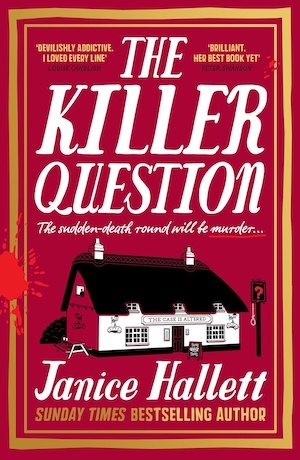
Crime pays, especially true crime. Seeking to cash in on the macabre boom in interest in all things criminal, Dominic Eastwood approaches a contact at Netflix about making a documentary series concerning the peculiar events that befell his aunt and uncle, Sue and Mal Eastwood, retired police officers turned publicans.
But what actually happened to them?
Well, Dominic has plenty of written evidence from the case, which he submits to his contact in stages so that she can piece them together and see how things would unfold over the course of a television series. It might not be the best way to secure a production deal, but it certainly does make for a tantalising mystery.
Indeed, The Killer Question showcases Janice Hallett’s signature narrative style, presenting a multi-layered, epistolary puzzle that is as absorbing as it is unconventional. Known for her innovative storytelling through documents, messages and transcripts – as seen in The Examiner and The Twyford Code – Hallett again leaves the matter of interpretation to readers.
There is a change of pace, however, as The Killer Question centres on a quieter and slower-to-unravel mystery, one that trades overt action and drama for a sense of simmering unease that gradually boils over into something darker. As the documents compiled by Dominic reveal, Sue and Mal left the police force to run a pub, The Case is Altered, in rural Hertfordshire.
So far, so bucolic.
They introduced a weekly quiz night, which initially brought locals together and revitalised the pub’s fortunes. That is, until a mysterious and unusually successful team of newcomers – the Shadow Knights – began to dominate the quiz, sparking tension, jealousy and seemingly something far more sinister.
Using WhatsApp chats, quiz sheets, emails, text messages and Dominic’s occasional commentary, we can try to put together what really happened during that ill-fated quiz season, why the Eastwoods suddenly retreated from the world, and what followed the discovery of a body in the river behind the pub.
Hallett’s the use of mixed media is not simply a stylistic choice but a storytelling device. It creates an immersive, investigative reading experience where clues emerge not through narration but through inference. The stakes are initially low – are the Shadow Knights cheating and, if so, why? – but the mystery expands into something deeper and more unsettling.
The pub setting is an inspired choice. Hallett captures the peculiar mix of camaraderie and competition that marks pub quizzes, turning it into fertile ground for conflict. The quiz is not merely about knowledge – it is about status, routine, identity and unspoken rules. When those rules are broken, especially by outsiders, the social fabric of the community begins to fray.
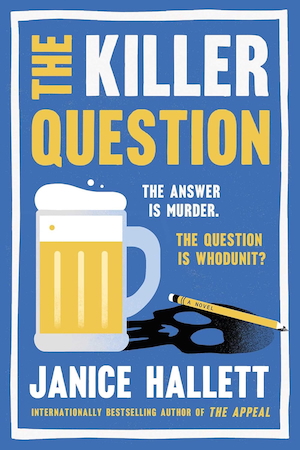
Hallett uses this dynamic to raise questions not just about who may have committed a crime but also about why such a seemingly innocuous tradition could morph into something deadly. The various quiz team members range from warm and witty to petty and paranoid, and while they sometimes veer close to caricature, their voices remain sufficiently distinct to carry the story.
For their part, Sue and Mal Eastwood are complex figures: decent, respected and quietly haunted. Their intentions for the pub and their past in law enforcement hang over the narrative, offering both credibility and suspicion. Dominic, as the documentarian and framing device, is an effective stand-in for the reader – sometimes insightful, sometimes blinkered by his own biases.
The documents that comprise The Killer Question appear realistic and organically reveal character dynamics, motivations and deceptions. The pacing of this reveal is steady and consistent. There are moments when the story risks stalling – particularly during extended group chats or detailed quiz breakdowns – but these are offset by the gradually developing mystery and ominous undercurrents that build over time.
Hallett continues to excel at conveying atmosphere. The country pub, with its crowded seating, loyal regulars and cosy quiz nights, is brought vividly to life. And yet, beneath the charm is a persistent sense of unease. The story taps into the idea that danger often hides in plain sight – not in the isolated mansion or the dark alley but in the spaces associated with comfort and community.
In this way, Hallett takes an apparently humdrum setting and uses it as background to the darker impulses that lie beneath the surface of ordinary lives. This mix of the mundane and the macabre generates a sense of immediacy and realism, and it also highlights one of Hallett’s recurring themes – the elusiveness of truth and the way stories are shaped by those who tell them.
Behind the pub banter and pints of ale lie old grudges, secrets and guilt, particularly the shadow of Sue and Mal’s past in the police force, which gradually emerges as the facts of the mystery are revealed. Hallett’s skill lies in balancing these tones: she can pivot from humour to unease in a single paragraph, and the effect is both unsettling and satisfying.
The quiz motif is more than just a narrative device. It is a metaphor for knowledge – who holds it, how it can be manipulated and what happens when the pursuit of answers turns toxic. Just as quiz participants compete to prove their superior knowledge, the characters vie for control over the story, each presenting their own version of events in the documents that comprise the book.
The humour that runs through the novel – from quiz night mishaps to sharp exchanges among the regulars and those leaving customer reviews of local pubs – provides a welcome counterpoint to its darker elements. But even in its most comedic moments, the novel never loses its sense of moral seriousness. Beneath the jokes and trivia is an exploration of guilt, loyalty and the difficulty of escaping the past.
The Killer Question is another masterclass in form and imagination – an intelligent, funny and haunting mystery that confirms Janice Hallett’s place among today’s most inventive mystery writers.
For more conundrums in the countryside, try Miss Winter in the Library with a Knife by Martin Edwards.
Viper
Print/Kindle/iBook
£9.49
CFL Rating: 5 Stars





This looks like my kind of read