


As colder winds start to blow, now’s the time to cosy up in your most comfortable chair and grab a crime novel that takes you away to a chilling location. Out in North America last month and landing now in the UK and Europe, Shane Peacock’s new novel A Place of Secrets could be just what you need.
The author’s second Northern Gothic Mystery is set in a small town, somewhere in Ontario. Two bodies are found in an old lady’s home. One is no surprise – the woman was 100 years old and lived a good life. Or did she? Because on further explanation another body is discovered, deceased some 60 years earlier. And soon, further discoveries mean that Sergeant Alice Morrow and Hugh Mercer could be investigating a cold, cold serial killer case in a town with… well… many secrets.
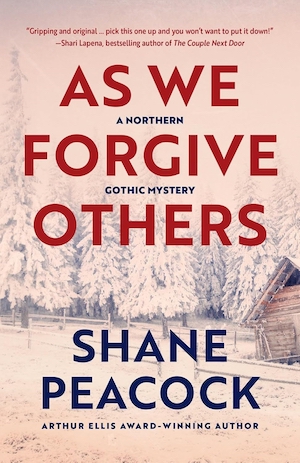
Shane has had a stellar career in Canadian publishing with his The Boy Sherlock Holmes series for young adults, Dylan Maples Adventures, numerous other books and successful plays. He’s won multiple awards and last year made the move into crime fiction with As We Forgive Others, which introduced Mercer and Morrow. We had to know more, so we invited Shane to join us here on Crime Fiction Lover.
What are crime fiction lovers going to love about A Place of Secrets?
It’s different, in the sense that it is set in Canada, but a more realistic Canada. Not a polite place where little ever happens, but a cold, mysterious society inhabited by unusual people, where a great deal of darkness lurks underneath that tranquil exterior. A Place of Secrets has an almost northern-setting Hitchcock feel to it. You will know what I mean once you get to the end of the book!

Who is Hugh Mercer, what inspired him and how have you developed this protagonist?
Hugh Mercer is a detective with the Manhattan Homicide Squad who comes to Canada at the beginning of As We Forgive Others suffering from a sort of PTSD, wanting to get away from the horrors of his job and marital problems. He assumes that Canada will be a good place to relax and re-charge, but he is mistaken and finds Canadians puzzling, and soon embarks on a relationship with a local female police officer that also leaves him uneasy. Together, he and the mysterious Sergeant Alice Morrow, someone harbouring even more secrets than he has, tackle a strange crime in As We Forgive Others and then an even darker and more mysterious one in A Place of Secrets. He grows a great deal as the stories proceed, learning about himself and the insular American culture he came from.
Who or what is he up against in A Place of Secrets?
As We Forgive Others is told from Hugh Mercer’s perspective, but A Place of Secrets is seen through the eyes of his Canadian romantic and professional partner, Sergeant Alice Morrow. So, we see him in a slightly different light in this new novel, as viewed by her. Each subsequent novel in The Northern Gothic Mysteries will be told, back and forth, by Hugh and Alice. Together, in A Place of Secrets, they encounter an apparent double homicide that involves a very elderly woman dying in her home and leaving a note about a body in her basement, which they soon realise was put there 60 years early.
As their investigation proceeds, they quickly find more related corpses hidden in other areas of the community and realise that a serial killer has been at work in the area, starting 60 years ago, but perhaps still at large. They do not discover who their killer is until very late in the novel, and the revelation shocks them – and hopefully everyone who reads the book!
How will the small town Ontario setting play a role in the story?
Canada has often been considered a sort of no-name place, a good country full of polite people where very little ever happens. The Northern Gothic Mysteries present a darker, more realistic Canada, a very northern country with a very northern personality, full of people with iceberg characteristics hiding most of their personalities. Canada and the town and countryside depicted in A Place of Secrets is never named. We aren’t told it is Canada or exactly where we are in the country. But readers know from the outset.
I’ve tried to create a community that is sort of an everytown or every-community Canadian location, set in the northern part of southern Ontario. Many readers try to locate the setting in particular places, and it’s fun to see where they think the story is set, but the point of the setting is that it could be many places in Canada, featuring characteristics common to most Canadian communities. Reading The Girl With the Dragon Tattoo and the Wallander series and other dark Scanadinavian crime novels, I was intrigued by how Canadian, in a sense, they were.
What has the response to As We Forgive Others been like and what aspects of it have you brought forward into A Place of Secrets?
As We Forgive Others gained a great deal of critical success. Thankfully! It won the Crime Writers of Canada Best Novel Set in Canada award and had lovely, featured reviews from sources like The Toronto Star and Kirkus Reviews. A Place of Secrets takes up right where Forgive left off, beginning chronologically in the storyline just a few weeks after that novel ended. As mentioned, Secrets is told from Sergeant Alice Morrow’s perspective, so we see Detective Hugh Mercer through her eyes and see some of what she was thinking about him in the first book. Also, as readers of the first novel will be interested to hear, we will discover Alice’s great secret in A Place of Secrets, referenced often and teased in As We Forgive Others.
What are some of the bigger themes you look at in the new novel?
While the first book explored forgiveness, the need for it and how little there is in our world, A Place of Secrets investigates not just the dark crimes in the story, but also the nature of secrets, the tendency of Canadians to harbour them, and the fact that all of us, all human beings, have secrets, that we need them to some degree to survive, but also that that tendency betrays a certain sort of darkness in all of us. And, of course, in A Place of Secrets, there are heinous and deadly secrets revealed.
This is a little different to Eye of the Crow and your other Boy Sherlock Holmes stories. What made you want to begin the Northern Gothic series what are some of the big, and less obvious, differences?
There are ways in which Eye of the Crow and the Boy Sherlock Holmes novels are similar to The Northern Gothic Mysteries, even though the former are ostensibly for young readers and the latter for adults. Both series take on serious subtextual themes like racism and prejudice – my Sherlock is Jewish – and forgiveness and the secretive nature of humanity. But the adult novels have freed me up to be able to talk about these sorts of things in deeper ways and also to present darker crimes and slightly more graphic scenes. I also get to offer some real romance between my main characters in the adult novels, in adult scenes!
Which other crime authors and/or books have inspired you, and what are you reading at the moment?
Throughout my career, I’ve written many different kinds of novels, from crime novels to romances to adventures to horror fiction, but I’ve always been intrigued by dark crime novels, and I tend to like the ones that are perhaps a little more literary and have some depth, like the Ian Rankin novels or Bleak House with Inspector Bucket or Edgar Allan Poe – Dickens and Poe being two of my favourite novelists. The Scandinavian crime novels of Henning Mankell and Stieg Larsson, both on the page and screen, were particular inspirations for my Northern Gothic Mysteries series.
I read mostly fiction, though I also love biographies. I’m often reading several novels at once. I recently finished Zadie Smith’s The Fraud and loved it. Michael Crummey’s The Adversary was excellent. Two books that have really stood out over the last couple of years are Jonathan Franzen’s Freedom and Cormac McCarthy’s Blood Meridian, the latter as good as the art of fiction gets, and terrifying too.
What’s next for Mercer, and what’s next for Shane Peacock?
A bit of news! I’ve just signed a contract for a third Northern Gothic Mystery. It will feature a story from Mercer’s perspective. This summer I also had a new YA novel out, called Show, about an imagined North America in 1899, where the Empire of America, a racist, entertainment-and-money-obsessed country, dominates the continent – it’s the tale of a group of diverse young circus performers travelling through that empire, pursued by an evil showman who is also running for the presidency of that country. I kid you not! I am also working on a new novel for adults, a fast-paced thriller based on an idea I came up with many years ago. And, I imagine there will be more Northern Gothic Mysteries! My path forward will be with more adult work and less for younger readers.