


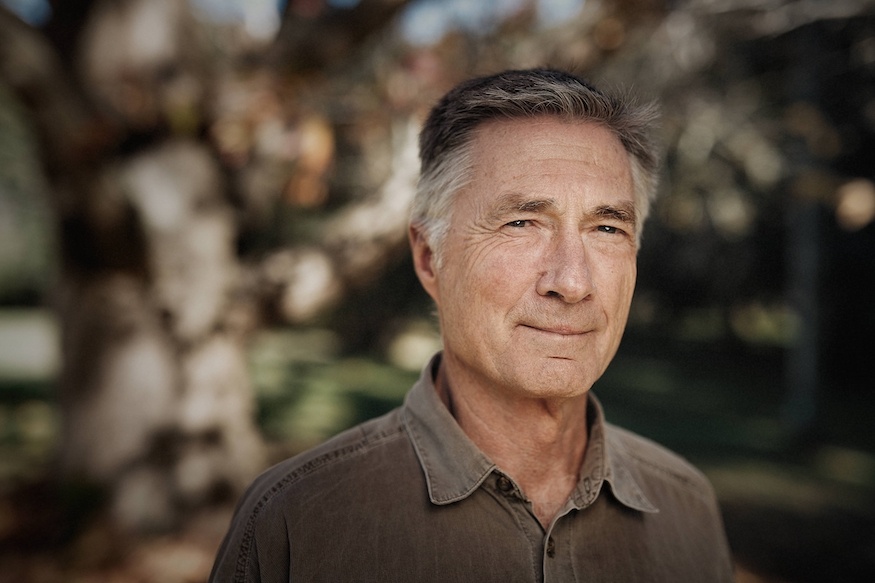
He’s known as Australia’s King of Crime, and in 2026 has made his first appearance on stage at the Theakston Old Peculier Crime Writing Festival in Harrogate. After writing 60 books, Garry Disher has finally arrived! To add to the firsts, we caught up with Garry in the billiards room of the Old Swan Hotel for a face to face interview.
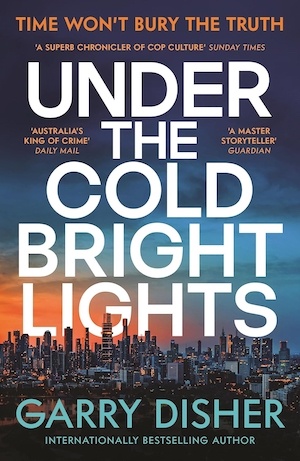
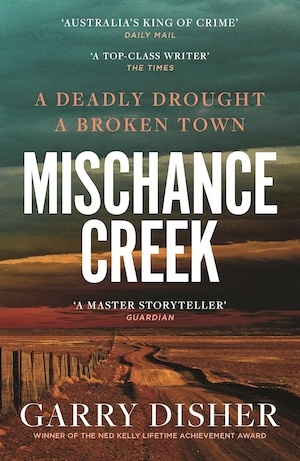
He’s in his 70s but has no intention of retiring from writing – and to prove it, his British publisher Viper has just released the latest Hirsh novel, Mischance Creek, and his first ever crime standalone, Under the Cold Bright Lights, featuring retired cop turned cold case detective Alan Auhl.
What’s his inspiration? How does he write? And what does he think of the Aussie invasion? Read on to find out…
What can you tell the readers about Under the Cold Bright Lights?
It started off when I read in the Melbourne Age newspaper that Victoria Police were rehiring recently retired detectives to work cold cases, to free up the young detectives for more shoe leather work. As soon as I read that article, the main character popped into my head, fully formed. Auhl is late 50s, early 60s. Slightly burnt out. His marriage has broken down. He’s tried various things, joined book clubs, gone on tours, gone on cruises. Nothing satisfies, and it’s a lifeline for him to go back to the police. The young hotshots call him a retread, but he’s had all those years of experience.
I’d always wanted to write a cold case novel and I’ve been collecting newspaper articles about cold cases for decades. So I worked out a couple of major plot lines for him because he’s a working cop. Another thing that gave me the idea was my daughter had just started university at Melbourne University, and in that part of Melbourne there are grand old terrace houses on broad avenues, many of them turned into student housing. I helped her move in. I was fascinated by the house, and I thought that’s where he lives.
A lot of Aussie crime is set in the outback, it’s dusty, it’s dry. This book is more in the city. What made you do that?
I like to keep fresh with the fiction. So if if I just wrote one dry outback crime novel after another, I’d soon burn out and lose the spark. So I try to intersperse standalones with different settings, different situations. That was the main reason. I used to live in Melbourne, where my daughter now lives and where she went to university, so it was still fresh in my mind. And I had friends there, so it was easy enough to recreate the city.
Under the Cold Bright Lights is a standalone, but I believe there may be some more to come. It was published in Australia in 2018, so has it been percolating?
It did start off as a standalone, but as has happened to me in the past, the main character has been tapping me on the shoulder, wanting more stories, so I’ve been scratching my head over a few more possible plot lines for him. Viper, my English publisher, has only in recent years taken me on, which has been a great thing. And with the success of the the Hirsch books, the Outback Cop books, and a couple of other standalones, they’ve been releasing more and more of my backlist. So yeah, Auhl hasn’t quite left me alone. I’d like to write about him again.
So why do you think that Aussie crime writing has exploded so much in the past decade?
It’s exploded internationally, and in Australia too. There are new crime writers coming along all the time, and crime writing panels at literary festivals are getting more and more popular. It didn’t used to be like that. Very early in my career, I was helped to set up the Melbourne Writers Festival, and I suggested Peter Corris to be a guest. They were horrified, and said, “It’s crime fiction, i.e. it’s junk. We don’t want that sort of thing on our festival.” So that attitude has completely changed.
As to why it’s popular in Australia and internationally, I think probably the novels of Jane Harper and Chris Hammer. I’m an overnight success with my 60th book, but they were overnight successes with first books that sold in hundreds of thousands. I did an author tour of Germany where my books are popular, and Jane Harper was everywhere. I think some new writers, are getting on the bandwagon. I’m often asked by major publishers in Australia to write a cover endorsement, and it’ll be just yet another small rural town with a dark secret novel – and some of them aren’t very good. So I would hope that Australian crime writing can move on.
What’s your writing process?
First of all, I plan in great detail. A lot of my colleagues don’t, and early in my writing career, I didn’t plan. They were mainly so-called literary short stories and novels, voyages of discovery, and I tried that approach with the first crime book – a Wyatt novel about a professional criminal. I just couldn’t get it to work, and the publishers hated it. Wouldn’t publish it. I was relying too much on coincidence and on trying to twist the plot or the character to fit each other. I realised that with crime fiction, you need a grasp on what’s happening and I needed to plan.
So, if I’m starting a new book – and I will as soon as I go back to Australia next week – I will start planning, and it’ll take me several weeks until the whole book’s in my head, and then I start writing. I write longhand. It has to be a blue biro. I think many writers are superstitious. Some writers will only write in a quiet room, others need music. Some need to look out a window. Others need to look at a blank wall. I need a blue biro, otherwise, it won’t work. And I write on the backs of old manuscript drafts.
After a few days, I will then spend an afternoon typing up what I’ve written, and by then I’m already tinkering with it, editing it. I do that over a few drafts, and each one gets more and more fine-tuned, taking a sentence out or whatever it might be.
And you were also saying about cuttings?
I jot things down. Like for example, I was on a tram in Melbourne recently, and I heard two teenage girls behind me talking, and one said the other, “Everything went wrong when Grandma came to live with us.” That’s all I need for a complete novel. And I went to a party once where a man was cadging cigarettes from people. But each time he did that, he fished in his pocket for a coin and paid for it. That’s really strange. I’ve never written about him, but that kind of thing will grab me, and I’ll think about it. Who is he? Why can’t he owe anything? And that might give me a character in a crime novel. Who knows?
But mostly, my ideas come from newspaper clippings. Some have been in my folders for 10 or 20 years. They’re waiting to be rounded out by another story, or to connect in some way with another newspaper clipping. I have manila folders, labelled with something like forensic stuff ups because that fascinates me, or minor characters, or weapons, or physical physical violence, or murder ideas. I kind of know where everything is, but it is a mess.
Where did Hirsch come from?
Again, that was supposed to be a standalone. I’d written all of the Peninsula novels, and I was a bit restless. My brother is a retired policeman, he was a country cop and some of his humorous stories appealed to me. Also the area where I grew up, which is dry wheat and wool country, three hours north of Adelaide. It’s not strictly outback but I’ve sort of painted it as the outback in my books. It can be quite beautiful and green in winter, for example, and it can get cold enough in winter for snow.
I didn’t want to write about a cop like my brother who grew up there. It seemed important that he should be an outsider, so I tried to figure out a backstory for Hirsch. I think in most crime fiction the main character is firmly rooted to place – like Wexford or Rebus or Bosch. It was meant to be a standalone, but now I’ve written five of them.
For those who are dipping a toe into the Aussie crime fiction, which authors would you recommend?
Certainly Jane Harper and Chris Hammer, Michael Robotham, but he sets his books in England, and the late Peter Temple – he’s terrific.
What are you reading now?
I reread certain authors like Michael Connelly, Ian Rankin, John Sanford and Mark Billingham. I left Australia with 10 paperbacks. I should have a Kindle, but I like to hold the actual book. So each time I finish one at a hotel or wherever, I leave it behind for someone else to read. I’m about 50 pages into a John Le Carre.
What can we expect next from you?
It could be an Auhl, or it could be another Grace. My novel Sanctuary was shortlisted for the Dagger Award last year, and it’s about a a young woman who’s a burglar. I’ve got ideas for a new one of those.
Under the Cold Bright Lights is out now. You can grab a copy with the buttons below.




In the US, Garry Disher deserves so much more attention. His multiple series are superb. Not only that, with all the visual medium reboots, do-overs, and copies of previous shows, it surprises me how his works have yet to be serialized in a streaming series or otherwise. Also, for this US reader, his Hirsch novels capture a layer of being modern-day westerns.
Thanks Eric. Too true!
Sanctuary will be coming out in the US on September 15 from The Mysterious Press!
Absolutely top-notch writer. I was lucky enough to meet Garry at an author’s talk and he’s a lovely bloke too. “Under The Cold Bright Lights” is a cracking novel and it’s good to see some Aussie crime back in the cities as I think we’ve ODed on the rural noir craze quite enough. And frankly, some of Jane Harper’s imitators are not very good.
Superb author, the Quiet King of Aussie crime, and a giant on whose shoulders that the likes of Chris Hammer, Jane Harper, and many others recently have stood on. Great to see him finally being published more prolifically in the UK.