

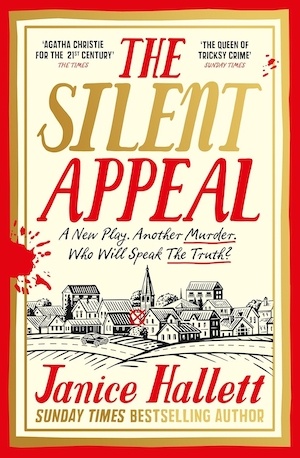
As the Fairway Players continue to prove in Janice Hallett’s sequel to The Appeal, amateur dramatics and murder are a perfect double act. Put a group of ambitious performers in a village hall, add a few bruised egos, romantic complications and questionable life choices, and it is only a matter of time before someone ends up dead.
In The Silent Appeal, the action and on-stage antics in Lower Lockwood are again presented not through conventional narrative but through emails, text messages, WhatsApp conversations, diary entries and other fragments of documentary evidence. The result is part murder mystery, part theatrical farce and part forensic exercise in nosiness.
And what is revealed about the would-be thespians is rarely flattering.
Several years have passed since the disaster-laden production of Jack and the Beanstalk, and the Fairway Players are preparing to stage Agatha Christie’s The Hollow. Choosing a murder mystery about complicated relationships, romantic entanglements and simmering resentment is hardly a recipe for tranquillity. Then again, tranquillity has never been the Fairway Players’ strongest suit.
The production brings together a mixture of familiar faces and newcomers, with old tensions resurfacing and new ones developing at alarming speed. Sarah-Jane and Kevin MacDonald are at the centre of proceedings, while the return of Sarah-Jane’s prodigal sister, Nicky-Rose Dearing, introduces another layer of personal and professional friction.
They are joined by a sizeable cast of performers, techies, spouses, relatives, friends and acquaintances, many of whom appear to have something to hide. And when no one proves willing to audition for the role of Gerda Christow, the first name that springs to Kevin’s mind is Issy Beck. Yep, that Issy.
Naturally, the question is not whether there will be a drama but whether the drama will remain on stage.
Janice Hallett’s greatest strength is her ability to combine the mechanics of modern communication with the machinery of a traditional mystery. A text message can be revealing in ways its sender never intended. An email can conceal as much as it communicates. A carefully worded exchange can say more about a relationship than pages of conventional exposition.
Better still, Hallett understands that people behave differently depending on who they think is reading. As criminal barristers Femi Hassan and Charlotte Holroyd again find when wading through the case documents, the Fairway Players may be amateur actors, but they are consummate performers in their everyday lives.
They are all prone to presenting one version of themselves in a group email, another in a private message and yet another in their own records. This reveals far more than might be desired about some characters while hiding things about others. Hallett provides access to the evidence, but evidence is not the same as truth.
Hallett also leverages the conventions of the Golden Age mystery. The choice of The Hollow is more than an excuse for a theatrical setting. Christie’s play serves as a framework for Hallett to construct her own puzzle, allowing themes and situations from the play to echo through the lives of the Fairway Players.
Where Christie had letters, telephone calls and overheard conversations, Hallett has WhatsApp. Where the classic detective might examine a handwritten note, Hallett’s legal eagles scrutinise timestamps, message threads and digital exchanges. The technology may have changed, but the fundamental principle remains reassuringly old-fashioned: Somebody is lying. Possibly several somebodies.
The Fairway Players are united by their enthusiasm for theatre, although that enthusiasm is accompanied by vanity and a competitive streak that would probably be more appropriate in the West End than a village production. Everyone has an opinion about casting. Everyone has an opinion about direction. Everyone appears to have an opinion about everyone else.
Hallett gets considerable comic mileage out of this, and the humour helps prevent the story from becoming too dark or overly complicated. There is an appealingly British quality to the whole enterprise: murderous intrigue conducted alongside discussions about rehearsals, costumes, casting and community commitments.
Yet beneath the humour are darker themes of obsession, manipulation, infidelity, resentment and misplaced loyalty. Hallett is particularly interested in the stories people tell themselves about their own behaviour. Few characters appear to regard themselves as villains. They all have explanations for what they do and reasons why everyone else is being unreasonable.
Fortunately, the summaries provided by Charlotte and Femi help keep track of such details. Their task is to examine the evidence behind a murder conviction and determine whether an appeal might be warranted. As they work their way through the mountain of material, sorting fact from assumption and clue from distraction, the substance of the case emerges.
It is an approach that demands a certain amount of attention. The cast is large, and the fragmented format means that keeping track of relationships, motives and timelines can occasionally feel like doing the administrative work for an especially controversial amateur theatrical society.
But that is the point. The Silent Appeal demands audience participation.
There is satisfaction in spotting something that seems insignificant and wondering whether it might become important later. A strange exchange, an oddly phrased message or a suspicious omission can acquire an entirely different meaning as the story progresses. But remember: Hallett makes sure to include a few well-placed red herrings along the way.
As a result, the return to Lower Lockwood benefits from familiarity. Established characters may have moved on, changed or acquired new complications, but the Fairway Players remain every bit as capable of generating chaos as they were before. There is history here, and it helps to appreciate the significance of it.
The Silent Appeal is a novel about performance, perception and the dangerous gap between what people say and what they mean. So take your seat, silence your phone and prepare for the curtain to rise. Just be careful who you trust in the theatre and beyond. After all, in Lower Lockwood, while the acting may be amateur, the murder is anything but.
For more by Janice Hallett, try The Killer Question, The Examiner, and The Mysterious Case of the Alperton Angels.
Viper
Print/Kindle/iBook
£14.89
CFL Rating: 5 Stars