

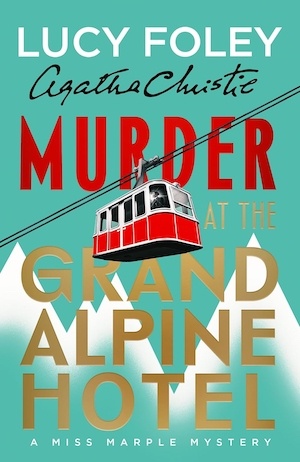
Agatha Christie’s formidable Miss Marple has been solving crimes for generations, relying on observation, experience and an unnerving understanding of human nature. So handing her over to Lucy Foley, a writer best known for atmospheric contemporary thrillers such as The Guest List, was an interesting proposition.
But Foley contributed to Marple: Twelve Stories, a collection previously reviewed on Crime Fiction Lover: 12 authors, 12 interpretations of Miss Marple, each writer bringing something of their own to a character who had, until then, belonged entirely to Christie. Foley’s story offered an intriguing glimpse of what she might do with the character.
Murder at the Grand Alpine Hotel is a considerably bigger test.
Set in 1950, the novel takes Miss Marple away from the familiar surroundings of St Mary Mead and sends her to a luxurious hotel high in the Swiss Alps. She is travelling with her old friend Dolly Bantry and Dolly’s new companion, Diana Glass (poor old Colonel Bantry having expired from causes undeclared).
The hotel initially appears to offer precisely the sort of restful escape that amateur sleuths are constitutionally incapable of enjoying – just think of Miss Marple’s many sojourns funded by nephew Raymond. There are spectacular mountains, snow-covered slopes, elegant rooms, glamorous guests and all the comforts to be expected of an exclusive Alpine retreat.
Naturally, the trip soon goes horribly wrong.
The isolated hotel is one of the signature settings of classic crime fiction. Once the snow cuts guests off from the outside world, there is nowhere to go, everyone has secrets and practically everyone has a reason to be suspicious. When MP and all-round bounder Anthony Narracott is killed, the resort becomes an idyllic setting for a closed-circle murder investigation.
It is an immediately familiar set-up, but familiarity is very much part of the fun. Foley appreciates that a Miss Marple mystery should feel like an invitation to play detective. Who is lying? Which apparently insignificant detail matters? Why is someone behaving strangely? And, most importantly, what has everyone failed to notice?
Foley keeps Miss Marple slightly apart from the narrative for much of the novel. Rather than offering direct access to her thoughts, events are related from several characters’ perspectives. This is somewhat of a departure from the original books, and Christie purists may initially wonder why Miss Marple is sometimes pushed to the edge of events.
But it is an ingenious way of making Miss Marple more Miss Marple.
Other characters underestimate her. They see an elderly woman, apparently occupied with knitting and more interested in social niceties than sinister motives. Yet she is always watching. That creates dramatic irony: while the other characters are busy trying to understand one another, Miss Marple is quietly collecting information they overlook.
This is where Foley demonstrates her understanding of what makes the character endure. Miss Marple’s greatest weapon has never been deductive genius in the Poirotian sense. She is not dazzlingly theatrical, nor does she need to dominate a room. Her strength lies in recognising that people are people wherever they happen to be.
A remote Alpine hotel may be a world away from a Kentish village, but jealousy, vanity, greed, resentment and fear travel remarkably well. Foley’s Miss Marple is therefore recognisable without becoming a caricature. She is observant, discreet and formidable, but there is also a sense of age and experience behind her deductions.
The supporting cast is equally good. Foley populates the hotel with the sort of exaggerated personalities that Christie used so effectively: people with carefully constructed public identities and considerably messier private lives. A fading starlet, a politically ambitious couple and other guests form a colourful collection of potential suspects.
Aside from using these archetypes well (from the skulking doctor to the blustering former colonel), Foley’s contemporary thriller experience is also evident, as seen in works such as The Hunting Party and The Guest List. Her characters tend to have sharper psychological edges than some of Christie’s more iconic creations, and she is interested in what lies behind the public face people present to the world.
The story is consequently more than a straightforward whodunnit. There is a strong element of the whydunnit, too: understanding the literal and emotional history of the characters becomes almost as important as identifying the murderer. That gives the novel a slightly darker undertone than might be expected.
That is also reflected in the setting. The Grand Alpine Hotel is glamorous enough to echo the escapism of the classic mystery but becomes increasingly threatening as the story progresses. Snow and mountains are beautiful until they become barriers. Luxury becomes confinement. A hotel designed to provide a retreat becomes a place from which nobody can escape.
Foley makes excellent use of that contradiction. The Swiss Alps provide picture postcard scenery, but there is something distinctly inhospitable beneath the surface. The cold, the isolation and the treacherous landscape reinforce the growing sense that the guests are trapped not merely with a murderer but with their own secrets.
There are a pleasing number of classic mystery tropes present, too. Suspicious persons, concealed war records, apparently accidental incidents and seemingly insignificant observations accumulate as the story progresses. Foley knows that the best clues are those that make sense twice: first as part of the story and later as part of the solution.
But Foley has not sought to write an imitation of Christie. The multiple viewpoints, heightened atmosphere and psychological tension are recognisably her own. At the same time, the isolated setting, eccentric suspects, hidden motives and steadily building clues belong firmly to Christie’s tradition.
That balance is important. Foley’s interpretation reflects the fact that Miss Marple was never merely a cosy little old lady who happened to solve murders. Christie’s detective was an astute observer of social behaviour, particularly the ways in which respectable people conceal their less respectable impulses.
As both Christie and Foley show, Miss Marple’s real superpower is not knitting, village gossip or even deduction. It is her ability to look at people and see what they really are rather than what they want others to believe they are. That is as useful in a snowbound Swiss hotel as it ever was in St Mary Mead.
Marple: Twelve Stories proved that Christie’s detective could be successfully reinterpreted by a new generation of writers. Murder at the Grand Alpine Hotel goes further, demonstrating that she can still carry a full-length mystery when directed by a writer with a very different literary identity to Christie.
The novel respects Christie without becoming overwhelmed by reverence, brings Foley’s considerable talents for atmosphere and ensemble plotting to the world of Miss Marple, and demonstrates that the baton passed via Marple: Twelve Stories can now be carried a considerable distance by an individual writer.
For a detective who has spent her entire life being underestimated, Miss Marple could hardly have asked for a more appropriate new lease of life.
Also see Sophie Hannah’s continuation of Hercule Poirot, which began with The Monogram Murders in 2014.
HarperCollins
Print/Kindle/iBook
£11.00
CFL Rating: 5 Stars