

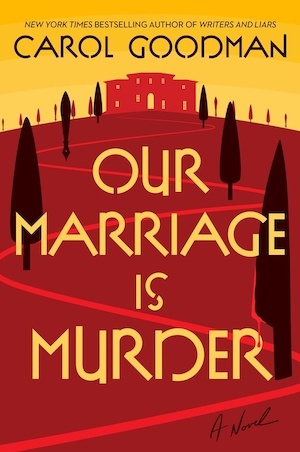
It’s been joked about at many a crime fiction conference, and some of them have even featured those role-play murder mysteries to solve, but what if a real-life murder took place at such an event? Can you imagine the white-tape victim silhouette we see every year at Harrogate being at the centre of an actual crime scene? Hopefully it will never happen, but the idea itself is the inspiration behind Carol Goodman’s new cosy mystery, Our Marriage is Murder. It also wraps in a crime-writing couple as its main characters, and what happens when that doesn’t quite work out in the long run.
Writing Death Takes the Castle together at the romantic Italian Castellarosa cemented the relationship between Fred and Thea Morgan-Lane. Two decades and 20 successful novels later, their Death Takes a Holiday series has made them the stars of a literary conference being hosted at Castellarosa – where else? What few know is that the bloom is off the rosa, and Thea wants to end the career of their amateur sleuths – also a married couple – as well as her marriage to Fred.
But they have one last book in its final stages, so have to put on a brave face for their loyal readers. It’s hard. Reminders of their first success are everywhere at the event, and the conference planner has even created a treasure hunt that follows clues in the original book.
A persistent, romantic legend hovers about the castle, which is that, in the 12th Century, a beautiful girl named Bianca Rosa fell in love with a knight travelling to the Crusades. She promises to wait for him until he returns, which he does, carrying a treasure. But Bianca Rosa is dead, and he dies at the foot of her tomb. Thea was in Italy to research this legend for her doctoral dissertation when she met Fred, and thoughts of poor Bianca Rosa were supplanted by a 21st-century romance.
In any case, it seems the Bianca Rosa legend was a dead end. The nun in charge of the monastery at the time persuaded Thea there was no tomb of Bianca or her knight in the monastery’s crypt and no treasure. In the intervening years, the monastery was purchased from the Church and transformed into an upscale hotel and conference venue. But the moral of the old tale still echoes in Thea’s thoughts: you can have the treasure or you can have true love, but you can’t have both.
The first conference event is an introductory panel involving nominees for the Poirot Prize, Fred and Thea among them. The conference starts off with a bang, or maybe a thud, when the organiser takes a sip of her cocktail and keels over dead. Poisoned – exactly like the first murder in Death Takes the Castle. The attendees are shocked, but continue with the conference events, which includes the aforementioned treasure hunt.
Before long it’s clear that someone has taken their fictional crimes all too seriously, as new copycat crimes occur. Mimicking their fictional detectives, Fred and Thea investigate the murders, with a keen eye for the details, since they’d written about these same crimes in Death Takes the Castle. It’s as if they’re following along in their own fictional footsteps. The local police also are on the case, of course, but not making much headway, being a little stuck on the idea that Fred and Thea are the most likely suspects.
Goodman’s setting, in and around the Castellarosa, including its elaborate grounds, makes a perfect backdrop for these deadly events. It seems the local beauty and the ugliness of motives need to balance each other out, and Italy must inspire these precarious balancing acts, as in Simon McCleave’s Last Night at Villa Lucia. Fred and Thea also recognised the intrinsic dynamics of this setting two decades earlier.
I particularly enjoyed the author’s description of the attendees, their preoccupations, their jockeying for attention and their overall behaviour. The publishers, publicists, readers – they’re all nicely described. She name-drops other notable conferences in the field, awards programs and the like, which grounds the whole chaotic scene in a very particular reality. You can feel sorry for Thea, believing Fred was unfaithful on a research trip they took to San Miguel de Allende four years earlier though I wish she had come to terms with that and moved on, or not. You can also feel sympathy for Fred, the target of her anger.
I found the plot a bit predictable, with the twists not unexpected. Still, there were enough other pleasures in the story to keep me reading with pleasure.
To see how a real-life married couple pulls off writing a book together also see Time to Burn by Ellery Lloyd or anything by Nicci French.
William Morrow
Print/Kindle
£6.99
CFL Rating: 3 Stars