

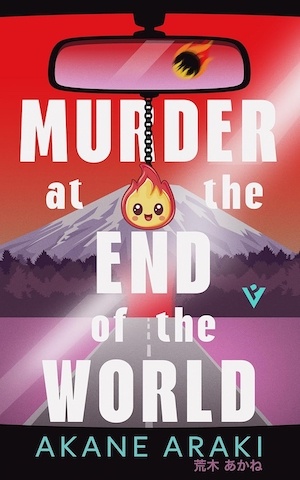
Translated by Jesse Kirkwood — In two months’ time, an asteroid named Telo is due to hit Fukuoka, Japan, with a kinetic energy equivalent to 45 billion megatons of TNT. “It’s the end of the world as we know it,”‘ as Michael Stipe once sang. Our narrator, 23-year-old Haru, is one of the few people remaining, and she feels fine.
Well, as fine as one could be in the face of mass extinction. Additionally, her father has recently committed suicide, her mother walked out on them years ago, and her brother, Seigo, has been hiding away up in his room for weeks, refusing to talk to anyone. Yet Haru doesn’t seem too shaken by impending death. In fact, she has decided it is a good time to take driving lessons.
I get Haru’s logic. Surely she won’t struggle to book an appointment and the roads will be nice and quiet, because, well, most people have either fled Japan or died by mass suicide, hanging themselves in nearby forests. Her country has become an apocalyptic dystopia, but she is determined to pass her driving test so she can drive down to the site where the asteroid will hit to witness the end of the world from ground zero.
Remarkably, Haru finds a driving instructor, Isagawa, at the local Dazaifu driving school, who is willing to give her lessons.
On this particular day Haru and Isagawa discover the body of a woman who has been stabbed multiple times in the boot of the training car. Isagawa immediately switches into investigative mode and, by going through the victim’s belongings, concludes that she was a financially comfortable professional with a high-status job, possibly a lawyer, who was on her way to meet someone. Isagawa might have extreme tendencies, but she’s also an ex-police officer who left the force four years earlier because her strong sense of justice clouded her judgement.
It soon becomes apparent that this is the third recent homicide and it could be linked to earlier murders in other prefectures where two young men were killed in a similar way. Clearly, there’s a murderer on the loose.
With little policing going on because of the Telo, the asteroid, violent crimes like murder are not unusual. The only two remaining police officers Haru and Isagawa encounter are Hajime Ichimura, who headed the Second Criminal Division of the Hiroshima Prefectural Police, and Sergeant Ginjima from the Juvenile Crime Unit. Neither is willing or apparently able to investigate. After all, what’s the point? And why would a serial killer start killing people when the world is about to end?
Haru and Isagawa find a purpose amidst the futility of their situation and head off on a road trip across Japan to find the perpetrator. Along the way, they encounter a cast of interesting characters, a community trying to survive, and they witness basic infrastructure falling apart with no gas, running water or electricity. To complicate matters, it seems another murderer, The Taxi Killer, has been operating further afield, leaving 15 people dead. Could there be a connection?
Against the background of the prevailing anarchy and futility of living, the story shows how human behaviour might change when the influence of cultural norms and expectations is stripped away. If we remove societal expectations and the force of the law, will people still behave according to a moral code?
The Murder at the End of the World is a unique combination of whodunnit, road trip buddy novel and apocalyptic tale. Despite its dark themes and slightly macabre nature, it’s quirky and fast-paced rather than heavy and depressing. The apocalyptic setup stands in contrast to the beauty of the night skies. Haru frequently glances at the sky, admiring its vastness even though this is also where their destruction will come from. It’s as dark and unusual as Japanese fiction can often be and readers familiar with this style will recognise the emotional distance of characters and aloofness and disconnectedness of their human interactions.
Who would have thought I’d enjoy a grim, surrealistic, dystopian Japanese mystery about the end of the world as much? Just beware: if you prefer more traditional crime fiction – cosy mysteries or procedurals, for example – don’t expect that from The Murder at the End of the World.
For another innovative Japanese crime story try Strange Houses by Uketsu.
Pushkin Vertigo
Kindle/Print
£14.24
CFL Rating: 4 Stars