

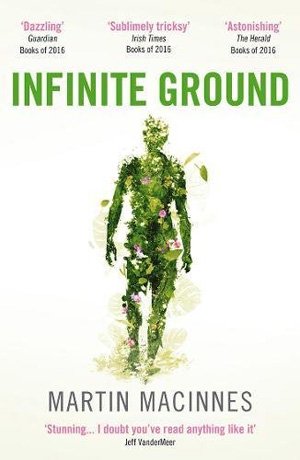
 Written by Martin MacInnes — A retired, unnamed investigator in a nameless Latin American city is woken up by a phone call in the middle of the night. The person on the other end asks for help with a case. No reason is given for the detective’s compliance, but he agrees to take the work. In doing so, we are told, he assumes his old status as a senior investigator.
A man has gone missing. Carlos, age 29, halfway through dinner with his mother got up and simply vanished. The investigator begins to piece together what he can of Carlos’ life so that he may get to the bottom of the disappearance. He walks through the Latin American heat. Everything is hard. He tries to piece together what he can by going through Carlos’ things at work, visiting the restaurant from where he vanished, and by conducting various interviews and reconstructions. The inspector turns to Carlos’ mother for answers, and she brings a list of all the details she can remember about Carlos’ entire life as if the answer to the mystery lies in the minutiae.
Infinite Ground, a debut by Scottish crime author Martin MacInnes, could be classified as a Scottish crime novel but what he is doing here goes beyond the bounds of traditional crime fiction. The language used is complex, literary, and full of postmodern tropes and intellectual games. Irreality saturates the text and the sense that the whole story is not being told abounds. MacInnes constructs a novel about the minutiae of our lives, and what happens when the symbols that we hold onto as real begin to reveal themselves as otherwise. The crime fiction form holds well as a frame for this novel of ideas that investigates, as crime novels do, the interconnectedness of symbols that coalesce to make meaning.
The opening chapters depend on the detective genre to get the action started but this is eventually turned on its head. The inspector interviews Carlos’ mother Maria only to find out that he is not talking her but rather an actor hired by Maria to stand in her place. The woman relays the information that she wasn’t there to witness and we are thrown into a surrealistic deep end. The stand-in wonders if something dark and strange is at work and so do we. Carlos disappearance might be an otherworldly occurrence or simply a strange corner in this house of mirrors.
MacInnes gets a lot right in his text. The book is funny and strange. The literary games he plays succeed more than not. The chapters about Carlos’s mother and Carlos’s workplace, a nameless corporation that hires actors to fill the vacancy, are vibrant and odd and full of brilliant ideas. MacInnes employs various semiotic ideas as part of his story and does so well. But don’t worry, you don’t need to know anything about semiotics to enjoy and be in on the fun, but a cursory understanding of the linguistic theory makes his work all the more impressive.
The bulk of the narrative is told in a rather formal third person and this is where the best of the book is. Some of the other stylistic choices aren’t as compelling but are still well done. A small paragraph from a mock anthropology text, Tribes of the Southern Interior, frames each chapter. This adds another obscuring lens through which we must try to decipher the novel, though this aspect grows tiresome. There are report extracts, case notes, and chapters of dialogue, which lend less to our understanding and often feel like an added obstacle planted by the author.
The second half of the book turns the surreal literary game of the text into overdrive. The section entitled The Forest uses a surreal and lyrical prose and is full of wonderful writing. The investigator dives deeper into the Borgesian maze leaving us at a place that questions where the line is between subjective imagining and reality, or irreality and reality lies.
Martin MacInnes’ debut is impressive, if not overdone at times. With that said, Innes is an author to watch. His gifts are many, and we will have to see how he refines and sharpens them in books to come. A stellar, challenging, and puzzling read from a great new writer.
For a little more playful surrealism try the app game Device 6, reviewed here.
Atlantic Books
Print/Kindle/iBook
£5.03
CFL Rating: 4 Stars