

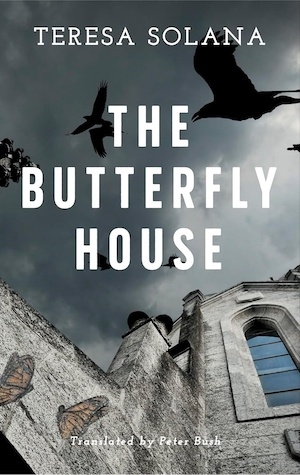
Translated by Peter Bush — Teresa Solana’s The Butterfly House is an idiosyncratic crime novel in which murder, family complications, police politics and the economic woes of Barcelona become increasingly entangled. It follows Black Storms as the second instalment in Solana’s series featuring Deputy Inspector Norma Forester.
Once again, Solana demonstrates that a murder investigation need not be all gloomy interrogation rooms and grim-faced detectives. The Butterfly House is frequently funny, occasionally outrageous and populated by characters whose personal lives are every bit as complicated as the cases they investigate.
It all begins with an unsettling discovery.
A woman’s body is found in the garden of a squat in Barcelona’s Vallcarca district. The victim is Raquel Bosch, a former bookkeeper who had fallen on hard times. The investigation initially seems relatively straightforward, but matters become considerably more complicated when it emerges that Bosch was 11 weeks pregnant, unbeknownst to her husband.
And Norma faces an additional problem: her daughter Violeta has been living in the squat where Bosch’s body is discovered. Violeta is studying philosophy but has embraced a more radical lifestyle, living alongside a group of squatters and becoming involved with Gerard, a physics student who soon finds himself under suspicion.
Norma’s role as both police officer and mother creates a particularly awkward conflict of interests. She wants to investigate the murder properly, but she also wants to protect her daughter from being dragged into the case. That tension influences every decision Norma has to make.
She is competent, experienced and determined, but she is hardly infallible. Instead, she is constantly juggling competing responsibilities: her career, her marriage, her daughter, her colleagues and her own rather questionable decisions.
Solana exploits the gap between Norma’s professional instincts and her maternal ones. When the investigation threatens Violeta, the distinction between police officer and worried parent becomes increasingly blurred. Norma knows what the rules are, but that does not necessarily mean she is prepared to follow them.
And Violeta is not the only member of the family to complicate things. Norma is married to Octavi, a forensic pathologist, while her wider family includes irrepressible mother Mimí and Aunt Margarida, whose talents as a hacker once again extend considerably beyond what might be expected from an elderly relative.
The relationship between Norma and Octavi is particularly well handled. Neither is presented as a saint, and both have their secrets. Norma is having an affair with David Subirana, whom she only sees when he visits Barcelona. She insists on keeping the relationship strictly controlled, with no calls, emails or clandestine correspondence between meetings.
It is a decidedly unconventional arrangement, and Solana wisely avoids treating it as a standard romantic subplot. Instead, it becomes another facet of Norma’s complicated existence. Her marriage is genuine, her family matters enormously to her and yet she has constructed a separate relationship for herself.
Solana has created a family that could easily become irritating in less capable hands, but their eccentricities give the novel much of its warmth and humour. As a result, Norma feels considerably more human than the standard fictional detective whose private life exists merely to provide occasional angst.
The murder investigation seems equally human and believable. There is no breathless race from one spectacular clue to another. Norma and her colleagues conduct interviews, follow up leads, argue over theories, eat lunch and deal with the ordinary frustrations of police work. Even when pressure is mounting, the mundane tasks still need to be completed.
Solana understands that painstaking police work can be interesting when the investigators themselves are interesting. Norma and her colleagues don’t magically know which apparently insignificant detail will prove crucial. They make assumptions, pursue the wrong leads and occasionally have to reconsider their conclusions.
The case initially points towards the obvious suspect. Bosch’s husband has no convincing alibi, the couple were experiencing financial problems and Bosch had apparently kept her pregnancy secret. But Solana is less interested in producing the standard murder mystery suspect than in examining the social circumstances surrounding her victim.
Money, unsurprisingly, becomes increasingly important. Bosch had previously worked for a construction company and was owed money for work she had carried out. Norma has to consider whether the murder might have had less to do with gaining money than with avoiding paying it.
This provides Solana with an opportunity to explore the economic pressures facing Barcelona. The city is experiencing both unemployment and precarious employment, in addition to the consequences of the sub prime financial crisis, which is occurring when this book is set. The squat where Violeta lives is significant in this respect.
It is easy for outsiders – and, initially, for the police – to regard its residents as troublesome radicals, but Solana gives them more complexity than that. Violeta’s politics allow her to explore the uncomfortable relationship between authority and justice. Norma may wear the uniform, but she does not automatically accept that the system is always right.
The media comes in for similar treatment. As the investigation attracts attention, television pundits speculate about it and quickly settle on the squatters as convenient suspects. Solana has obvious fun with this tendency to turn complicated criminal investigations into simplistic television narratives.
The police hierarchy is also beset with problems. Norma’s relationship with Superintendent Mistral is particularly poisonous, with their mutual distrust and professional rivalry evident. When confidential information about the investigation reaches the press, Norma finds herself facing disciplinary action.
This reinforces one of the series’ key messages: the police are not a monolithic force. There are good officers, irritating officers, ambitious officers and officers simply trying to get through the day. Norma herself is willing to bend the rules when she thinks circumstances justify it, and the consequences are not conveniently brushed aside.
The Butterfly House is perhaps less concerned with historical trauma than Black Storms, but it retains Solana’s interest in the gap between the official version of events and the messier reality underneath. Police procedure, politics, family relationships and social inequality are constantly rubbing against one another.
So crime fiction lovers looking for something a little different would do well to spend some time in Norma Forester’s Barcelona. There is murder, certainly, but there is also family, food, politics, bureaucracy, infidelity, bad decisions and the occasional very welcome laugh. In Solana’s hands, those aspects make for a thoroughly enjoyable mystery.
For more visits to Barcelona’s seamier side, try How to Kill Your Friends by Phil Kurthausen and The Barcelona Brothers by Carlos Zanón.
Corylus Books
Print/Kindle
£4.59
CFL Rating: 5 Stars