


There is something distinctly unsettling about the idea of being trapped in your own house. It should be the place where you can retreat from the outside world, shut the door and feel safe. But what happens when the person making your life unbearable is the person sharing your home?
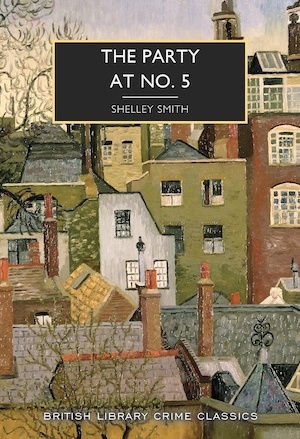
In The Party at No 5, Shelley Smith takes that premise and turns it into an extraordinarily tense study of resentment, manipulation and domestic drama. Originally published in 1954, it certainly isn’t a conventional murder mystery and now has been deservedly brought back into circulation as part of the British Library Crime Classics series. We’ve reviewed a number of other books in the set here on Crime Fiction Lover, going back more than a decade.
There is no detective waiting patiently for a crucial clue, no succession of suspects being summoned to the drawing room and no puzzle to solve alongside a canny amateur sleuth. Instead, Smith presents something considerably more disturbing: a crime novel in which you watch the disaster taking shape and wait helplessly to see how far things will go.
Mrs Rampage lives alone in a large London house filled with antiques and sentimental knickknacks. Her daughter Jonquil lives abroad, somewhere on the way to Rangoon, but, while she is struggling to maintain the house, elderly Mrs Rampage rejects her niece’s suggestion that she employ a companion.
Understandably, Mrs Rampage is a woman who values her privacy, her possessions and her independence. Less understandably, she is also selfish, suspicious and deeply inconsiderate of other people’s feelings. Her reluctance to share her home is therefore met with a solution that seems, at least initially, almost ideal.
Her niece is acquainted with a Mrs Roach, a respectable widow and former warden of an old folks home who has fallen on hard times. After some cajoling, Mrs Rampage agrees that Mrs Roach can come live with her, providing companionship and practical assistance. It doesn’t take long for the arrangement to go awry.
Neither woman can easily be classified as victim or villain. Mrs Rampage is hardly a heroine. Her obsession with her possessions and her penny-pinching attitude make her capable of casual cruelty, while her treatment of Mrs Roach steadily fosters an atmosphere of hostility within No 5.
Yet Mrs Roach, initially presented as patient, helpful and long-suffering, gradually reveals another side to her character. And this is where the novel becomes gripping. Mrs Roach needs somewhere to live. She has very little money and few prospects. Mrs Rampage has a home, security and a collection of valuable possessions.
What begins with a degree of social comedy gradually becomes uncomfortable, then sinister and, finally, genuinely disturbing. Smith is clearly interested in the absurdities of human behaviour, and there are moments of dry humour, but the comedy becomes increasingly strained as the relationship between the pair deteriorates.
The unequal circumstances of the two women provide the basis for a conflict in which neither is entirely innocent. What begins as mutual irritation and encroachment upon personal space gradually becomes something much more dangerous when Mrs Roach starts to manipulate the situation around her.
Smith shows how a person’s perception of another can be altered almost imperceptibly. A small complaint becomes evidence of eccentricity. An act of forgetfulness becomes something more sinister. A perfectly ordinary disagreement can suddenly be interpreted as proof that somebody is no longer entirely in control of their faculties.
The possibility that Mrs Rampage might be losing her marbles is important. Smith reveals how easily an older person’s behaviour can be dismissed or reinterpreted, especially when there is somebody nearby with an interest in controlling the narrative. This is made more uncomfortable because Mrs Rampage is not a particularly sympathetic character.
No 5 is large, cluttered and increasingly claustrophobic, its rooms and contents forming the stage on which the living arrangement breaks down. There is irony in the fact that Mrs Rampage’s treasured home, the physical embodiment of everything she has accumulated and protected, gradually becomes the place where she is most vulnerable.
In addition to its material presence, Smith allows the tension to accumulate through behaviour: a conversation that doesn’t quite go as expected, a change in routine, an apparently insignificant omission. The cumulative effect is much more disturbing than a succession of sensational incidents.
The structure of The Party at No 5 is also crucial. Because it is an inverted mystery, Smith is less interested in asking who is responsible than in exploring how and why the situation develops. You are placed in the uncomfortable position of knowing more than some of the characters. You see the danger long before the consequences become unavoidable.
This creates a different kind of suspense from that of the traditional whodunnit. There is no need to wonder which character is the wrongdoer. Instead, you are left wondering whether anyone will recognise what is happening in time and whether such recognition will actually make any difference.
Smith’s interest in psychology is evident throughout. Mrs Roach’s outward respectability neatly contrasts with what is gradually revealed about her motives. She is not a cartoon villain plotting in a clearly sinister fashion. Her behaviour develops from circumstances that are recognisably human: insecurity, financial desperation and social resentment.
The frightening part is not that she is fundamentally incomprehensible but that her actions can be traced back to ordinary weaknesses taken to extraordinary extremes. There is also sharp awareness of the limitations imposed on women of the period, particularly those who lacked money or a conventional family structure to protect them.
This is why the novel is more than a straightforward tale of domestic crime. Beneath the suspense is a study of female vulnerability and social isolation. Mrs Rampage has money but is increasingly dependent on others. Mrs Roach has practical capability but lacks financial security. Both are trapped by their circumstances, albeit in very different ways.
It’s almost painful watching the two women destroy whatever possibility they had of living peacefully together. Neither is particularly willing to compromise, and each seems to interpret the other’s behaviour in the least charitable way possible. Small grievances become weapons. Private weaknesses become opportunities. The house becomes a battleground.
Of course, while the psychology feels contemporary, there are aspects of The Party at No 5 that reflect its period. Some of the attitudes towards women, ageing and sexuality are uncomfortable, and the treatment of certain relationships is very much rooted in the social assumptions of the 1950s.
While disagreeable and sometimes distracting, these elements make it an interesting historical account as well as an effective crime novel. They reveal the world in which Smith was writing and show how perceptive she could be about the vulnerabilities of people in that world.
So, more than 70 years after its publication, The Party at No 5 remains an important reminder that some of the most effective crime stories don’t begin with a body. Sometimes all you need is a house, two incompatible personalities and a growing suspicion that something has gone terribly wrong behind closed doors.
For more classic domestic crime, try Jack on the Gallows Tree by Leo Bruce and Airing in a Closed Carriage by Joseph Shearing.
British Library Publishing
Kindle/Print
£9.59
CFL Rating: 4 Stars