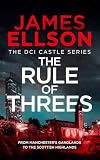



Policing is an incredibly difficult job and, often, the drama and trauma we read about in the pages of crime novels are a reflection of real life. Crime author James Ellson’s career is a case in point. Today he writes crime novels full of action and intrigue, packed with realistic detail and the kind of empathy only an ex-cop can express. His latest, The Rule of Threes, arrives on 2 July 2026 – it’s the fifth in the DCI Castle series, which starts off in Manchester but heads to the Highlands of Scotland as Rick Castle tries to find a missing protected witness.
James’s career in the police ended abruptly after a breakdown. After moving to the Peak District, setting up a smallholding with his wife, and doing a lot of hiking and climbing, he started writing. His fictional detective DCI Rick Castle appeared in a trilogy of novels – The Trail, Cold Dawn and Cold Summer, which take Castle to Nepal. The first three were followed by Baseline, about a Russian sleeper cell in Manchester. The books are infused with detail informed by James’s work in the police, which spanned 15 years in London before a transfer to the Greater Manchester Police, in Stockport and Moss Side.
Since jotted down the things he knows about on the back of an envelope – the police, trekking in Nepal and beekeeping – James hasn’t looked back. We think you’ll agree that our chat with him is full of fascinating insight. No books are quite like the DCI Castle series.
What will crime fiction lovers love about The Rule of Threes?
The plot of The Rule of Threes centres on a protected witness who’s gone missing. The witness was relocated from Manchester to Northwest Scotland after giving evidence at a murder trial for a member of an organised crime group.
The title refers to a principle of survival – three weeks without food, three days without water, three minutes without oxygen.
Who is DI Rick Castle and how have you developed this character? Did you base him on yourself, a little?
I am not Rick Castle but there are elements of me in him, including his passion for the police (The Job) and its psychological impact. Rick dealt with 17 deaths in his first week of nights as a DI, and suffers flashbacks and an obsession with the number 17. He sees a psychotherapist to discuss these and other issues. The facts are different in my life, but the feelings are the same, and I mine my experiences to bring Rick to life on the page.
In The Rule of Threes, Rick is picked apart by the CPS and disbelieved. Starting to doubt himself, he meets with his psychotherapist. She asks about his childhood, and together they discuss the unreliability of memory and the power of suggestion. These scenes at end of book are some of the most interesting and affecting I’ve written.
What’s he up against in The Rule of Threes?
The antagonist is William Redman, ‘The Big Red’, who runs an organised crime group. He’s featured in earlier Castle novels, but comes to the fore in The Rule of Threes.
One of the gang’s members is serving time for a murder; his former partner is the protected witness (who’s gone missing) and gave evidence at his trial. Hence, Redman’s OCG have clear motive for tracking her down.
Rick’s involvement in the case leads to him being targeted – or at least, that’s what he thinks!
Who are the other interesting characters we’ll meet?
Starfish is one of Redman’s soldiers; the book opens with Rick chasing him on foot. There are three reasons for his nickname, including the hue of his skin; for the other two, you’ll have to read it!
Maggie, a police analyst, is Rick’s fiancée. It’s her second career after serving in the army as a sapper. She’s a wheelchair user.
Other significant characters include Superintendent Robinson (Rick’s boss); PC George Barton (a PC who wants to join Rick’s unit); Louise (CPS lawyer); Emma (Rick’s psychotherapist); and Gollum, Redman’s dog.
Tell us more about the setting because the story starts in Manchester and lead into the Scottish Highlands. What role do the settings play in the story, and how have you used them to create atmosphere or peril?
The book is predominantly set in Manchester and Northwest Scotland, both of which I know well. Manchester from working there, and Scotland from mountaineering.
Together with my wife, I am climbing the Scottish munros – Scottish hills over 3,000 feet. We have climbed 247 of the 282. Most of our holidays are spent in Scotland, including one in Knoydart where part of The Rule of Threes plays out. I have walked in the hills described in the book, caught the ferry from Mallaig to Inverie, and stayed in the bunkhouse.
Knoydart, to the west of Fort William, is the largest wilderness area in UK. Although it’s part of the UK mainland, you have to catch the ferry to Inverie, and crucially, from a detective and crime writer’s point of view, mobile phone reception ends midway through the boat crossing, and makes Inverie a closed community.
How have you balanced the action aspects with police procedural, and how does your experience as a cop feed into the content and telling of the story?
DCI Rick Castle leads a small team at South Manchester, the Special Investigation Unit. He utilises the detective method, a process of investigation used for serious and major crime which I learnt as a senior investigating officer, and is taught to every SIO in the country to tackle serious and major crime. The method is based on asking yourself four questions:
What do I know?
What are my hypotheses for what happened?
What do I need to know?
How can I find out?
These questions are employed by DCI Castle in each book, including The Rule of Threes where he harnesses the method to find the missing protected witness. I’ve not seen this in any other crime fiction.
Were there any wider themes you wanted to explore in this novel, or in the series in general?
The psychological impact of investigating numerous deaths is explored across The DCI Castle series, and the unreliability of memory is explored in The Rule of Threes.
This is the fifth book featuring Rick Castle. Can it be read as a standalone or do we need to read all the previous novels?
The Rule of Threes can be read as a standalone, as can book four, Base Line.
However, the first three books in the series are a trilogy with an overall story arc, and are best read in order. Throughout the series, Rick’s backstory develops, for example, his obsession with death, and his relationship with Maggie.
Which other crime books and/or authors have influenced you and why? What are you reading now?
James Ellroy – and not just because I sit next to him on a bookshelf! I was advised to read his book The Black Dahlia during my creative writing degree to understand the importance of character and backstory. The protagonist is a LA street cop called Bucky Bleichert, and the first hundred pages describe a boxing match with another officer. No plot whatsoever, but by page 100, I was totally hooked.
I often read more than one book at a time. Currently, Don Quixote and Hide and Seek, an early Rankin.
What’s next for DI Rick Castle and what’s next for James Ellson?
I’m working on the sixth book in the Castle series called Coolredda – a fictional name for a huge coalmine in Australia. Rick’s investigation into an environmental protestor from Manchester leads him there. It’s due June 2027.
I’ve also written the first in a new series about a former detective called Rockburn, now a private investigator. The second book should be published later this year.
Writing about a PI allows more creative freedom than a police procedural. Rockburn rides a big motorbike and plays darts; and the narrative draws on the mythical realism of Lee Child’s protagonist Jack Reacher.
The Rule of Threes goes on sale 2 July 2026, and you can order a copy using the buttons below.