

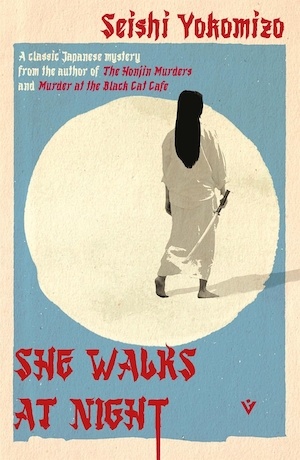
Translated by Jesse Kirkwood — She Walks at Night by Seishi Yokomizo (1902-1981) is a wonderfully strange blend of Golden Age puzzle mystery, Gothic melodrama and distinctly Japanese atmosphere. Originally published as Woman Walking at Night in Japan, in 1948, it’s another perplexing case for Kosuke Kindaichi, although the real intrigue lies less in the mechanics of the crime than in the unsettling world surrounding it.
At the heart of matters is a classic impossible crime-style problem: a decapitated body discovered on the estate of a deeply dysfunctional aristocratic family. But, as is typical with Yokomizo, the plot is only half the story. The real appeal lies in the uneasy combination of social satire, grotesque family drama and the lingering shadows of Japan’s past.
Naoki Sengoku, a satellite member of the wealthy but troubled Furugami clan, confides in his friend Torata Yashiro, a struggling mystery writer. Naoki’s worries centre on Yachiyo Furugami, a beautiful but unstable young woman who suffers from episodes of sleepwalking and whose sudden engagement to artist Koichi Hachiya is raising eyebrows.
Surprisingly, the fact that Yachiyo admits to having previously shot her fiancé in the leg isn’t the strangest aspect of the affair.
Yachiyo has also been receiving mysterious letters warning her not to walk at night. Soon after Torata learns of the situation, a murder occurs on the Furugami estate, the headless body is found and the murder weapon is an antique samurai sword. The weapon, however, had been locked away in a safe, leaving the police with a baffling puzzle.
Plus, why would someone want to pilfer a decollated bonce?
As the investigation falters and tensions rise within the household, more violence follows. Eventually the authorities call in Kosuke Kindaichi, Yokomizo’s dishevelled yet brilliant detective, whose apparently absent-minded demeanour hides a razor-sharp analytical mind and an ability to perceive the mundane behind the supernatural.
The structure of She Walks at Night is reminiscent of the Golden Age mysteries we love. Like a country-house puzzle by Agatha Christie or John Dickson Carr, the story involves a closed circle of suspects, a baroque murder method and an increasingly tangled web of motives. Yet the tone is far stranger than its British counterparts.
Yokomizo delights in grotesque details – decapitations, inherited feuds, hints of madness – and the effect is often gleefully macabre. Fortunately, nothing fools Kosuke Kindaichi. He is an unconventional detective: rumpled, socially awkward and sometimes distracted. But beneath the untidy hair and modest demeanour lies an investigator with startling insight.
As is his custom, Kindaichi enters the story relatively late, letting the atmosphere and suspicion within the Furugami household build. By the time he arrives, the family already seems steeped in secrets and resentments, and it seems likely that the murder is merely the surface expression of something much older and darker.
Unlike the cold intellectualism of Hercule Poirot or the methodical logic of Sherlock Holmes, Kindaichi often appears almost passive. He listens, observes and waits, allowing the suspects to reveal themselves. The fact that he is regularly underestimated is the secret to his success and to the doom of murderers throughout Japan.
Perhaps the most striking element of the novel is its setting. The Furugami estate lies in the Musashino countryside to the west of Tokyo, surrounded by earthen walls and isolated from the outside world. This physical isolation mirrors the social isolation of the family itself: a clan clinging to prestige and wealth while simmering with internal rivalries.
Yokomizo often situates his mysteries in rural or semi-rural settings where the past still exerts a powerful influence. The Furugami household feels like a relic of an earlier Japan, with its strict hierarchy, lingering feudal attitudes and inherited grudges. The katana used in the murder is not just a grisly prop but a symbol of that unshakeable past.
This sensibility neatly reflects the Shōwa-era milieu that Yokomizo frequently explored. The result is a story that feels suspended between eras: modern police procedures coexist with old superstitions, while contemporary relationships unfold within the rigid framework of an aristocratic household.
This interplay between past and present is central to the novel’s atmosphere. The sense of decay – of traditions lingering long after their relevance – creates an environment where secrets thrive. The Furugami estate becomes almost a character in its own right: a labyrinth of grudges, hidden relationships and inherited shames.
Yet what makes the novel particularly memorable is its mixture of puzzle logic and Gothic excess. There are drunken patriarchs, unstable heirs, secret affairs and ominous prophecies. The story hints at the supernatural – especially through Yachiyo’s sleepwalking episodes – without ever abandoning the rational explanation required by classic detective fiction.
The tone can sometimes feel melodramatic, but that is part of the charm. Yokomizo writes with a sense of theatricality, relishing the strange personalities and shocking events that populate the story. This approach highlights how distinctive Japanese Golden Age crime fiction can be.
While it shares the intricate plotting of classic British puzzle mysteries, it often carries a darker emotional undercurrent. Themes of family obligation, shame and inheritance play a far more central role, giving the narrative a psychological weight beneath its ingenious mechanics.
Yet, for all its darkness, She Walks at Night is eccentric and occasionally outrageous, packed with colourful characters and shocking revelations. The impressively constructed puzzle offers a glimpse into how Japanese detective fiction blends the logic of classic whodunnits with folklore, family tragedy and the weight of history.
So, as Kindaichi untangles the twisted relationships within the Furugami household, his findings reveal something more unsettling than the murder itself: the quiet, destructive power of secrets preserved across generations – exactly the kind of outcome that Yokomizo specialised in.
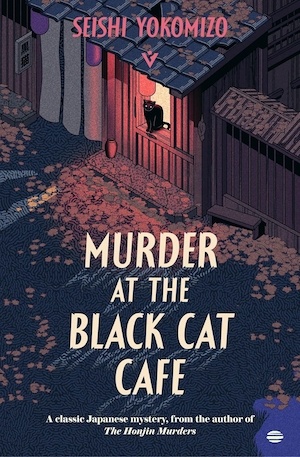
For more fiendish mysteries by Seishi Yokomizo, try Murder at the Black Cat Café.
Pushkin Vertigo
Print/Kindle
£5.99
CFL Rating: 5 Stars