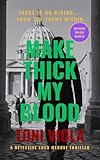


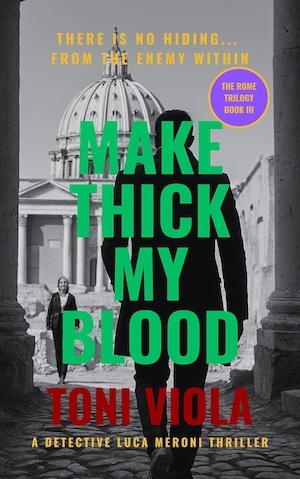
Set against the volatile backdrop of Rome, Toni Viola’s Make Thick My Blood blends procedural investigation, political intrigue and personal reckoning into a thriller that is as interested in the moral pressures placed on its characters as it is in solving a crime. As a result, it progresses briskly as a mystery while conveying a dark psychological undertone.
The story begins far from Italy, on a Caribbean beach in Antigua. It is a moment of deceptive calm. Luca Meroni reflects on the battles he and a companion have survived – organised crime, corruption and personal demons – while acknowledging that the victory has been hollow.
The sense of dislocation is immediate: Meroni is physically removed from his complex homebase in Rome but emotionally tethered to it. In this way, Viola immediately establishes one of the central tensions plaguing the dedicated detective: the impossibility of truly leaving the past behind.
When time and events shift back to Rome, the fragile sense of calm evaporates.
A well-known television journalist, Teresa Conti, is discovered after being brutally attacked near the historic site of Pompey’s Theatre. The crime bears disturbing similarities to earlier incidents around the Roman Forum, where victims were drugged, humiliated and left in Roman-style costumes smeared with blood.
Almost immediately, the investigation becomes deeply personal for Meroni. Not only is he familiar with Conti and her fear that something bad is underway, but in an early twist he is arrested on suspicion of being her attacker. Hence, the plot is set in motion not through a slow procedural build-up but through an abrupt destabilisation of Meroni.
By placing Meroni under suspicion and suggesting that he faces very real consequences, Viola forces the investigation to be viewed from an unusually precarious vantage point. Authority becomes uncertain, loyalties shift and the institutional framework of policing appears fragile.
Much of Make Thick My Blood unfolds through conversations and investigations that gradually expose a web of political manipulation. Several of the earlier attack victims are connected to members of Rome’s city council, suggesting that the crimes may be less random than they first appear.
The symbolism of the attacks – victims dressed in Roman togas, smeared with blood, dumped locations tied to the city’s ancient history – adds an unsettling theatricality to proceedings. It feels as though the perpetrator is staging a grotesque performance against the backdrop of the Eternal City.
To highlight the disquieting nature of the contrast been the city’s surface grandeur and its seedy underbelly, Viola ensures that Rome has an active presence throughout the book. Streets, cafés and historic sites are all described with the familiarity of someone who understands how the city’s past and present overlap.
The Roman Forum, Piazza Cavour, Trastevere and other landmarks are not simply scenic settings – they reinforce the sense that modern crimes unfold in the shadow of ancient power. The juxtaposition is effective. Rome is both timeless and politically combustible, an ideal setting for a story in which ambition, corruption and revenge intertwine.
At the centre of it all is Luca Meroni, a detective whose personality is also defined by contradiction. He is both intuitive and reckless, a man who solves problems by bending rules but who remains driven by a genuine sense of justice. Viola gives him a dry sense of humour and a tendency towards philosophical reflection, qualities that soften his harder edges.
Meroni’s relationships deepen his character considerably. Inspector Tina Ferrara, for instance, is not merely a professional partner but someone bound to Meroni by a complicated personal history. Their exchanges move easily between professional collaboration and emotional vulnerability, hinting at feelings that have never quite been acknowledged.
And then there’s Silvia Bassi, a younger investigator whose diligence contrasts with Meroni’s instinctive approach. Through Bassi’s perspective, Viola reveals the machinery of investigation more clearly: the gathering of evidence, the revisiting of statements, the slow assembling of patterns that others have overlooked.
Viola’s plotting is careful rather than flashy. Clues are seeded gradually, often through seemingly casual conversations or minor details in witness statements. The pattern of attacks becomes clearer as the story progresses and the possibility emerges that the crimes are tied to past scandals involving political figures and their partners.
Viola explores the intersection of personal guilt and public power. Many characters carry secrets – affairs, betrayals, compromised decisions – that threaten to surface under scrutiny. The attacks exploit these vulnerabilities, weaponising shame as much as physical violence. The crimes are not simply acts of brutality but attempts to manipulate reputations.
The title of Make Thick My Blood, drawn from Macbeth, hints at this darker psychological territory. The line invokes a deliberate hardening of the conscience, a willingness to suppress remorse in pursuit of a goal. That idea echoes throughout the story. Several characters must decide whether to protect themselves, expose others or uncover the truth.
Stylistically, Viola favours brisk chapters and dialogue-driven scenes. The pace rarely slows for long, which suits the investigative structure of the book. Even when characters pause for coffee in a Roman café or stroll through an historic square, the dense conversation usually carries forward a thread of suspicion or revelation.
As the third book in the series, Make Thick My Blood occasionally assumes familiarity with earlier stories from Meroni’s life. References to previous cases and personal traumas add depth but sometimes feel slightly opaque. Nevertheless, the central mystery remains accessible, and Viola provides enough context to keep things coherent.
As Meroni begins to realise the truth, the story becomes less about identifying a single culprit and more about confronting the culture that has allowed such manipulation to flourish. He is forced to consider what justice means in a world where victories are rarely clean: the mystery may be resolved, but the cost of that resolution lingers.
For more crime fiction set in Italy, try An Enigma by the Sea by Carlo Fruttero and Franco Lucentini and The Venus of Salò by Ben Pastor.
Larkspur Publications
Print/Kindle
£2.99
CFL Rating: 4 Stars