

If a man is found stabbed through the forehead by a unicorn, the sensible reaction is probably to question the witness, the lighting conditions and perhaps the sanity of everyone involved. But in The Unicorn Murders that bizarre image is simply the starting point for one of the most exuberantly improbable mysteries of the Golden Age.
Published in 1935 under the pen name Carter Dickson, the novel features the bluff, brilliant and often hilariously irascible detective Sir Henry Merrivale. It arrived at a moment when its author, John Dickson Carr, was establishing himself as the undisputed master of the ‘impossible crime’ with works such as The Hollow Man and The Mad Hatter Mystery.
Carr had a gift for creating crimes that appeared not merely unlikely but outright supernatural – murders that occurred in sealed rooms, killers who vanished from locked chambers and deaths apparently committed by ghosts. The Unicorn Murders pushes that taste for extravagant obfuscation to gleeful extremes.
A mid-flight mystery
The story begins with a setup that feels part spy thriller, part detective novel. Former British intelligence agent Kenwood Blake encounters fellow operative Evelyn Cheyne in Paris and becomes entangled in a curious affair involving a priceless object known only as ‘the unicorn’.
The situation escalates when a small plane carrying diplomats, criminals and lawmen is forced to make an emergency landing near the remote Château de l’Ile. Among the passengers are two legendary figures: the flamboyant criminal Flamande and his relentless pursuer Gaston Gasquet of the French Sûreté.
The complication? Both men are masters of disguise, and no one present knows what either of them looks like. Somewhere among the stranded travellers lurk both hunter and hunted. It’s the perfect scenario for Carr’s favourite theme: identity as illusion. In a story where anyone might be someone else, suspicion becomes a kind of sport.
Then comes the murder.
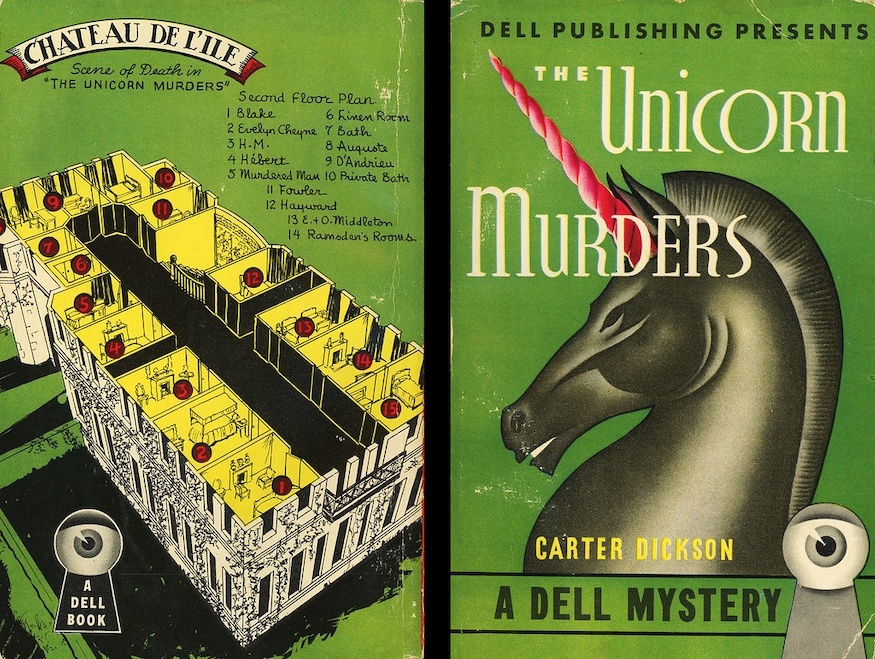
One of the party suddenly collapses with a wound in his forehead so peculiar that witnesses describe it as resembling the horn of a unicorn. Even stranger, the killing appears to have happened in full view of observers, making it seemingly impossible for anyone present to have committed the crime.
Enter Sir Henry Merrivale
To untangle the mess, Carr deploys one of his most entertaining creations. Sir Henry Merrivale – affectionately known as HM – is a wonderfully contradictory detective: intellectually formidable yet physically dishevelled, capable of razor-sharp deductions but equally prone to explosive impatience and eccentric outbursts.
When compared with Carr’s other famous sleuth, Dr Gideon Fell, HM is less scholarly and more volcanic. He blusters, bellows and occasionally bulldozes his way through a case, wrestling the truth into submission. Yet behind the bluster lies a mind perfectly tuned to the peculiar logic of impossible crimes.
In The Unicorn Murders, HM spends much of the novel grappling with two interlocking mysteries: (1) the identities of Flamande and Gasquet and (2) the method behind the apparently supernatural killing. The novel turns these puzzles into a sort of intellectual chess match, with disguises, misdirection and psychological games obscuring the central crime.
Carr at his most playful
Carr’s reputation as the master of locked-room and impossible mysteries rests on classics such as The Three Coffins and The Plague Court Murders. When compared with those tightly engineered masterpieces, The Unicorn Murders is arguably looser and more flamboyant.
But that is part of its charm.
Where some Golden Age mysteries feel like meticulous crossword puzzles, this one often resembles a magician’s stage act. Carr revels in theatricality: disguises within disguises, dramatic reveals and an atmosphere that teeters on the edge of fantasy. The very notion of a ‘unicorn murder’ feels like a deliberate provocation to readers who expect tidy realism.
And yet, in true Golden Age fashion, the solution ultimately depends on logic rather than magic. Carr’s trick involves constructing situations that appear supernatural while hiding entirely rational explanations beneath them. The fun lies in seeing how far he can push the illusion.
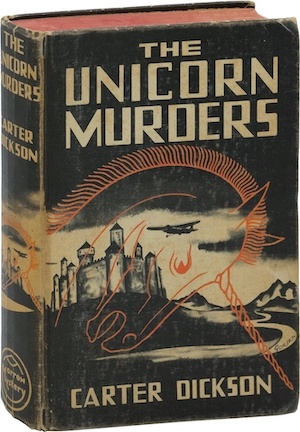
A castle full of suspects
The château setting provides the ideal environment for Carr’s brand of elaborate puzzle plotting. Once the stranded party gathers inside the isolated estate, the atmosphere becomes almost theatrical: a confined group of strangers, rising tension and the growing sense that everyone is concealing something.
This closed-circle structure was a staple of 1930s detective fiction, but Carr spices it up with the added complication of disguised identities. It is necessary to constantly question appearances. Is the polite traveller really the infamous thief Flamande? Could the quiet observer actually be the relentless Gasquet?
And perhaps most importantly, can the reader solve the puzzle before HM does?
A product of the Golden Age
To modern readers, The Unicorn Murders may seem delightfully eccentric. Its mixture of espionage, a bizarre murder method, theatrical deduction and the need to seriously suspend disbelief (how can colleagues at the Sûreté not know what Chief Inspector Gasquet looks like?) belongs squarely to the Golden Age.
During the 1930s, writers such as Agatha Christie, Dorothy L Sayers and Ellery Queen were refining the fair-play puzzle mystery. Carr’s contribution was to push that form toward the outrageous, inventing crimes that seemed utterly impossible and then explaining them with dazzling ingenuity.
Few writers have ever handled that particular balancing act so well.
The verdict
Nearly 90 years after its initial publication, The Unicorn Murders remains a fascinating example of Carr’s imaginative plotting and bold characterisation. It may not be his most polished puzzle mystery, but it captures the exuberance that made him such an influential figure in crime fiction.
Modern impossible-crime writers – from Japanese honkaku mystery authors to contemporary puzzle specialists – owe a clear debt to Carr’s willingness to stretch the genre’s boundaries. The idea that a mystery could flirt with the supernatural while remaining logically solvable became one of his signatures.
And if the novel occasionally feels a little wild, even slightly absurd, that’s part of the experience. Carr did not write mysteries that behave themselves. Instead, he wrote stories where men could apparently be killed by unicorns, detectives could unravel impossibilities and the line between illusion and deduction became deliciously blurred.
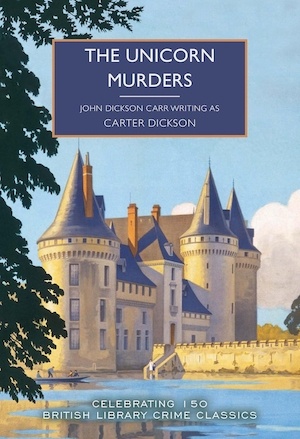
The Unicorn Murders has recently been republished, becoming the 150th title featured in the British Library Crime Classics series.