

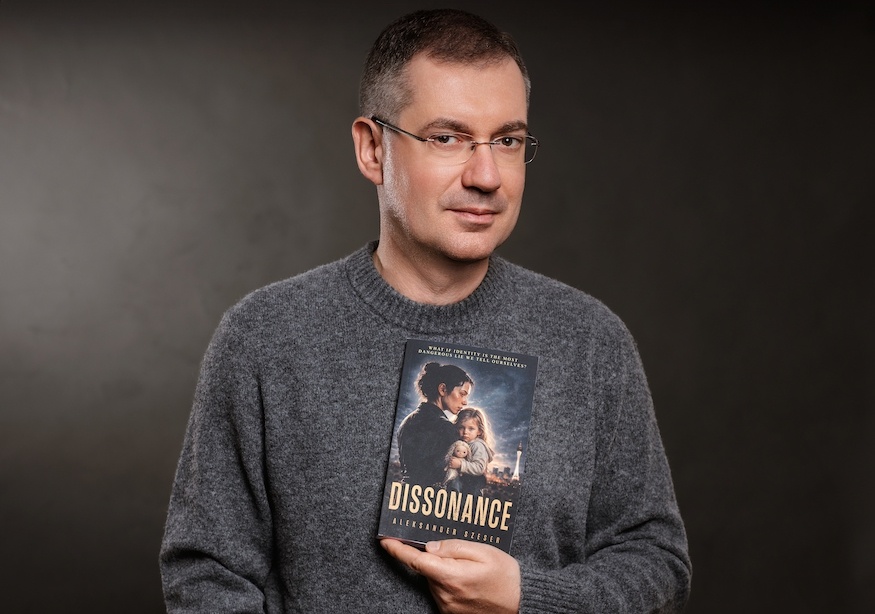
He’s a screenwriter, a filmmaker and he’s written about economics and philosophy too. Now, the Polish author Aleksander Szeser has released his first crime novel, Dissonance. It’s a thriller that plays on one of Crime Fiction Lover’s favourite themes – secrets from the past – but it does so in a unique way and asks some pretty big questions about how we define ourselves.
It all starts in dramatic fashion. Kira seems an ordinary Los Angeles mother, but a worrying note passed to her young daughter puts her on edge. Soon, there is a violent kidnap attempt and Kira does what she has to in order to save herself and her little girl. However, it brings attention Kira doesn’t want, scrutinising eyes and a trail into Kira’s past that seems to stop dead. Events catalyse changes in her home life too, and her marriage. Husband Max feels like he knows her less and less.
As the questions close in, so do other forces and you’re in for plenty of action and tension, and you’ll never guess where the next twist is going to come from. We won’t reveal too much here – instead we decided to ask Aleksander to tell us more about Dissonance, where his ideas came from, how he crafted the characters and more. It’s a debut crime novel that has been 20 years in the making…
What are crime fiction lovers going to love about Dissonance?
What I particularly enjoy is that slightly unhinged feeling that something much bigger is coming before the characters fully understand what it is. Around Kira, that becomes a tightening circle: danger is closing in, the police are asking increasingly uncomfortable questions, and the people closest to her are surprised by how she responds. The story uses some familiar thriller expectations, but gradually turns them in directions I hope readers will not see coming. What looks familiar at first may not turn out to be quite what you thought it was.
I’m in a bit of a Catch-22 with stories like this: the less you know, the more you’re likely to enjoy discovering the story for yourself, but you still need to know enough to want to begin. That is why I would rather let Dissonance keep some of its secrets. However, one detail worth mentioning is the time period. The main story takes place in 2012, with another important timeline reaching back to the early 1990s. 2012 still feels recent, but looking back from today, it is surprising how much the technological and social environment has changed in only 14 years. That distance became part of the atmosphere and texture of the story as well.
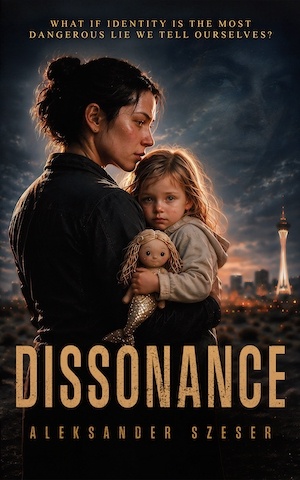
Who is Kira Hunt, what inspired this character and how have you developed her?
That is really the central question of the book, both for the reader and for everyone in Kira’s life. If you could ask her instead of me, and frankly I’m not sure I can speak for her on this one, she might struggle to define herself too. The more interesting question is whether she would give you the same answer at the beginning of the story as she would at the end. One hint: this is not an amnesia setup. It is something quite different.
What is she up against in Dissonance?
Kira is caught between several conflicts at once. Someone is coming after her and her family with a very clear motive, while a parallel police investigation starts asking questions about Kira herself and about things in her past that do not quite add up. So the pressure comes from different directions at the same time, and each line of conflict makes the others harder to navigate.
Where did you get the idea to write about someone who is cut off from their past, and how did you wrap a crime mystery into that?
I decided to return to some of the stories I had developed over the years, often first as screenplays. Dissonance was always one of my favourite concepts, and I finally wanted to bring it to life beyond my own imagination.
I often say that a good story doesn’t revolve around one good idea but a hundred good ideas. In Dissonance, one important seed came from a psychology study, combined with my love of atmospheric action and opponents who often share more than either side would willingly admit. For me, the intersection of different disciplines is often very fertile ground for a story. Once the characters become real enough to start making their own decisions, that’s when the fun begins for the writer: you put obstacles in their way and see what they do. If they get out too easily, you make it harder in the next draft. The crime mystery grew naturally out of what those decisions concealed, revealed and set in motion.
Can you tell us more about your antagonists, because the fight for Kira and her family gets very heated and violent, doesn’t it?
It certainly does, but the violence carries its own theme. The story is partly about how grievance, resentment and vengeance can escalate beyond anyone’s original intention until everyone caught up in the conflict has to live with the consequences. I would rather keep the antagonist in the shadows for now, but one of the things I find interesting about the central conflict is how your perception of both sides can shift as more of the mystery is revealed. The book does not offer a quick or easy moral answer. Ultimately, I would rather leave that judgment to the reader.
You’ve aimed for a cinematic feel. What will the reading experience be like in terms of the atmosphere and the action?
My screenwriting and directing background is probably visible in the way I build scenes. I tend to trust behaviour, space, detail, subtext and decisions rather than explain every emotion directly. The reader gets a clear visual and dramatic sense of what is happening, but still has room to interpret what the characters are feeling and why they act as they do. Ideally, the prose gives you enough visual material to see the scene vividly, while leaving enough space for you to become a bit of the director yourself.
What are the bigger themes you wanted to explore in the novel, and why were those themes interesting to you?
With my background in philosophy, I could not resist placing some larger questions underneath the thriller. Dissonance asks about personal identity, continuity of self, and who has the right to define who we really are, especially when different people may carry very different versions of the same person in their minds. It is also a story about guilt, regret and vengeance, but on the other side of those are forgiveness, unconditional love and the limits of personal responsibility. Hence the title.
The concept and the tension remind me a little of Harlan Coben when he was at the height of his powers. What are some of the crime fiction books and/or authors that have influenced you and why?
That is a very generous comparison, especially because it was not a conscious reference point for me. The slightly awkward answer is that I don’t really have a neat list of crime writers I consciously model myself on. My mind tends to wander in other directions when I’m looking for ideas. Quite often they begin with something I encounter in psychology, philosophy, science or history, especially when it challenges familiar assumptions about how people behave. For me, some of the deepest mysteries are already there in human existential struggles and in whatever ultimately pushes people to act. The thriller plot becomes a way of putting pressure on those things and seeing what happens.
What’s it like to have your crime debut in your hands at last, and what’s next for you and for Kira?
Holding the first physical copy was genuinely extraordinary for me. For years I assumed these characters and this story might never find a space of their own outside my imagination, and suddenly they were there in an actual book, about to start a life of their own. Other people could now read them, interpret them, and make something of them that was no longer entirely mine to control.
For now, I want to bring several other stories I have developed over the years to life, mostly within the wider family of thrillers, horror and hybrids of the two. Dissonance stands on its own, and I can easily imagine exploring Kira’s life in either direction. Whether I return to her will probably depend less on finding a story than on whether I choose to pursue that path rather than one of the other stories already on my radar.
Dissonance is out now and you can grab a print or Kindle copy with our buttons below.