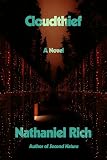


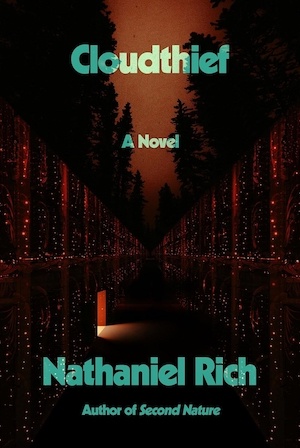
Here’s a book for people looking for a new take on the political thriller, beyond the familiar tropes of corrupt officials, property developers, police coverups and soulless oligarchs. Nathaniel Rich’s new heist thriller Cloudthief points its literary finger directly at the massive data centres working toward accumulating, analysing and redistributing all human knowledge. They are the physical embodiment of the cloud. Data centres are where all the details of daily life, of business planning, of government operations reside. Along with their secrets.
The construction of these silicon hubs is increasingly opposed by local communities because of their electricity and water demands, their noise and hefty footprints. This book explores more serious underlying flaws in this infrastructure, when an unlikely pair of activists decides to take direct action against them. It’s narrated in the first person by Tim, a disillusioned climate journalist who feels all the eco-trends are going the wrong way.
The story begins when Tim is persuaded by his artist friend Ces, ‘an inveterate conniver and hustler,’ to participate in exploiting the poor security at a Manhattan mini-storage facility. All sorts of people have stashed their temporarily or permanently unwanted goods there and, except for paying the rental fees, largely forgotten about them. Ces believes there’s money to be made in creative reselling. He’s not wrong, but the duo uncovers something far more intriguing – a woman named Virginia living in one of the tiny units.
To say Virginia is quirky is to say the sun is hot. Soon, it becomes her plan to move Tim up from storage-unit theft to the big leagues. She wants them to hit a data centre in Oklahoma, which isn’t well-guarded and where they can lift several decommissioned servers. All the data about government, business and private transactions and intentions are in there, along with a tsunami of useless information as expected. This could be the big haul. Those secrets.
Where the big bucks will be, Virginia insists, is when those data are used to play the prediction markets. She knows how prediction markets work and how pervasive they are, allowing people to bet on an infinite array of real-life events as varied as elections, sports outcomes and economic trends. Virginia believes the secrets on the purloined servers will let her practice her own form of insider trading on a geopolitical scale.
She believes her plan will work because governments and businesses decided to save the cost of gearing up for storage, and transferred that responsibility to data centres. In the process, they inadvertently lost control. It’s a pleasing parallel in this story to the way overburdened householders send their excess stuff to the mini-storage centres, like the one she inhabits. As with an unwanted set of china, data that are out of sight are out of mind.
The narrator directly addresses the reader occasionally, but it’s not immediately clear whether this is a generalised ‘you, the reader,’ or some particular ‘you.’ The answer, which eventually comes along, is a sadly sweet one. There’s a subplot concerning the narrator’s sister, afflicted with progressive hearing loss, which leads to a separate crime in some ways mirroring the Oklahoma heist.
Tim, the main character, is sympathetic, a bit bumbling, but you will want him to succeed. His friend Ces brings a lot of humour to the story, and Virginia, well, you probably have never read anyone like her. Brilliant and single-minded to a fault. She wants to stay off the grid and out of sight – no mile-wide trail of data following her – and is obsessive about the measures needed to achieve that. Yet, despite the technical nature of the problems Tim and Virginia encounter, author Rich presents this story clearly and persuasively. There is fine writing here.
If the full criminal potential enabled by poorly guarded data centres, prediction markets and the massive collection and storage of every type of information has only begun to be appreciated, this novel does us a service in revealing some of the risks of these developments. This highly entertaining book is one you won’t soon forget.
Rich has won major prizes for his science writing, is a writer-at-large for the New York Times Magazine and a regular contributor to The Atlantic and others.
Also see The Exploit by Daniel Scanlan or London Rules by Mick Herron.
MCD
Print
£26.99
CFL Rating: 5 Stars