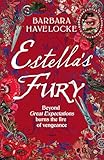


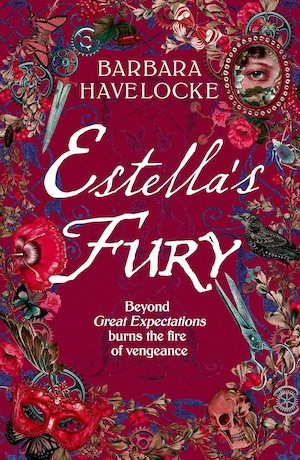
Not only are the works of Charles Dickens rich in atmosphere, they’re full of unusual characters that beg further exploration. PLEASE, SIR, CAN WE HAVE SOME MORE? Barbara Havelocke is an author who has heeded the call — and then some. Estella’s Fury follows on from Estella’s Revenge, with the author giving us a new perspective on Estella Havisham – a deliciously twisted character, plucked from Great Expectations. Along the way, she mixes in some 21st century themes. Let’s see if it works…
As a young girl, Estella was adopted by Miss Havisham and brought up to display the impeccable manners of a Georgian lady among the upper-most upper crust of society. She was also more or less conditioned to hate men and to become the instrument of revenge for the elderly spinster who took her in. Havisham, remember, was a woman cruelly jilted at the altar and who over the years became increasingly bitter, disappointed and vengeful. In the Dickens novel, she used Estelle to bait and torment the young boy, Pip.
In Havelocke’s reimagining we meet up with the adult Estella, and at this point she is unhappily married to Drummle. She carries the trauma of her childhood experience at Satis House with her. It forms part of Havelocke’s psychological portrait of the grown woman, an amplification of what Dickens gave us.
Life has not been kind to Estella. She is in London and it is 1835. One year prior, she fell for the dashing gentleman Bentley Drummle, a charming socialite. Things changed after they married; his real character was revealed and he became an abusive husband. Estella suffered but was not willing to put up with his behaviour permanently. So – slight spoiler for the first novel – Estella acted and now she carries a certain amount of guilt for what transpired. It weighs on her but there were mitigating circumstances.
Remarkably, Drummle wasn’t the victim but he is now a prisoner in his own house – chained up in the attic! The tables have certainly turned in this relationship and Estella has a dark secret. To escape the house and gain some thinking time, she visits her friend Elizabeth at Wynterton House. Elizabeth is the wife of Sir John Taykell – a match Estella had no small part in arranging. But rather than finding sanctuary, she walks into even more trouble.
When she meets Elizabeth, Estella knows something is wrong. Firstly, there’s something odd about the servants’ behaviour. Then she finds out one of the maids recently left without giving notice, which means scullery maid Nora must now act as Estella’s lady’s maid. The pair get on and Estella helps the young woman to adapt to the elevated role. Eventually, Estella knows she will have to go home to deal with her husband – but before she leaves, Nora goes missing too.
The housekeeper, Mrs Switcherly, says Nora was unhappy and fled, but that wasn’t the impression Estella got about about a girl who seemed to like her new responsibilities. Something must have happened to bring this about. In her brief time at Wynterton, Estella came to care about Nora. She leaves to deal with her chained up husband but has Nora’s plight on her mind too. She is fiercely determined to the bottom of what happened.
This is a slow burn read, one in which the crime doesn’t exactly confront you; instead it smoulders in the background with a lingering sense of wrongdoing permeating the pages. Estella gradually reveals her personality and view of events. Understanding what is happening, she is an advocate for those who suffer abuse in her world – namely women and children. We see beneath the veneer of respectability that masks the bad behaviour of so-called gentlemen in 1830s London. What really goes on behind closed doors?
Estella’s voice reveals a woman keen to address the problems the women face, commonly caused by male entitlement and misogyny. The novel touches on sex trafficking and child labour, and the sham of what we now call Victorian values, although the book takes place two years prior to Victoria’s ascent to the throne. Yet it is also a reflection on issues that are relevant today. Despite her sense of justice and fair play, Estella is still a woman of a certain class, and the way she reflects these attitudes and the times rings true.
The author has fun riffing on Dickens, not just through characters from Great Expectations but also the themes of Bleak House and other novels by him. This is an enjoyable and plausible take on Estella. There is a clear sense of reasoning behind her behaviour, in a world that really is full of bad men. Some may not like the purloining of Dickens’ characters but Havelocke does it well and with purpose. I was taken in to Estella’s world and her marriage to Bentley Drummle, which I haven’t really commented on, and it’s an interesting story in its own right.
Certain elements will run into the next novel. There are further details of Estella’s life in Dickens that Havelocke may work on, broaching serious topics while having fun along the way, honouring a great literary tradition while giving us a fresh perspective on 19th century society. It’s not a traditional crime novel and this may not be everyone’s idea of a seasonal story but it works for us, drawing on darker rather than cosy mystery sensibilities.
Read our interview with Barbara Havelocke here.
Hera Books
Print/Kindle/iBook
£5.99
CFL Rating: 4 Stars