

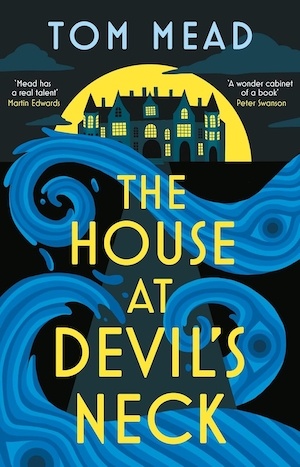
The influence of Golden Age mysteries on modern crime fiction is huge. Readers simply cannot get enough of the closed-circle murder mystery and the locked-room puzzle – archetypes handed down from Agatha Christie and John Dixon Carr through generations of writers to the new kids on the block. No one knows the tropes and tricks better than Tom Mead, a scholar of Golden Age crime fiction. Can the locked-room mystery still be exciting and ingenious? Can it be original? Lets find out with The House at Devil’s Neck.
This is the fourth outing for illusionist/detective Joseph Spector, who is brilliant on stage and off, though very much out of the theatre on this occasion. It’s August 1939, the eve of World War II, as a small group of passengers assemble in London for a coach journey that will take them to a haunted mansion at an isolated spot called Devil’s Neck. The building was used as a World War I field hospital and the spirits of its patients are said to roam the corridors.
In fact, the mansion has a controversial history dating back to 1640 when it was built by Adolphus Latimer, a man with a reputation among the locals as a mystic. During the English Civil War it was the site of a witch trial that saw 46 women slaughtered.
Among the travellers is sceptic Joseph Spector, who has seen the charlatans up close but cannot resist the adventure. Francis Tulp considers himself to be a scientist, an investigator of phenomena, formerly a member of the Occult Practice Collective. The others include Imogen Drabble, who described herself as a writer, and Madame Adaline La Motte, a medium.
Back in London, Scotland Yard Inspector George Flint has a strange case to deal with. It relates to the very first investigation he worked on a quarter of a century earlier. The Aitken Inheritance case began with the sinking of the Titanic in 1912. Financier Dominic Edgecombe was feared lost and so, following the tragedy, the family inheritance passed to younger brother Rodney. Then, in 1914, Dominic turned up but Rodney denied this man was his brother in court. He was in debt and could not afford to lose the fortune henwas already spending his way through.
Dominic committed suicide before proof emerged that he was in fact who he said he was, in 1917. Now it’s 1939 and Rodney Edgecombe has threatened his valet and secretary with a gun before locking himself in his office. As the police arrive a shot is heard. On entering the room they find the man dead, an apparent suicide.
The group arrive at the house, connected to the mainland by a causeway. A seance is held to invoke the ghost of a soldier when a storm sets in and the guests are cut off from the wider world. It is not long before the group is thinned out by mystifying and improbable murder.
Naturally, the two cases are connected. Mead employs his extensive knowledge and invention to create an ingenious story, and manages to reach a level of originality that proves both locked-room and closed-circle are as exciting as ever in his hands. They can even work hand-in-hand, which he achieves in The House at Devil’s Neck.
There are so many good things about this novel. The coach journey is a brilliant way to introduce the cast and have them get to know each other. The first clues are set out and fold us gently into the story. It contrasts with the racy start of the London murder that instantly taxes the grey cells.
This is a masterclass for the puzzle-loving reader. There are a few footnotes toward the end of the book, some will love this, others may not. They are easy to ignore. John Dixon Carr would love the cleverness of Mead’s books. He creates intriguing outlier characters and Spector is fun to spend time with. The spooky atmosphere suits the narrative so well. This feels like the most accomplished novel in the series to date. To be enjoyed and admired.
For more early 20th-century mysticism see the tales of Minky Woodcock by Cynthia von Buhler.
Head of Zeus
Print/eBook/Kindle
£5.03
CFL Rating: 5 Stars