

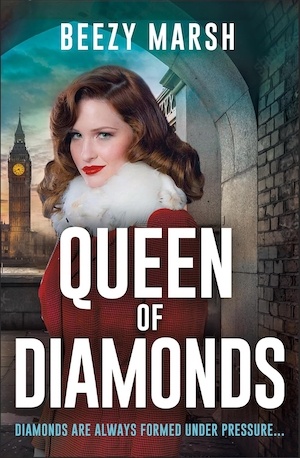
This is the third in Beezy Marsh’s trilogy inspired by a real-life female shoplifting gang that operated in London in the first half of the 20th century. The first two books, Queen of Thieves and Queen of Clubs, dealt with the gang’s activities during their heyday in the 1940s and 50s. Now we have an origin story, telling us how their leader – Alice Diamond – got her dubious start two decades earlier.
Alice, the future Queen of Diamonds, is an orphan working long, hot hours in Pink’s Jam Factory. Aspiring to a better life, she shoplifts little indulgences for herself on her off-hours – silk stockings, colourful scarves, and the like. In this story, poor children start out as diminutive thieves by necessity, stealing a bit of food, which their families have not nearly enough of. It’s a grim environment in the Elephant and Castle neighbourhood, 1923.
Alice’s story is interspersed with that of Mary Carr, another legendary leader of a real-life shoplifting gang whose career began several decades earlier. Mary grew up in what was then one of London’s most notorious slums, Seven Dials. In Marsh’s story, Mary is noticed by a Mayfair lady out slumming. She’s looking for subjects for her paintings of dirty, downtrodden, poverty-stricken children and finds Mary a perfect model for her art.
By inviting the girl to her home and studio, the condescending Lady Harcourt exposes Mary to a completely different life, whetting her appetite for better things. Mary soon realises she’s treated completely differently when wearing Lady Harcourt’s daughter’s hand-me-downs than when dressed in her own dirty rags. From that point, there’s no going back. What’s more, from exposure to Lady Harcourt, she improves her speech patterns. Increasingly well-dressed and speaking posh, she and her mates can be accepted in the most elegant shops where they prefer to steal.
Alice and Mary’s histories parallel each other closely – their impoverished, neglectful childhoods, their similar friends and soon-to-be gang members – and their targeting of luxury goods. They both aspire to the furs, jewellery and fine things they see wealthy ladies wear. That their desires never go beyond material goods, even if of the finest kind, reflects what they feel most deprived of. Alice was known for sporting several diamond rings, which, when trouble breaks out, serve as a high-class version of knuckledusters.
Author Marsh evokes sympathy with her descriptions of the girls’ sordid living conditions and unambitious, resentful family members. It isn’t surprising that they aspire to glamour beyond the understanding of the people they grew up with. What’s remarkable is that they are brash and determined enough to get it. Both women manage gangs of equally desperate, yet loyal young women and foster clever ways to steal. Both gangs bear the sobriquet ‘Forty Thieves’. Eventually, both women run into trouble with the authorities and endure harrowing experiences in British institutions. Along the way, Alice and Mary encounter and overcome numerous obstacles and difficulties and discover occasional unexpected allies.
In fact, the stories of Alice and Mary are so similar, it was an occasional challenge to keep their histories separate. Inadvertently (I think), this demonstrates how little progress for women’s social status had occurred between the latter decades of Queen Victoria’s reign and the decades after World War I. Poor women continued to be victimised by employers, police and institutions, while being treated with indifference by the upper classes. Who wouldn’t want to forge a path through that forest of daily indignities?
All that is fairly sociological. What about the story? It never flags and rests on the tremendous strength of the characters Marsh has created in Mary and Alice. She gives them considerable Cockney slang, which, even if when I wasn’t absolutely sure what a particular phrase means, didn’t impede understanding the gist. Their manner of speech and their cheeky attitude contribute to their strong personalities, and for me it was easy to become absorbed in their ups and downs.
Mary and Alice chose a risky strategy to escape their origins and mostly, and for a considerable time, carried it off. Marsh effectively conveys the London milieu in which they operate, and it tallies with how I at least think of the city in those times. She puts us right there, fingering those silks, decorating those bonnets, and running for our lives when the coppers appear.
Also try The Innocents by Bridget Walsh.
Orion
Print/Kindle
£9.97
CFL Rating: 4 Stars