

Christmas Eve, 1943. Bored and depressed at spending the War working in a Birmingham munitions factory, Anthony Pratt looks forward to finishing his nightshift and then travelling with wife Elva to the Tudor Close Hotel in Rottingdean, a village outside Brighton. Before World War II, the couple made a living providing music and entertainment at imposing country houses and grand hotels, hobnobbing with the likes of Bette Davis, Cary Grant and Basil Rathbone.
Those days seem to be long gone, but the communiqué they received from the hotel’s manager promises a last hurrah before Tudor Close is fully requisitioned for the war effort. To help celebrate the holiday season, Anthony is to play the piano in the hotel dining room each evening and the Pratts are to spend the rest of the time running a murder mystery game for the guests – Mr X, in the X room, with the X… That kind of thing.
If this setup sounds familiar, it should do – it’s the backstory to the creation of Cluedo (Clue in the United States), the classic detective game. The game really was invented by Anthony Pratt during World War II, inspired by his love of detective fiction and by the murder mystery parties he used to attend with friends, and the design of house that serves as the setting for the murder really was based on Tudor Close.
However, in Nicola Upson’s festive version of events, the unfortunate victim isn’t Dr Black or Mr Boddy; rather, it’s Miss Silver, Rottingdean’s only tobacconist and confectioner. The Pratts discover her in the stockroom, apparently beaten to death with her own walking stick, when they stop in to collect some cigars on their way to the hotel. The police are quickly on the scene and suspect the incident to be a burglary gone wrong.
Allowed to go on their way after some cursory questioning, the Pratts arrive at a Tudor Close that is quite different from what they remember. Half the hotel has been taken over by the Canadian Army, while the other half is decidedly down at heel. The manager doesn’t even have sufficient funds to hire actors for the murder mystery, meaning that the Pratts will have to try a different approach, provided they can tear themselves away from solving the real-life murder, of course.
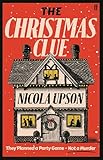
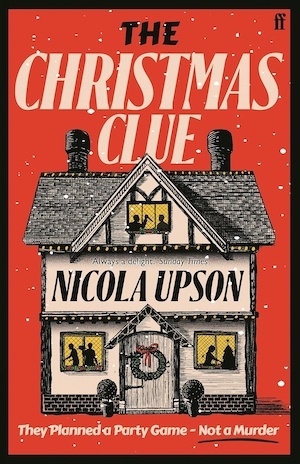
The Christmas Clue is a wonderful tribute to both classic crime fiction and Christmassy crime fiction, two of the best means of becoming a corpse. Nicola Upson’s decision to base the mystery around the creation of Cluedo is an inspired one, adding an extra layer of intrigue and a welcome dose of nostalgia. Aspects from the game are integrated throughout the story, which leads to some great aha moments too.
The country house hotel setting is perfect for a seasonal whodunnit. In addition to reflecting the layout of the boardgame, the mishmash of rooms and draughty hallways of the remodelled and repurposed Tudor Close provide an intriguing landscape for the detectives and their suspects to navigate, as does the nearby village and adjacent church, complete with graveyard.
The period touches are also spot on, from Anthony’s regret about not being able to fight, to the many memories of how much better life was before the War, to all the practical difficulties and privations due to the wartime conditions. In particular, the presence of the Canadian soldiers provides organic opportunities for the Pratts to reflect on cultural and racial issues of the time.
The idea of people spending the holiday at Tudor Close as a way of recapturing the past and avoiding the present neatly reflects the sense of escapism often associated with boardgames such as Cluedo. Naturally, it proves impossible for anyone to escape the tragedies of war and the home front, although pretty much everyone present at the hotel is hiding (or hiding from) something, meaning there is no shortage of suspects.
The fact that Christmas 1943 is a white Christmas in Rottingdean adds to the atmosphere of the story and provides a plausible explanation for why the murder of Miss Silver does not lead to a greater police presence and more active investigation in the local area – space has to be left for the amateur sleuths to operate, after all. Plus, all the trudging about in the snow and resting by the fireside adds a deceptive sense of cosiness to proceedings.
And it is important to emphasise the deceptive aspect now that the ‘C’ word has been raised – in this case ‘cosy’, but ‘Christmas’ is also applicable. While Christmassy crime and cosy crime have become synonymous, for all its festive elements The Christmas Clue is no cosy mystery. In fact, beyond the fact of Miss Silver’s bludgeoning, the puzzle that the Pratts must unravel is a dark and disturbing one.
Still, the devious twists and turns that Upson has contrived for them to follow mean that the puzzle mystery is complex and nigh on unguessable. It’s arguable as to whether she plays fair in the Ronald Knox sense, but Upson certainly makes the Pratts committed clue followers who are sufficiently suspicious of all they meet. They do stumble after encountering at least one hurdle that commonly plagues amateur sleuths, but their investigative exploits remain entertaining and convincing.
The Christmas Clue is a short but impactful and enthralling murder mystery. Whether it’s the candlestick, the lead pipe, the rope or some other implement under the tree, there is plenty to unpick concerning the murder of Miss Silver and the multivarious peculiar goings-on at Tudor Close.
For more Christmassy crime fiction, try something from among these Christmas crackers.
Faber & Faber
Print/Kindle/iBook
£4.49
CFL Rating: 5 Stars