

 Written by Edmund Crispin — Between 1944 and 1977, Robert Bruce Montgomery wrote a string of novels under the name Edmund Crispin. Today he is considered to be one of the underappreciated masters of the Golden Age of crime fiction. His novels featuring eccentric Oxford professor Gervase Fen were always witty and literate, and Frequent Hearses is one of the picks of the bunch.
In this, the seventh in the series, Fen visits a film studio to advise on the production of a biopic of poet Alexander Pope. It may be difficult to conceive of a Pope biopic being produced in 1950s London, but it does allow for some of Crispin’s trademark humour and literary knowledge to flourish. The novel’s title is from one of Pope’s poems about people dying left right and centre.
While Fen is advising on the production, young starlet Gloria Scott throws herself to her death from Waterloo Bridge. Fen has no reason to suspect anything other than suicide, until it becomes clear that Gloria Scott was just a stage name, that she was pregnant and that someone has searched the young actress’ apartment and tampered with the corpse to remove any hints as to her real identity. A lecherous cameraman is then found poisoned, and tests confirm it was murder. But what, if anything, links the two deaths? Of course, Fen is the man to find out.
The book’s main strength is in its representation of the film industry in post-war London, an industry which the author was familiar with from his day job as a writer of musical scores. This representation is far from friendly, and in fact the infighting and the darker side of the industry feature heavily as the plot and the links between each of the deaths unfolds. Like in The Glimpses of the Moon, Fen takes a slightly more back seat role than in earlier novels, although his witty repartee is still a central feature of Frequent Hearses. There are moments when this novel is clearly stuck in 1950, when it was published, most obviously in its representation of women. If you can put this aside, and the fact that large sections of the plot are quite difficult to believe – particularly an epic chase scene – you’re in for a very enjoyable read, perfect for any lover of the golden age.
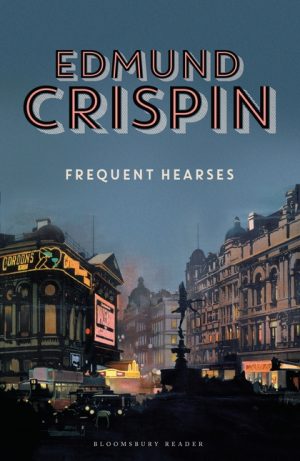
I’d hesitate to recommend this as the starting point for those unfamiliar with the novels of Edmund Crispin – you are probably best off reading them in order, starting with The Case of the Gilded Fly. But those who enjoy intelligent, literate Golden Age crime fiction would certainly do well to read through to Frequent Hearses and beyond. This new paperback edition comes from Bloomsbury Reader with a period cover image. You might want to read it with a dictionary at the ready – Crispin uses words you may not encounter every day. Or any day, really. The language is part of the fun and if you like a writer of intelligence and wit, as well as a certain irreverence, you’ll do well to delve deep into Crispin’s oeuvre.
Bloomsbury Reader
Kindle/Print/iBooks
£4.68
CFL Rating: 4 Stars