


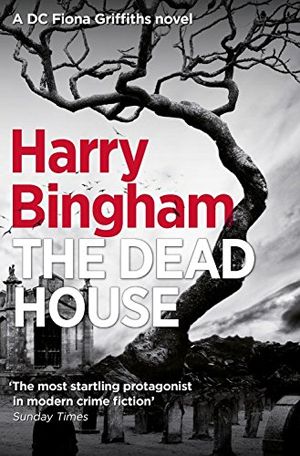
 Written by Harry Bingham — The body of a young woman is found in the annexe of a tiny church in the sleepy hamlet of Ystradfflur, deep in the remote Welsh countryside. The room has a history going back to medieval times and was a ‘dead house’ where bodies would be left following death and before burial.
The corpse is laid out neatly. She is wearing a thin summer dress, though it’s a cold October night, and holding a bible. There are no signs of trauma. It’s as if the woman has simply fallen asleep. Is there a case here at all?
DS Fiona Griffiths is at a loose end. A major case she was on is wound up. She manages to get herself seconded to the dead house investigation, working closely with DI Allun Burnett, the detective normally covering Ystradfflur and the surrounding area. Griffiths sees a case where others do not.
Her investigations lead her to a secluded monastery. The resident monks live a simple life and offer respite to those who need it. It seems the dead woman may have spent some time in solitude there. Griffiths interviews locals and discovers the corpse in the dead house isn’t the only major crime to occur in these parts. Just three miles away 16-year-old Bethan Williams went missing, presumed raped and murdered by a local man, Len Roberts. At the time no evidence could be found to convict Roberts and he still lives in the area, near to Bethan’s father. Griffiths believes the two events are connected and digs as only she can…
We have previously reviewed the previous books in Harry Bingham’s series including Talking to the Dead. That review said, “In a lifetime of reading crime fiction I have never come across anyone quite like Fiona Griffiths…” In fact, that has been used as a testimonial on the jacket of The Dead House, and I can’t disagree at all with the quote. This is a quite brilliant novel and Griffiths a superb protagonist. But why, what makes this novel stand out so much?
First, the prose – it’s relatively straightforward. You don’t need to Google any strange, rarely used words to get through it. However, this simplicity belies the intelligence in the narrative. There’s a languid genius to it. The narrative trots along in one of those stories where it’s worth reading every word. Bingham produces an immersive atmosphere that the you really should take the time to wallow in. Like a mud bath, even when you step out of the novel some of it clings to you.
Second is the characterisation. The standout is Griffiths herself, a woman who acknowledges her own strangeness, her own difference to the rest of us. It’s like she looks at the world with her head tilted to one side, seeing what we see, but a little differently. She’s a superb creation, there’s no other way of putting it. Periodically Griffiths will drift off into her own little world, how she considers the case, what she should do next. Also, she tackles aspects of her private life that aren’t anything to do with the investigation but they’re fantastic little windows into her mind.
Like many police characters, Griffiths is damaged and can’t quite hide it. However, even this is atypical. She was adopted at the age of two, left in her parent’s car for them to find. Who is she really? And is this why she is so odd? We don’t know, and neither does she. A delicious secret.
This different visual angle comes through constantly. For example a character brings through a pile of documents and she describes feelings of the paper itself, what it must have experienced. As The Dead House is written in first person you get to experience this for yourself – clever, clever use of writerly tools.
Griffith’s supporting cast is just as important and nearly as quirky. The most valuable of these is DI Burnett, who doesn’t get much about Griffiths (who could?) but understands her well enough to let her do things her way.
The style is a mix of short, clipped sentences, often just single lines, or ultra brief statements in particular phases of narrative. It gives the impression of Griffith’s breathless thoughts. For example when she is with the body at the opening – she describes it as a beautiful event – it’s all she can do to squeeze out the words. Brilliant.
Only one issue stands out after this novel: why aren’t Harry Bingham’s books number one on every chart?
This is the fifth Griffiths novel, it can absolutely be read as a standalone. There are occasional references to past events, again they are so well done they simply add to the mystery, rather than creating a hole. I, for one, will be going out and getting the others. Immediately.
So should you.
Click here to discover the other books in the series and what we said about them.
Orion
Print/Kindle/iBook
£6.99
CFL Rating: 5 Stars


Sounds a sensational thrilling read
Can’t wait to read