

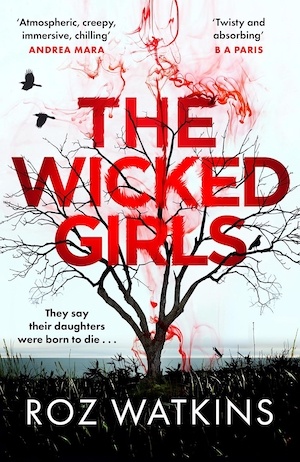
It was back in March of 2013 that I read and reviewed The Wicked Girls by Alex Marwood here on Crime Fiction Lover. It was that author’s debut and proved to be one of those books that never really leaves you. So a little bell rang in the back of my mind when Roz Watkins’ novel landed on my doormat – it appears that, 13 years on, there are still wicked girls stalking the crime fiction universe.
In her book, Roz Watkins takes us to the Cornish village of Peneerie, a place with a history that appears to be repeating itself. About 200 years ago Eliza, a teenage serving girl at a local manor house, jumped to her death from the cliffs. She left behind a curse that the girls of the village would not get past their 17th birthdays. Spooky.
Jump to the present, and a group of friends from the posh local school are all about to celebrate that milestone – or are they? Because two of their number take their own lives by leaping from the spot made famous two centuries ago. Is it a curse? Suicide contagion? Or teenage girls reaching the end of their tethers? Whatever’s really happening, Kat is determined that her daughter, Ruby, won’t be the next to die.
Kat has pretty much a hate/hate relationship with Peneerie. Her husband left her, leaving Kat with a huge mortgage and a house with continual mould and damp problems. The garden seems to have some kind of water course runnng through it and it’s an ever-losing battle to stop the mud from taking over the few hardy little plants that have survived thus far. And then there’s the sea. Kat REALLY hates the sea, and as the house is on a clifftop it overlooks the briny in all its moods and shades.
Why then, hasn’t she left, taking Ruby with her? They’re in negative equity, and Kat is currently working three jobs just to make ends almost meet. And Ruby has her friends and doesn’t want to leave them. So, Peneerie it is.
This is a story told from two perspectives: That of an overwrought mother, whose mental health appears fragile and whose relationship with her beloved daughter is on a knife edge; and the more sanguine Ruby, battling all the usual hormonal issues and peer pressure to be expected of teenagers her age. Of the two, Ruby seems the more grounded and sensible until she and her friends try out a ouija board in the derelict old house where the fated Eliza once worked. Suddenly things go off the rails in tragic fashion.
This is an eerie and disturbing read, with the darkly claustrophobic atmosphere of a horror story and some edge-of-the-seat moments that will have you jumping at any unexpected sound. Watkins has developed a scarily authentic set of teenagers here, who are not only trying to cope with the trials and tribulations faced by all young people across the decades, but also the very modern issues of social media, toxic masculinity, fake news and cyberbullying.
The backdrop to all of this is the wild Cornish coast, offering echoes of everything from Daphne du Maurier’s Rebecca to the much more contemporary The Lost Women by Tim Weaver. What is it about Cornwall that draws people to write about it, and to do the job so well? Here, Watkins paints in even the smallest details, from the insularity of the local pub to grated up, long forgotten tunnels, all covered in a liberal coating of sea spray and buffeted by the unrelenting winds. The changes of pace can feel a little disorientating – early chapters seem to drag a little, even though they are short – but the story is strangley immersive and once I got into the reading flow it was hard to put this one down.
HQ
Print/Kindle/iBook
£9.99
CFL Rating: 4 Stars