

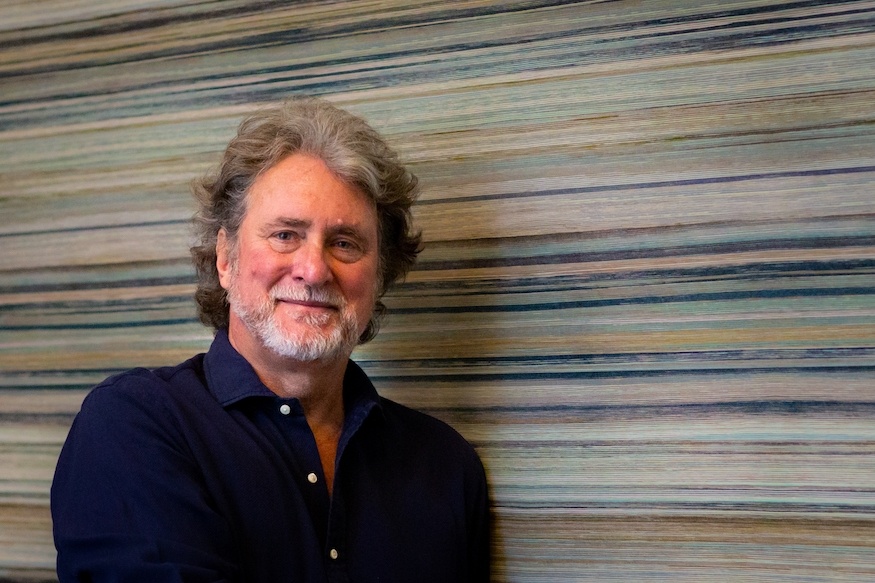
If I was sitting in a bar or a cafe, and I met Mark Grenside out of the blue, the first thing I’d say to him after getting to know him would be: “You should write a crime novel.” Definitely.
Originally from London, he first worked in insurance for Lloyds, specialising in kidnap, ransom and product extortion insurance. I mean, there’s 20 books right there. But then, he shed the suit and went to work with Jim Henson, whose famous studios created The Muppets and The Dark Crystal. Taking that experience, he became a producer and worked in talent management. See – plenty more grist for a crime novel mill. And to round things off he worked in some top-level stuff – rights, channel distribution and so on, for example helping buy the Hallmark Channel and selling it to NBC.
The thing is, whether in a cafe or a bar, my advice to Mark would be completely redundant. He has actually written three novels already and two of them have just been published by Sharpe Books, along with a revised edition of Mark’s debut. The books comprise his Marcus Riley series, about a movie producer a little like Mark himself, who gets drawn into mysteries and adventures at locations around the world. It’s Hollywood action with character, colour, wonderful settings and clever twists to hook you in.
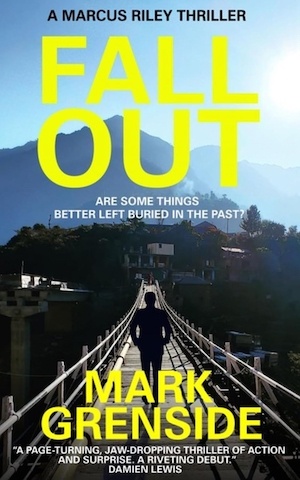
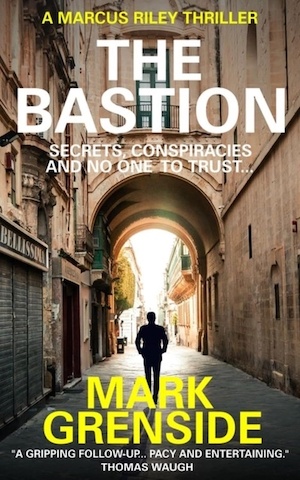
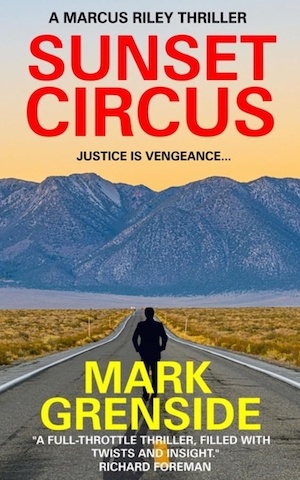
The first in the series is Fall Out, published in an updated format in August 2026. Alongside it, Sharpe released The Bastion and Sunset Circus. Reading them, you’ll go from the Philippines to the Nevada Desert with plenty of stops in between. Making films is hugely collaborative, and some would say cumbersome, so for Mark becoming a writer has been a chance to unleash his imagination, and take control of his characters. We asked him to tell us more about the series, how he’s developed it and what’s on the horizon…
What are crime fiction lovers going to love about the Marcus Riley thrillers?
Four things, I hope.
First, no one has really written thrillers set within the film industry, which works more like a proscenium arch: stories start with an event in entertainment but reveal something that has little to do with it, built on a nugget of history uncovered through research or my travels – I’ve visited over 120 countries.
Second, character and style: I write as if you’re watching a movie, short visual descriptions, snappy dialogue, entering scenes halfway through, which keeps the pace fast. I try to reflect that people are rarely totally bad, although a few I have created are. The interesting people are the souls that are neither black nor white, but grey.
Third, locations readers rarely see: the Aleutian Islands, the jungles of the Philippines, the Urals, the Cannes Film Festival and the maze of tunnels underneath Valletta.
Fourth, multi-layered storylines, sometimes centuries apart, woven together as the story progresses.
Who is Marcus Riley, what inspired the character, and how have you developed him?
There’s a dollop of me in there, but he’s far smarter, funnier and braver, flawed but in ways we all are, not by drink, drugs or a failed marriage like so many protagonists. His bravery is drawn out by his partner, Melinda ‘Mako’ de Turris, a Cannes event designer when they met, pulled together by a mystery that began on Marcus’s first shoot 20 years earlier. He brings out a better side in Mako, originally self-centred and living only for the present. They’re a team, but equals. The nearest comparison is Nick and Nora in The Thin Man series.
What’s he up against in each of the stories, in a nutshell?
As with all stories, they’re a journey for the lead characters.
Fall Out has a talent agent with a deep secret, a Philippine businessman whose loyalties are unclear, a recovering addict director making a comeback, an innocent-looking 60-year-old Filipino assassin, and a corrupt completion bond issuer. All involved in the largest single theft in the last hundred years.
The danger in The Bastion comes in many forms: the owner of a bank whose accounts contain nothing but harmless photographs, a former kidnap and ransom negotiator, an escapee from witness protection and a cyber black hat.
Sunset Circus involves a century-old crime family, led by a fearsome matriarch whose power was built on Romanov treasure and whose immunity rests on a secret that would change world history. Their dominance is threatened by their Bratva partners and that secret’s accidental discovery in a movie prop.
Who are some of the other interesting characters we’ll meet during the series?
There’s a long cast list, some carrying a smidgen of people I know, twisted enough that only I’d recognise them. If there’s a trait running through them, it’s that my women are as strong as my men. Fall Out features the widow of a stuntman and the ya-ya, or nanny, of a Filipino businessman, both pivotal to the plot. The Bastion involves the kidnap of the world’s foremost female action star, and Sunset Circus is led by a formidable matriarch.
What made you decide to set your stories within the filmmaking industry and what opportunities does that give you as a writer?
They say write what you know, and if you don’t, you’d better be a convincing liar. People are fascinated by Hollywood, so I lift the kimono a little on what it’s really like, though it’s only the catalyst for bigger stories. Fall Out opens with a stuntman’s death halting a shoot; The Bastion with the murder of a special effects editor; Sunset Circus with the death of a hobo who sold riddles on Venice Beach, though before his fall he’d been a prop buyer. The McGuffin behind each story has nothing to do with movies; it’s a tangential start to something larger.
What would you say your process is as a writer? Do you like to plan out your plot line, or do you just write and let Marcus and the other characters lead the way?
I start with the kernel of an idea and begin writing, asking myself three questions throughout: What would the reader least expect to happen? Does this ring true, both factually and in the characters’ reactions? And at the end of each chapter, do I want to find out more?
Like the films that are connected to each story, your mysteries take place in interesting and exotic locations around the world. How do these feed into the stories and contribute to the atmosphere of each one?
Location, location, location. It’s a key element, not just because readers usually know little about these places, but because the settings are almost always tied to the historical hook the whole story hangs on.
And what’s the balance like between the mystery and action aspects of the stories?
Character is action. Action for its own sake becomes boring, though having shot so many sequences myself, I understand it better than most writers do. A story must flow, led by a storyline into the tributary of mystery and action. And never forget surprise.
You recently updated Fall Out, the first one. What did you want to change and why?
It was my first book, and despite being edited, it was still overwritten. I’ve now completed six novels, and I hope I get better with each one. It needed some judicious pruning and chapter restructuring to speed up the story.
Which other crime books and/or authors have inspired you, and what are you reading right now?
I’m inspired by writing in all its forms, screenwriters as well as novelists. Raymond Chandler is the gold standard for technique, Frederick Forsyth for mixing history with fact, and Michael Crichton for sheer imagination. On scripts, William Goldman and Lawrence Kasdan take some beating. As for reading. I enjoy Damien Lewis’s books but right now I am in editing hell on book six.
What’s next for Marcus Riley, and what’s next for Mark Grenside?
Two more books are out at year’s end: Sympathy for the Devil (Australia and North Korea) and The Gaping Void (the Hamptons, Madeira, Timbuktu and Los Angeles). I’m also editing The Dolos Legacy (San Francisco’s Presidio, Panama, Los Angeles, Washington and China), while heavily involved in three businesses.
All three books can be ordered using the buttons below, or head to the author’s website, here.