
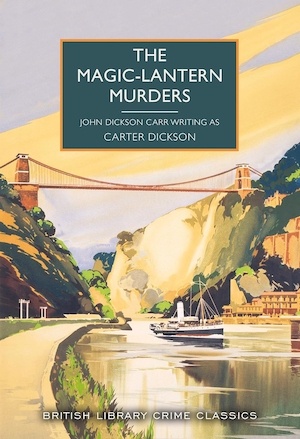
There are few writers more closely associated with the impossible crime than John Dickson Carr. Writing as Carter Dickson, he introduced Sir Henry Merrivale, one of the Golden Age’s most unconventional detectives, a man capable of turning even the most bewildering murder into an opportunity for theatricality.
The Magic-Lantern Murders was originally published in 1936 and was titled The Punch and Judy Murders in the United States. It is a particularly intriguing example of Carr’s work because, while it involves murder, espionage, deception and a suitably elaborate solution, it is as much an adventure comedy as a traditional detective story.
Events begin the night before Ken Blake’s wedding to Evelyn Cheyne, as featured in The Unicorn Murders. Blake has retired, at least temporarily, from his work as a government agent, and marriage offers an chance to leave danger behind. Naturally, this is precisely when Sir Henry Merrivale decides that Blake is indispensable for an urgent assignment.
Merrivale dispatches him to Devon, where a mysterious operation is unfolding around Paul Hogenauer, a scientist of German origin whose interest in spiritualism and occult phenomena has prompted suspicion. Before Blake can make sense of what is happening, however, Hogenauer is dead, apparently poisoned with strychnine.
Matters become even more complicated when a death occurs in Bristol under similarly suspicious circumstances. Blake suddenly finds himself caught up in a bewildering tangle involving secret agents, impersonation, strange scientific experiments and a criminal mastermind known only as ‘L’.
It is an astonishing amount to pack into a story whose events unfold over a remarkably compressed period. In his introduction to this new British Library Crime Classics edition, crime author Martin Edwards describes the novel as a race against time in which Blake must help solve the mystery while striving to make it back to London for his wedding.
That ticking-clock element gives the novel much of its energy. Carr continually throws obstacle after obstacle into Blake’s path, rarely allowing him to regain his bearings. And that is what differentiates The Magic-Lantern Murders from many of Carr’s more celebrated works.
Carr is famous for constructing apparently impossible situations that can actually be dismantled logically. Here, though, the puzzle is almost submerged beneath the action. Blake spends much of the novel being pursued, improvising, assuming fake identities and attempting to understand what exactly is going on.
The result is closer in spirit to a 1930s spy thriller or farcical chase movie than to a classic whodunnit. Still, that does not mean the mystery is neglected. Far from it. Carr scatters clues throughout the story, although many are disguised by the sheer absurdity of the surrounding circumstances.
His greatest trick is to highlight the wrong issues. The strange scientific elements, the rumours of espionage and the elaborate manoeuvrings of the characters obscure the central crime. When Merrivale eventually begins to impose order on the chaos, it is clear that the apparent madness has not been entirely random.
Merrivale can be an acquired taste, with his bullying manner, theatrical behaviour and apparent determination to make everyone around him as uncomfortable as possible. But Carr understood that his eccentricity was an important part of his appeal. Merrivale is not simply a detective who happens to be eccentric; he is almost a force of nature.
Interestingly, The Magic-Lantern Murders gives Blake considerably more room to shine than other Merrivale mysteries. He experiences the danger firsthand, and his increasingly desperate attempts to extricate himself from one predicament after another provide much of the book’s humour.
His situation is particularly amusing because of the contrast between the importance of his mission and his very understandable desire to just go home. Saying that, the novel’s humour is undeniably polarising. Carr’s comic style can be broad, and some of the antics are deliberately exaggerated.
There are moments when the story seems almost to be parodying the conventions of the spy thriller it is employing. Yet there is considerable charm in that abandonment of genre restraint. Carr is not trying to create a sombre meditation on espionage. He is having fun with the genre, and we readers are invited to join him.
The period atmosphere suits this approach. Beneath the increasingly improbable plot lies a fascinating portrait of Britain in the 1930s, when spy fiction could still trade on the fear of foreign agents and mysterious scientific developments while retaining the reassuringly familiar machinery of country houses, railway journeys and officialdom.
Yet the novel’s success really lies in masking what kind of mystery it actually involves. Is it a spy thriller? A comedy of errors? A murder mystery? A scientific puzzle? An impossible crime? The answer is all of the above. Carr keeps changing the emphasis, and that shifting focus is part of the entertainment.
The Magic-Lantern Murders is a mystery in which the killings may be serious, the espionage may be dangerous and the clues may prove significant, but the journey between murder and dénouement is gloriously chaotic. Carr takes Golden Age conventions, mixes them with spy lore, adds a generous helping of farce and then lets Merrivale sort through the wreckage.
The result is ingenious and frequently very funny. It may not be Carr at his most austere or intellectually rigorous, but The Magic-Lantern Murders demonstrates something equally valuable: his ability to make detective fiction feel like an exhilarating game in which the rules are constantly changing.
For more British Library Crime Classics, try Jack on the Gallows Tree by Leo Bruce and Airing in a Closed Carriage by Joseph Shearing.
British Library Publishing
Print/Kindle
£9.75
CFL Rating: 4 Stars