

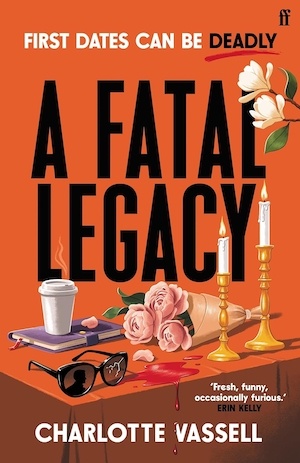
All is not well at the Horatio Combe Institute in Priory Square, Camden, London. And it’s not just the mokomokai who are looking peaky. Owner/operator Digby Coombe-Watson – descendent of notorious colonial pilferer Horatio Coombe – has been murdered. And on a rug rumoured to have been donated by Naser al-Din, then Shah of Iran!
The classic murder mystery has always been fascinated by the concept of inheritance. Not merely inheritance in the literal sense – the money, property and possessions passed from one generation to another – but inheritance as a broader social force: the traditions, prejudices, secrets and expectations that families leave behind.
From the country house mysteries of Agatha Christie to the more psychologically complex crime novels of today, the question has always remained the same: What happens when the past refuses to stay buried? It is a question Charlotte Vassell addresses in A Fatal Legacy when she returns to the world of Detective Inspector Caius Beauchamp with the fourth novel in the series.
Vassell understands the appeal of Golden Age crime fiction without simply attempting to recreate it. She recognises that the classic detective story was never really only about the mechanics of murder. At its best, it was a study of society: a way of examining the fault lines beneath apparently respectable communities.
When Digby Coombe-Watson, preoccupied with the future of his great-grandfather’s deteriorating property and whether he will actually be able to do anything about it, decides to ignore society’s unwritten rules and invite someone into his life – and home – the consequences prove fatal.
This is classic mystery territory: a seemingly contained event that gradually expands into something much larger. Vassell knows the importance of escalation. The best whodunnits do not merely add bodies; they deepen understanding of the world in which the crime occurs. Every revelation should alter perception of the characters and the relationships among them.
Caius Beauchamp is an intriguing addition to the long tradition of fictional detectives. He belongs to a lineage that includes Christie’s Hercule Poirot, Dorothy L Sayers’ Lord Peter Wimsey and Ngaio Marsh’s Roderick Alleyn: investigators whose appeal lies not just in their ability to solve crimes but in their ability to interpret the society around them.
But Beauchamp is not simply a nostalgic throwback. Vassell uses him to explore a world in which old social structures still exist but are increasingly unstable. He conducts his investigations among people who are accustomed to influence and protection, but who cannot necessarily protect themselves from exposure.
This is where the novel’s Golden Age influences become most apparent. Traditional detective fiction often placed a brilliant outsider into a closed community and asked them to identify the hidden corruption within it. Beauchamp fulfils that role, but with a contemporary awareness of the complexities involved.
As a result, he is a detective who is just as interesting away from the crime scene as when on the case. In fact, Beauchamp is an unusually likeable lead detective: intelligent without being smug, competent without becoming infallible and sufficiently self-aware to recognise the absurdity of his increasingly unusual circumstances.
Those circumstances have become considerably more complicated over the course of the series. Beauchamp’s unexpected connection to the aristocracy and inheritance provides an entertaining counterpoint to his career as a police officer, and here the tension between his professional and personal worlds becomes increasingly significant.
That gives A Fatal Legacy additional depth. Vassell examines not only who killed Digby but what inheritance actually means: what families preserve, what they conceal and what they expect subsequent generations to accept without question. The title consequently has broader resonance than the immediate question of who is responsible for the murders.
As quickly becomes apparent, legacies can be valuable, but they can also be burdensome. They can preserve memories, reputations and traditions while also preserving resentments, inequalities and old wounds. Vassell clearly has an interest in the way wealth (or the lack thereof) shapes behaviour.
Her characters inhabit a world where social connections matter, appearances are carefully maintained and reputation can be almost as valuable as money. These aspects are perfectly suited to crime fiction because they create the central conditions for a mystery: people with something to hide and strong reasons to do so.
Yet Digby does not appear to have had an obvious enemy, and the circumstances surrounding his death leave Beauchamp and his colleagues with more questions than answers. As additional victims emerge, the detectives have to establish whether apparently separate events are connected and, if so, what the common denominator might be.
For a murder mystery, A Fatal Legacy is rarely grim. Vassell has an excellent ear for social awkwardness and enjoys skewering the pretensions of the people who inhabit her characters’ world. Even when the subject matter becomes darker, there is usually some wonderfully dry observation or dialogue ready to defuse the tension.
The contrast between the seriousness of the crimes and the ridiculousness of some of the circumstances surrounding them is particularly effective. Vassell focuses on the mechanics of the investigation but also on the personalities of the investigators and the peculiarities of the society in which they operate.
DS Matt Cheung and DC Amy Noakes remain essential to the series’ appeal, and the dynamic between the three detectives gives the novel much of its warmth. Their professional relationship feels convincing precisely because it is not relentlessly solemn. They tease one another, disagree and have to adapt when circumstances force them to work differently.
That is the key reason why A Fatal Legacy works so well. Vassell has created a detective series that is about much more than solving murders. The mysteries are important, and this one is satisfyingly intricate, but the real enjoyment comes from spending time with characters who have continued to develop from one book to the next.
Faber & Faber
Print/Kindle/iBook
£7.49
CFL Rating: 5 Stars