

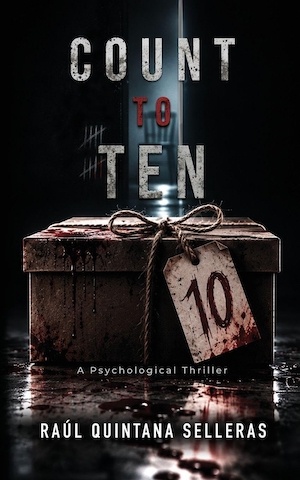
Some crime novels ask you to solve a murder. Others ask you to understand a murderer. Raúl Quintana Selleras’s Count to Ten does something more unsettling: it asks you to spend several hundred pages inside the mind of a man who has committed terrible crimes while simultaneously encouraging you to question almost everything he says.
The result is a dark psychological thriller in which murder, family, identity, guilt and obsession become increasingly difficult to separate. No attempt is made to disguise the identity of the Chaos Killer. The question is why and, perhaps most importantly, whether the killer’s carefully constructed version of events can be trusted.
It all begins with the murder of nondescript Vincent Perez in downtown Miami, a brutal killing that initially appears to be an isolated act of extraordinary violence. Perez is found horribly mutilated, with the Latin word unum, which means ‘one’, written on his forearm. For Ryan Morris, then a university student fascinated by criminal profiling, the case becomes an irresistible puzzle.
While his classmates are content to repeat theories about the victim and the possible motives, Ryan is interested in the evidence. His insistence on acknowledging what remains unknown establishes one of the novel’s key concerns: the difference between genuine investigation and the stories people tell themselves when the facts are inconvenient.
That dichotomy shapes Ryan’s subsequent career. Years later, he is a Dallas-based police officer tasked with investigating a series of murders that appear to be connected to the Perez case. The increasingly elaborate killings involve clues relating to numbers, language, classical references or seemingly insignificant objects.
The investigation provides Count to Ten with something approaching a traditional serial killer puzzle, but Quintana Selleras is less interested in a conventional police procedural than in the psychological consequences of the investigation. Central to that is Ryan’s relationship with his identical twin, Evan.
Evan is an artist whose paintings are celebrated for their disturbing imagery. He is arrogant, provocative and deliberately transgressive, but beneath his cultivated persona lies a more complicated character. His art draws on violence, suffering and death, forcing him to confront the possibility that his supposedly detached artistic fascination has deeper roots.
The contrast between the brothers is effective. Ryan is methodical, organised and self-confident, while Evan is impulsive, chaotic and driven by instinct. Yet the more that is learned about them, the less convincing that distinction becomes. Indeed, it becomes apparent that the brothers are not simply opposites. They are reflections of one another.
Ryan’s narration is consequently one of the book’s greatest strengths. He is intelligent, observant and often darkly funny, but he is also deeply unreliable. His contempt for other people is frequently uncomfortable, and his observations about society, the media, victims and the police are often provocative.
There are times, however, when Count to Ten pushes its characters’ intellectualism and philosophical observations so insistently that the story becomes more difficult to wade through than it needs to be. Ryan and Evan are certainly both fond of pronouncements about society, art, morality, religion and human nature.
Quintana Selleras sometimes allows these conversations to continue beyond the point at which the dramatic momentum has been established. The brothers’ tendency towards grand declarations can be excessive, but it does lead to some potentially interesting justifications of extravagance and murder.
The ambiguity concerning whether the focus of Count to Ten is simply Ryan’s story or the question of how persuasive a sufficiently confident psychopath can be works particularly well in the novel’s treatment of the media. The murders rapidly acquire the label ‘Chaos Crimes’, which develops into the more memorable ‘Chaos Killer’.
The name becomes part of the mythology surrounding the crimes. As the investigation grows, public perception begins to matter almost as much as evidence. People want a recognisable villain, a comprehensible motive and a satisfying explanation. Quintana Selleras repeatedly demonstrates how readily those things can be manufactured.
The structure of the story reinforces this theme. Count to Ten moves backwards and forwards through time, shifting between Ryan’s university years, his police career, the aftermath of his family’s tragedy and the present-day mystery surrounding the boxes left by the Chaos Killer. The purpose of these jumps gradually becomes apparent.
The past is not merely backstory. It is the mechanism through which the present is being manipulated. As Evan works through the ten boxes left for him, the story becomes increasingly claustrophobic. What begins as an investigation turns into something closer to psychological punishment.
And aside from the mental torture, Quintana Selleras doesn’t shy away from graphic violence. Some scenes are extremely explicit, and the brutality is occasionally stomach-churning. Yet the violence generally has a narrative purpose: it is tied to the killer’s theatricality, the victims’ significance and the recurring tension between art and destruction.
Count to Ten is not content to be just another serial killer thriller in which detectives chase an eccentric murderer through a succession of increasingly gruesome crime scenes. Instead, it asks what happens when the person investigating the crimes has a connection to them that he cannot — or will not — acknowledge.
And that leads to Quintana Selleras’s greatest success: his manipulation of you, the reader.
The opening of Count to Ten reveals the identity of the Chaos Killer, but that knowledge does not destroy the tension. If anything, it changes the nature of the suspense. You’re left wondering what has been omitted, distorted or misunderstood. You know the killer believes he is telling the truth, but you also know that it is his truth.
Quintana Selleras understands that the most disturbing mysteries are not necessarily those surrounding a corpse. Sometimes, the real mystery is the person standing beside the dead body – watching, interpreting and quietly deciding what the rest of us are allowed to believe.
See the Crime Fiction Lover interview with Raúl Quintana Selleras here.
Wicked Ink Publishing
Print/Kindle
£6.99
CFL Rating: 4 Stars