


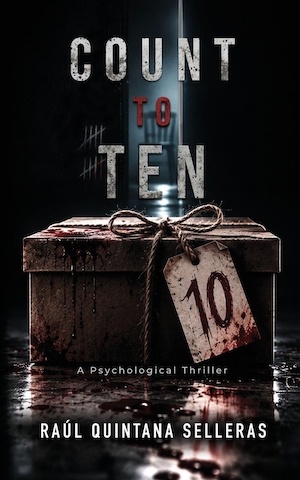
Having written plays, philosophy and award-winning essays, Raúl Quintana Selleras is a talented Cuban American author who has gravitated towards crime fiction as a new vehicle to explore some of the bigger questions we face as individuals, and as a society. The entertainment we get from reading mysteries and thrillers is obvious, but for Raúl it is also a place to explore concepts like freedom, morality, identity, guilt and even death. And that’s exactly what he does in his debut crime novel, Count to Ten, out 10 October 2026.
On the face of it, the story sounds a bit like Se7en, and it certainly journeys into a dark, psychological territory. However, Raúl’s story does more than sow worry and fear – it aims to question what we know about the world around us and the stories or theories we come up with when there are things we can’t know. For example, in a murder investigation.
Evan Morris is a Dallas artist whose career is based around shocking his audience. Now, however, he’s being held captive and each day, he’s given a box. Inside the 10 boxes that come his way are things that force him to confront who he is, and the stories he’s constructed around himself, his art and everything he does. Meanwhile, his brother Ryan is a cop wrapped up in the case of the Chaos Killer – an unpredictable serial killer who leads him this way and that. Is there a connection between the killer and his brother’s predicament? Well, you’ll have to read the book to find out!
Putting philosophical conflicts inside a crime story and adding suspense and feeling through the narrative is a difficult and intriguing aim for an author, so we decided to ask Raúl for more about his book. On the outside, Count to Ten a thriller, on the inside, it has the potential to offer so much more…
What are crime fiction lovers going to love about Count to Ten?
I hope readers will enjoy its combination of psychological suspense, moral ambiguity and an unreliable narrator who speaks directly to them. The novel presents a serial killer investigation, but its real mystery lies in understanding the characters: their secrets, competing versions of the past and the stories they tell themselves to justify what they have done.
Count to Ten also asks readers to participate rather than simply observe. The narrator addresses them directly, offering his version of events and inviting them to judge him – but he also tries to manipulate that judgment. Ultimately, the novel asks a troubling question: if someone explains the logic behind an unforgivable act convincingly enough, does understanding that person bring us dangerously close to excusing them?
Who is your protagonist, Evan Morris? What inspired this character and how have you developed him?
Evan is a successful but deeply troubled Dallas artist whose disturbing paintings turn violence and suffering into celebrated art. He is charismatic, impulsive and seemingly free, but beneath that confidence is a man carrying secrets he has never fully confronted. I developed him through contrasts: artist and possible monster, victim and offender, loving brother and destructive rival.
What is he up against in Count to Ten?
Evan awakens imprisoned in an abandoned warehouse, with no clear memory of how he arrived there. His unknown captor has left him ten numbered boxes containing objects connected to his past, and he must open them one by one to receive food, water and the possibility of survival. At the same time, the wider story follows the Chaos Killer, whose murders have devastated Evan’s family and drawn suspicion increasingly close to him.
There’s a strong concept behind the book with the then boxes Evan is presented with. Where did this idea come from, what’s in them and what do they represent?
The phrase ‘count to ten’ is usually associated with controlling anger, but I wanted to turn that comforting childhood instruction into something threatening. Each box contains evidence of a secret, betrayal, crime or loss from Evan’s life. Collectively, they strip away the identity he has constructed. They are both a countdown and a forced confession, leading him toward a truth he may not survive.
The setting is Dallas. Does the city play a role in the story, and how have you built the atmosphere for this thriller? What’s it going to feel like for readers?
Dallas offers a compelling contrast between polished prosperity and the darkness concealed beneath it. The story moves through galleries, affluent homes, police environments, stadium districts and anonymous industrial spaces, allowing the city to feel simultaneously expansive and claustrophobic. Readers should feel that danger can exist behind any carefully maintained façade – and that the apparent order of the city may be concealing chaos.
Are there any other important characters we’ll meet? Tell us more about them.
Ryan Morris, Evan’s identical twin brother, is a police detective investigating the Chaos Killer and serves as the novel’s narrator. Karina, Ryan’s wife, and Beatrice, their daughter, occupy the emotional centre of the brothers’ conflict, while Patricia McMillan – a theoretical physicist – becomes entangled in both men’s lives. Their mother is also important because the twins’ rivalry, resentment and need for approval began long before the murders.
Were there any bigger themes you wanted to explore, or was your focus more on building suspense and amping up the thrills?
Suspense was essential, but I wanted the thrills to carry larger questions. The novel explores whether freedom without responsibility is really freedom, how resentment can disguise itself as duty, and whether art can release our darkest impulses or merely give them another life. It also asks how easily intelligence and moral reasoning can be used to rationalise cruelty.
What are some of the crime fiction books and/or authors that have influenced you, and what are you reading right now?
My influences extend beyond conventional crime fiction because I am drawn to psychologically and philosophically complex characters. Dostoevsky’s Crime and Punishment is an obvious touchstone in its examination of guilt and self-justification, while writers such as Patricia Highsmith, Gillian Flynn and Thomas Harris demonstrate how compelling a story becomes when readers are placed uncomfortably close to a dangerous mind. At present, I am continuing to read across psychological crime and literary fiction, looking particularly for novels in which character and moral tension drive the mystery.
What’s next for Evan and what’s next for Raúl Quintana Selleras?
Count to Ten was designed to deliver a complete story, so saying too much about Ryan’s future would risk revealing where his journey leads. For me, the next step is continuing to write fiction that combines the momentum of a thriller with philosophical and psychological questions. I am especially interested in characters who believe they understand themselves, only to discover that they have been living inside a carefully constructed illusion.
Count to Ten is released in print and digitally on 10 October 2026. You can order a copy using our links below. You can visit the author’s website here.