

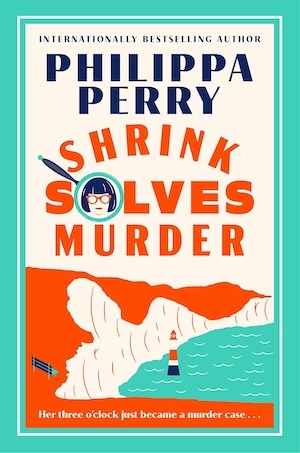
Shrink Solves Murder, the crime fiction debut from psychotherapist and bestselling writer Philippa Perry, recognises the appeal of placing intelligence, observation and human understanding at the centre of a good mystery rather than procedural mechanics or increasingly elaborate acts of violence.
The novel introduces Patricia Phillips, a psychotherapist living in Westlinke, a coastal Sussex town sandwiched between Birling Gap and Beachy Head. While Pat sees most of her patients via Zoom, the occasional one does make the trek down from London for an in-person appointment.
Henry Clayton was supposed to be attending his first such appointment at 3pm. Instead, the police knock on Pat’s door. Henry has been found dead at the foot of nearby cliffs, apparently the result of suicide. But something doesn’t add up. While Henry had been experiencing relationship problems, there were no signs that he intended to harm himself.
When the police prove quick to dismiss her concerns, as well as the results of her impromptu evidence-gathering, Pat’s professional instincts come in unexpectedly useful. In between yelling at irresponsible dogwalkers and protesting unsightly planning applications, she begins to investigate for herself.
Shrink Solves Murder is built on Perry’s incisive character work. Pat is not an exaggerated eccentric or an artificially quirky detective. Instead, she feels startlingly real: intelligent, occasionally prickly, perceptive, stubborn, compassionate and flawed in ways that make her instantly believable.
This authentic grounding is the novel’s greatest strength. Perry understands, perhaps more keenly than many established crime writers, that mysteries are rarely driven by plot alone. Crime fiction ultimately depends on motivation, whether it be jealousy, resentment, fear, insecurity, shame or ambition.
As a result, Perry pays close attention not simply to what the characters do but to why they do it. Even relatively minor characters such as the book group Pat crashes and the local publican feel psychologically coherent, behaving less like convenient plot devices and more like people whose actions emerge naturally.
Equally impressive is the novel’s bucolic setting. The Sussex coastal backdrop evokes the deceptive tranquillity so essential to this kind of mystery. Perry understands that picturesque settings often work best when contrasted with deeply dysfunctional social dynamics simmering beneath carefully maintained surfaces.
Still, despite dealing with death, suicide, trauma and manipulation, the novel never becomes oppressively dark. Perry maintains a good balance between seriousness and humour. Much of the latter comes from Pat, whose sharply analytical worldview creates plenty of understated comedy.
The dry wit is strong throughout the novel. This humour is not rooted in overt punchlines but in the absurd contradictions of ordinary human behaviour. It feels entirely consistent with Perry’s broader body of work, where insight into human psychology is often accompanied by a quietly mischievous sense of humour.
The supporting cast also contribute significantly to the novel’s charm. In particular, Pat’s chum and investigative companion, Pritchard Knowles, brings a whimsical energy that offsets Pat’s more controlled and analytical temperament, creating a partnership dynamic that feels warm and believable.
In fact, the interactions between Pat and Pritchard are among the strongest elements of the novel, recalling the classic detective fiction tradition of pairing a sharp and deductively intelligent investigator with a more socially fluid counterpart who sees and moves through the world differently.
The mystery is nicely complex without succumbing to over-engineered twists. Perry’s plotting is carefully structured, with revelations emerging logically from characters’ behaviour rather than arbitrary narrative reversals. In true Miss Marple fashion, Pat’s insights into human behaviour allow her to solve the crime long before the police.
Yet what makes the novel particularly interesting is how successfully Perry integrates her professional expertise without allowing it to overwhelm the story. It would have been easy for the book to become overly self-conscious about its psychological themes, leaning too heavily into therapy jargon or turning every interaction into an extended case study.
On the contrary, Perry exercises admirable restraint. The psychological observations enrich the story without dominating it, conveying the sense that Pat notices dimensions of behaviour others overlook without turning Shrink Solves Murder into a textbook disguised as entertainment.
Smart, funny and psychologically astute, the novel delivers exactly what the best cosy mysteries should: the reassuring pleasure of watching intelligence bring order to chaos. If Shrink Solves Murder is the beginning of a series, there’s bound to be a queue of folk keen to book their next appointment with Pat.
For more coastal cosy crime, try The Body that Floats by Jayne Chard and The Murder at World’s End by Ross Montgomery.
Crown
Print/Kindle/iBook
$17.10
CFL Rating: 5 Stars