

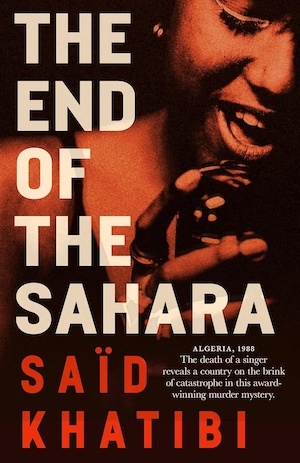
Translated by Alexander E Elinson — In The End of the Sahara, a murder mystery by Saïd Khatabi, the story of who killed Algerian nightclub singer Zakia Zaghouani is slowly turned and examined from all sides like a colourfully refracting glass ball. This is the first time we’ve reviewed Algerian crime fiction on the site, and The End of the Sahara may well be the first Algerian crime novel you’ve come across.
The story takes place in an unnamed Algerian city near the desert only about 25 years after independence, which followed on years of bloody conflict that left scars and disarray. The book opens in the days leading up to the October 1988 riots. Rumours of an impending ‘merchants’ strike’ and shortages of food, medicines and other necessities add fuel to the fires of unrest.
Investigating Zaza’s death is complicated. In fact, any number of people seem to have had at least some motive for the crime, and their private lives and blood relationships are hopelessly entangled. You’ll want to bookmark the list of major and minor characters at the back of the text.
Khatibi assembles an intriguing cast of characters. Ibrahim, whose desultory management of a video store produces little income, is worried that his constant shortage of funds won’t cover the cost of staying out of the military. Inspector Hamid, tends to throw people in jail and ask questions later, if at all. Maimoun owns the Sahara Hotel, the end of which is forecast in the book’s title, and believes Zaza was prepared to marry him. Kamal, the hotel’s receptionist, is the eyes and ears of the entire enterprise. And, most luckless of all, Bachir Labtam also expected to marry Zaza if and when his mother’s concerns about a stable future could be satisfied. He is immediately arrested as the chief suspect soon after Zaza’s body is found, despite the lack of evidence against him.
Among the women, Zaza herself has been playing a complicated game, pitting one man’s desires against another’s and spying for both her employer and the police. Zaza’s dogged mother Halima wants her daughter’s killer brought to justice, and rails against the inspector’s slow progress. Noura Arkoub, Bachir’s cousin, is his defence lawyer and is investigating the crime herself. She’s puzzled and disappointed that men don’t find her more attractive. Safia Bechiche, also a singer, is Zaza’s rival at the Sahara.
The various short scenes in the novel rotate among these and a few other characters’ points of view. From this approach, you gradually assemble a well-rounded picture of the community, with all its ambiguities and uncertainties. That and the strong sense of place are what stand out most about this novel. I did consult the list of characters at the end rather frequently and experienced a little momentary confusion here and there, in part because some of their motives and actions are deliberately obtuse.
Misogyny is near-universal among the novel’s men, and most of the women have suffered from the behaviour of the men in their lives. Even polygamy, legal for men under Islamic law, was tolerated. Yet, these are strong women. Their power may be behind the scenes, but it is definitely there, despite the attempts to erase it.
Khatabi has created a cultural mosaic – a brilliant picture of Algerian society at a particular point in time. The characters have secrets and suspicions, they have betrayed each other from time to time and they seem intent on settling old or even new scores. As many of them say, their world is ‘dog eat dog.’ The economic conditions are desperate. Only Maimoun appears to have sufficient capital, thanks in no small part to his lucrative black-market operations. The police detective Hamid should be a solid character, but he’s not nearly as sharp as he needs to be.
Reading a novel in translation can be an act of faith, particularly in a language like Arabic where many words have multiple meanings. And there is a profusion of dialects and colloquialisms. The translator of this novel, Alexander Elison, is an experienced fiction translator. While the text is probably correct in a literal sense, I couldn’t help wonder whether any translation could reflect all the nuances and connotations of the original.
Saïd Khatibi, who is also a travel writer, translator, and journalist, grew up in Algeria. He has written several prize-winning novels and, in 2023, won the Sheikh Zahed Book Award in the Young Author category for The End of the Sahara.
Read our interview with author Saïd Khatibi here.
Bitter Lemon Press
Print
£10.29
CFL Rating: 4 Stars