

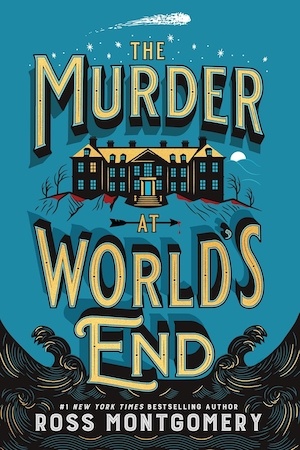
A historical locked-room mystery that balances homage with invention, The Murder at World’s End is Ross Montgomery’s debut adult novel. Set in the autumn of 1910 on a windswept island off the Cornish coast, it is both a complex puzzle mystery and a vivid evocation of Edwardian society on the cusp of modernity.
At Tithe Hall, a decaying manor house situated on an island only accessible by a tidal causeway, self-styled gentleman of science Viscount Stockingham-Welt is gripped by apocalyptic fervour due to the imminent passage of Halley’s Comet. Media sources of the time share his concern, stirring up widespread panic.
Convinced the world is about to end, whether due to the impact of the comet or the consequences of the myriad poisons it no doubt carries in its wake, the Viscount orders that the entire household – family and servants alike – be sealed inside the building. The Viscount himself plans to spend the night safe and secure in his study. Obviously, the comet has passes by harmlessly, however the Viscount is found dead inside his locked study, struck through the eye with a crossbow bolt, the most likely suspect being the suit of armour stationed outside in the hallway.
Based on this perplexing murder, Montgomery presents a quintessential locked-room mystery that evokes the Golden Age of detective fiction but with fresh, modern sensibilities. Into the claustrophobic setting of Tithe Hall steps Stephen Pike, a young man recently released from borstal for a crime he insists he did not commit.
The unfortunate timing of Stephen’s arrival – in the midst of preparations for the comet and mere hours before the Viscount’s murder – makes him the prime suspect. He’s the only outsider in the secluded household. Compounding his misfortune is the bumbling Scotland Yard inspector whose zealous investigations deepen the mystery rather than resolving it.
Stephen embodies a whole set of societal prejudices and insecurities tied to class and reputation. His origin in the lower echelons of society immediately positions him as an outsider, while his criminal record means that his presence among the genteel residents and their staff renders him invisible at times and dangerously conspicuous at others. Tithe Hall, with its rigid hierarchies and oppressive grandiosity, is more than an atmospheric setting. It is a microcosm of Edwardian society, where a person’s birthright and present station dictate their perception, trust and opportunity.
Stephen’s struggle involves not merely solving the mystery but also navigating the barriers placed before him by a system that continues to judge him for his background rather than his character. He must clear his name from suspicion and find his footing in a community that is, in many ways, predisposed to see him fail. Montgomery also uses Stephen’s character to explore the treatment of criminality and rehabilitation. His time in borstal frames his internal conflict and external obstacles throughout the story. In a period when a criminal record was an indelible scar on a person’s future, Stephen’s search for honest employment reflects both vulnerability and resilience.
Can someone labelled a criminal truly be accepted back into Edwardian society? The raw unease Stephen feels under the inspector’s scrutiny and the ease with which others assume his guilt capture the ambivalence of a class system that treats lower-class transgressions as character flaws rather than systemic issues.
Fortunately, help is at hand in the form of Miss Decima Stockingham, the Viscount’s formidable and foul-mouthed great-aunt. A woman well into her 80s, she is fearless, intellectually voracious and more than ready to challenge convention. She also has a serious potty mouth, another unusual characteristic for a woman of her age and station. In an era when women’s contributions to science and intellectual life were often dismissed or marginalised, Miss Decima’s sharp mind and unapologetic toughness serve as a quiet rebuke to those who would confine women to the domestic sphere or relegate their wisdom to footnotes.
Yet, despite such attributions, her position in life is decidedly precariousness. Though she comes from privilege, her voice is frequently dismissed, her presence tolerated rather than respected, and her age treated as something to wonder at rather than to value. She both depends on and disdains the benevolence of the Viscount. Here again, Montgomery addresses a social fault line: the precarious role of female relatives, especially those who refuse to be sidelined. Miss Decima’s cantankerousness isn’t merely comedic, it emerges from a lifetime of being underestimated. She is a critic of her nephew’s recklessness and pomposity and a voice of reason in the face of superstition.
Her intelligence and wit undermine the notion that women – particularly elderly women – should fade into the background, and the way other characters react to her underscores the cultural tensions around gender and authority. Perhaps due to her own outsider status, she is the one who befriends and defends Stephen when he is most vulnerable. Where Stephen presents youth and self-doubt, Decima exhibits fiery independence and scientific curiosity that drives much of their amateur sleuthing. The unlikely alliance between the under-butler and the elderly aristocrat entails humour, mutual exasperation and genuine affection as they navigate the house and its inhabitants’ secrets and grievances.
This dual-protagonist dynamic works exceptionally well. Stephen and Decima offer divergent perspectives on early 20th century life: Stephen, young, poor and eager for redemption, trying to build a future after societal rejection; Decima, seasoned by decades of experience, observing a world she finds increasingly baffling yet irresistible. Their interactions are often funny, occasionally tender and consistently realistic. The believable if eccentric method of their investigation extends beyond straightforward whodunnit mechanics. In particular, Decima’s scientific method and unabashed personality subvert and reinvent expectations of period dialogue and propriety.
Tithe Hall’s isolation, besieged by relentless wind and salt spray, adds gothic texture that both complements and contrasts with the comic undertones of the story. Locked-room mysteries hinge on enclosed spaces and constrained suspicion, and Montgomery uses this to his advantage, with every hint at an intrusion into the seclusion feeling charged with tension.
The passage of Halley’s Comet, a celestial event that really did prompt public fascination and fear in 1910, adds to the period authenticity and thematic resonance: both the characters and the setting are, at least temporarily, cut off from the wider world, forced to confront their fears, prejudices and assumptions as events unfold.
As the murder mystery progresses, clues are revealed with cumulative momentum, requiring the nascent sleuths to navigate a web of relationships, hidden motives and period-specific intrigue. This blend of intellectual challenge and historical world-building ensures that the puzzle is taxing and satisfying in equal measures.
Overall, The Murder at World’s End succeeds as both a loving tribute to and a revitalisation of the classic locked room mystery. Its unique blend of wit, warmth and atmospheric suspense ensures it stands on its own merits. As the first volume in the Stockingham & Pike series, it lays a strong foundation for future adventures.
For other locked-room mysteries, try My Grandfather, the Master Detective by Masateru Konishi and Helle & Death by Oskar Jensen.
William Morrow
Print/Kindle/iBook
$21.63
CFL Rating: 5 Stars