


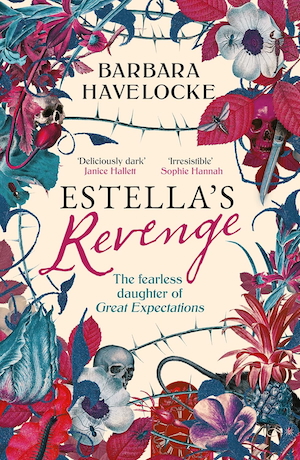
Since 2017, Barbara Copperthwaite has been a crime author worth following if you enjoy frighteningly realistic psychological crime fiction, and books like Her Last Secret and the Perfect Friend have been favourites on both sides of the Atlantic. But a couple of years ago, she had an idea – a wonderfully, gothic-y, creepy idea. It centred around Estella, the young girl raised by Miss Havisham, whom Pip meets and falls in love with in Charles Dickens’ Great Expectations. What if Estella were the central character in a crime novel? And so she wrote Estella’s Revenge under the nom de plume Barbara Havelocke.
Now, former journalist Barbara is back with Estella’s Fury, a second tale in which Estella confronts evil-doing and corruption, both in the great halls and the shadowy alleys of Dickensian London. The character appears to be the perfect lady, but beneath that grace and those fine manners there is all sorts of turmoil. We decided to ask Barbara to bring us up to speed with Estella and tell us about the new book.
What are crime fiction lovers going to love about Estella’s Fury?
It’s Great Expectations meets Dexter. Imagine the serial killer with a moral code is in Victorian times… and is female… and is determined to punish men who harm women.
You’ll love this book if you love: a creepy, gothic mansion filled with secrets and whispers; a conspiracy among servants; a missing girl, who impossibly vanishes mid-conversation; and a woman filled with rage and cunning, who won’t stop until someone has paid for their crimes. Even if it means revealing her own secrets. Even if it costs her life.
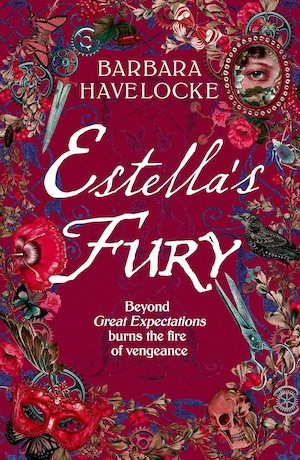
You don’t need to have read the Dickens classic in order to enjoy the Estella books. If you do, there are some lovely little nods to it, but if you know nothing about Dickens, you won’t feel you’ve missed out – about half of the people who’ve left reviews on Amazon and other sites mention they’ve never read Great Expectations.
What gave you the idea of taking Estella out of the Dickens milieu and making her the protagonist for a crime story?
Imagine a child who, from the age of three, is raised in a dark, cold, cobweb-filled house, and told daily to ‘never love, never trust.’ Imagine that child is isolated from others, and when she does meet people she is encouraged to practice cruelty – her mother even arranges for a boy to visit weekly, for the child to hone her skills on. This is Estella’s story in Great Expectations. Looking at it through a modern lens, she is trained to be a psychopath. At the very least she will be traumatised and emotionally damaged.
How could I resist writing her untold story, and exploring what being in a violent marriage might trigger in her? Everything was already there, it felt to me, but no one had noticed it yet – a psychopath hiding in plain sight in one of the most-read and most beloved books in the world. I would describe Estella’s Revenge as an origins story; a fascinating and twisted tale explaining why she is how she is. In Estella’s Fury she accepts herself, steps into her power and owns it – and has no hesitation in meting out her own unique brand of dark justice.
Who or what is she up against in Estella’s Fury?
Estella thinks that by visiting her friend, Elizabeth, she’s taking a break from the secrets in her life. Instead, she finds herself trying to work out what has happened to a young servant who somehow disappeared mid-conversation. What she uncovers is a huge conspiracy – one that holds a mirror up to some of the things happening in society today. Even as Estella solves one mystery she uncovers another and another… and that makes even the over-confident Estella wonder if she has bitten off more than she can chew. When anonymous notes start to arrive, she has to make a choice between vengeance and her own vulnerabilities. The story also makes Estella start a search about her own life. She must confront some uncomfortable truths about her origins, and how much of herself has been shaped by her birth parents, and how much by her strange upbringing.
Who are some of the other interesting character we meet?
In Estella’s Fury I had such fun exploring her relationship with Jaggers, the knife-sharp lawyer in Great Expectations, who doesn’t let anyone close. Estella is the chink in his armour and they have an almost father/daughter relationship – but all conversations are conducted as if they are verbally duelling in court.
There are also some surprise appearances from other characters, and even a cameo from Nancy, of Oliver Twist. Orphans are a theme of the story, so there are oblique references to Oliver Twist – not least because Estella is aware how different her own life could have been if she hadn’t been adopted by Miss Havisham. But there are plenty of characters of my own invention, from Sir John Taykall, whose breath can be smelled long before he enters a room, to the sinister housekeeper, Mrs Switchley, and the always angry head gardener, Brock Bellis…
What have you focused on when it comes to recreating Dickensian London?
The atmosphere is everything. It’s not enough to simply accurately describe, I’ve had to ensure I capture the spirit of Dickensian London, because that is what people love. For example, Estella’s Fury starts and ends in fog, so I spent a lot of time reading the famous descriptions from the start of Bleak House, but also did a lot of research into the facts of it, how deadly it was, and so on. No matter what I write, it has to fit in with Great Expectations’s timeline, characters and spirit, and so it is my constant reference material.
What’s been the biggest challenge pulling off a gothic mystery using a character from one of the world’s greatest novels?
The biggest challenges are also the greatest fun. Everything must fit inside the world of Great Expectations, but aside from that anything is possible. Before I started writing Estella’s Revenge I worried about how to go about it, tied myself up in knots about how to capture Dickens’ voice. Any attempt would surely end up being a weak echo. Then I realised that I didn’t need to, because Great Expectations is written in first person from Pip’s perspective – it is his story and voice. Estella’s Revenge and Fury are written in first person from her point of view, and so it is her voice that I create, while also including some of the darkness, and also comedy moments, that Dickens so excelled at.
Although I’m a full-time author living in Birmingham, I was raised in Lincolnshire, and it really informed my writing of Estella’s Revenge and Estella’s Fury. Everyone always thinks of London, of course, when speaking about Dickens, but in Great Expectations, Pip is formed by his childhood in a small village beside a sea marsh – and I was raised in a small Lincolnshire village, beside a sea marsh. There’s even a family-run brewery nearby, although admittedly a couple of miles away!
What’s next for Barbara Havelock and Barbara Copperthwaite?
It’s so odd speaking of myself in the third person, but here goes! Barbara Copperthwaite has a holiday thriller being published on 30 March 2026, which I’m very excited about! It’s set in Spain, and starts with one of the group coming round, a large lump on the back of her head, and her group of friends asking: “What did you do, Polly? Why?”
Beside her lies the dead body of her oldest and best friend. There’s a once in a lifetime storm happening around them, trapping them with a killer who might just be Polly, and as the flood levels rise, so do the stakes…
Barbara Havelocke will begin writing her next gothic historical thriller in the new year. It’s pretty much plotted out in my head, so now I just need to get cracking!
You can grab a copy of Estella’s Fury using the buttons below.