

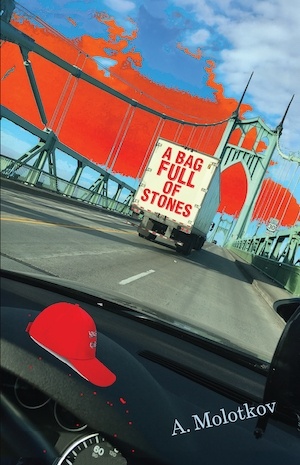
This is one of those crime stories that you hope isn’t based on real-life events, but expect it could be. A Molotkov’s debut crime novel, A Bag Full of Stones, explores what might happen when a person whose mental faculties are teetering at the edge of chaos is subjected to an unrelenting stream of vitriol aimed at people perceived by some to be enemies. Right now, in the United States and elsewhere, the conditions for the kinds of crimes Molotkov has envisioned in fiction simmer barely below the surface in reality.
Set in Portland, Oregon, in 2019, a volatile mix of identity politics has created an environment where one man feels morally bound to take corrective action. He even refers to himself as The Corrector. He’s a weak vessel to affect social change, however, and on a steeply downward spiral. He drinks too much bourbon. He lives with his mother, who is dying in a hospital bed in their living room, and he’s haunted by the insults of his dead father. He has no friends. His antagonisms cost him his job. What he has been successful at is murder.
As the story opens, police detectives Brenda Smith and Dmitry Volkov are investigating the death of an elderly Yemeni engineer. A plain red card found on the body indicates that his death is linked to the murder of a South Asian woman a year earlier. Within days, a third victim – this time an American nurse who is Muslim – is found, bearing the same red calling card. Conditions for panic over the city seem all too ripe.
The detectives are not without complicated, distracting lives themselves. Volkov is a Russian émigré with a loving wife and small daughter. He’s kept his serious gambling problem secret from the family. As his debts escalate, he’s blackmailed by Russian gangsters who want him to ‘help’ them with a criminal case they are involved in. What they want him to do will be an ethical and legal morass that will end his career and possibly more. Volkov is pained to realise he escaped Russia only to become embroiled in such personal and professional dangers in America.
For her part, Smith is a lesbian, just starting a new relationship. She hasn’t told her new partner she’s a cop, a piece of information not likely to be well-received, but which becomes harder to reveal with every passing day.
Each character’s story is told in short snippets, sometimes only a page or two, which can feel rather disjointed. Yet, it’s a practical way to handle such a large cast of characters – the two cops, the Corrector, and the victims, living and dead. Molotkov has developed a notion that the dead withdraw only gradually from the world of the living and continue for a time to have thoughts and observations.
The thoughts of the murdered Yemeni engineer and the nurse focus on bringing their murderer to justice. When Detective Smith has a ‘feeling’ or a flash of intuition about the case, here or there, perhaps their messages are getting through. How often must real-life detectives wish the victims in their investigations could talk to them?
Anti-immigrant sentiment, uncontrolled gambling, complicated relationships – that’s a lot to tackle, but Molotkov isn’t through. The mixed emotions and difficulties the Corrector faces in caring for his dying mother are a commentary on a further dysfunctional aspect of American life: the health care system. To the good, the mother is enrolled in hospice, and a nurse comes to check on her every few days, equipment has been brought in, and her pain appears to be managed.
At the same time, the deteriorating home environment and the instability of her sole caregiver (her drunken son) should be obvious to any health professional. In one of the most moving scenes in the story, the Corrector tells his mother what he’s done, expecting her to be proud of him. Instead, she is clearly horrified, yet helpless to do anything about it. She never speaks to him again.
The depth of character development in this crime story make it a stand-out. Described as a literary crime story, A Bag Full of Stones and its unvarnished appraisal of the tragedies latent in the current political moment provide a great deal to think about.
Read our interview with A Molotkov here.
Apprentice House Press
Print/Kindle
£5.19
CFL Rating: 5 Stars