

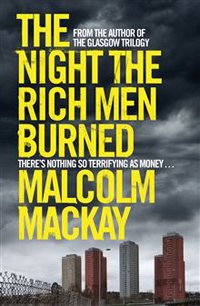
As with Malcolm Mackay’s past books, The Night the Rich Men Burned is set in Glasgow. This time, we are deeply embedded in the world of money. Not the money used in the international currency market, or the money gambled on a fluctuating stock exchange. This money trade is much more secure. We start with cash obtained through drugs, prostitution and fraud. This then finds its way into the hands of loan sharks, who lend it to the desperate and clueless at the bottom of the economic food chain. These loans come with ridiculously high interest rates, and when the loans become un-repayable, the debts are then sold on to the enforcers at 50p in the £1. The enforcers then use intimidation and violence to collect as much of the debt as they can. Everyone’s a winner – except the victims.
Mackay gives us a complex hierarchy of criminal middle managers. They include the likes of Potty Cruickshank – morbidly obese – who was handed the business by his uncle, and you will search his bulk in vain for a shred of human decency. Marty Smith is a chancer with a fake smile who wants to move up the ladder from his prostitution business to where the real money is. However, the story focuses principally on two young men who are drawn into criminality by a mixture boredom, unemployment and a misapprehension that they are about to enter a glamorous and exciting world. Alex Glass and Oliver Peterkinney have been friends since childhood, but they react to their new life in different ways. One advances through the criminal ranks with relative ease, while the other is marginalised and becomes bitter and frustrated.
As the relationship between the two young men worsens, the desperate scrabble for superiority among the gang bosses turns equally sour. Words lead to threats, threats lead to violence, and violence leads to death. Mackay is very good at portraying family members of the warring participants, innocents themselves, but powerless to change the actions of their loved ones. If you’ve read The Glasgow Trilogy you’ll recognise some of its characters who feature only on the periphery here. For example, the names of Peter Jamieson and John Young appear, but they play no significant part in the action, apart from being malign and brooding shadows in the distance.
The writing is shot through with grim poetry. Mackay doesn’t waste words on elaborate topographical descriptions, or detailed accounts of the weather. We are hardly aware if it is hot or cold; we are not even sure, at times, if it is night or day. All that matters are the words and actions of his cast. The actors are almost entirely male and, with rare exceptions, they are flawed but potentially violent wasters who prey on the weaknesses of society’s natural victims. Make no mistake. If this is theatre, it is the theatre of cruelty. You will not finish this book and feel better about the human condition. It is an emotionally exhausting read, and contains many of the elements of classical tragedy – the continuity of place, the fatal coincidences, and the vaulting ambition of powerful men.
There were strong hints of Mackay’s skill as a writer in his Glasgow Trilogy and you can read our reviews of books one, two and three by following the links. But this is on a different level altogether. It is a harrowing, but quite brilliant tour de force.
Read our interview with the author here.
Mantle
Print/Kindle/iBook
£9.85
CFL Rating: 5 Stars