

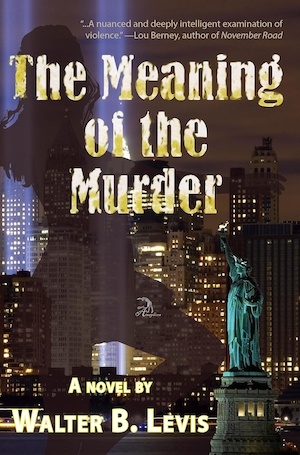
Billed as a literary approach to the topic of murder, Walter B Levis’s The Meaning of the Murder has a lot of plusses and, for me, a few minuses. He avoids all the cheap-shot cop story tropes, the too-easy slotting of characters into good cop/bad cop boxes, which in itself is refreshing. Every one of the main characters is a bit of both. But it felt he was trying too hard, maybe digging a little too deep into characters’ thoughts, which made it a bit of a slog to get through the not-that-long 230-some pages. They circle their issues repeatedly, just like in real life, but in fiction we can move on.
The main character, Eliana Golden, grew up in an Orthodox Jewish family in New York City. She saw her father walk out the door one day in 1994, when Eliana was 13. He never came back. He was a whistleblower preparing to testify against executives of the bank where he worked. They were funnelling monies to terrorist groups in defiance of federal law. Though other employees apparently turned a blind eye to the bank’s activities, in her father’s world, this was wrong. Alas, he disappeared before he got the chance to say so in court.
His widow suffered, as did his three orphaned daughters. The oldest, Livi, later married a wealthy hedge fund operator, but the protagonist of this book, Eliana, became a detective within the New York Police Department. She followed that path, unpopular within her family, for one and only one reason: to find the person responsible for her father’s disappearance and (presumed) death.
Her younger sister, Charlotte, has never moved emotionally past the family tragedy. She says that, if she encounters the killer, she will murder him. She’s become a drug user, and only escapes jail because of Eliana’s intervention. Now she lives in an inpatient mental health facility.
As the story begins, Eliana has received a long-hoped-for tantalising, but vague, clue about a man who claims he once killed a ‘Jew banker.’ Once she learns where she might meet the man – a Turkish-American named Vachik Savoyian – she single-mindedly pursues him. She keeps after him despite the evident dangers and uncertain outcomes, lies to her mentor and her ex-husband about what she’s doing, and pursues a cat-and-mouse game – or is it? – with this mysterious character.
At multiple points, Eliana receives concerned, kindly meant guidance from her former mentor and from her ex-husband, Danny, who is also an NYPD officer. They see she’s running off the rails – even she recognises the number of laws she’s breaking – and keep trying to nudge her into a safer, more acceptable role within the Department. Continually, though, her monomania makes her go outside the rules, take dangerous chances, and expose herself to unnecessary risk.
She isn’t even sure that Vachik Savoyian actually knows anything about her father’s death. He’s an Arabic-speaking assassin, who works for the US government. And he’s riddled with guilt about something. He immediately figures out who Eliana is and what she wants. She may be following him, but he’s following her too, and their back-and-forth is most of the book.
Overall, this story is well written, although you will have to accept the idea that over 20 years Eliana still hasn’t moved on from her father’s disappearance – even for the sake of her own sanity. Levis has created an effective meditation on the moral compromises involved in the kind of work Vachik does, and Eliana too, without a conclusion, if one were possible, about the work itself.
For more New York, try Double Takedown by Kevin G. Chapman or Broadcast Blues by Dick Belsky.
Anaphora Literary Press
Print
£2.34
CFL Rating: 3 Stars