

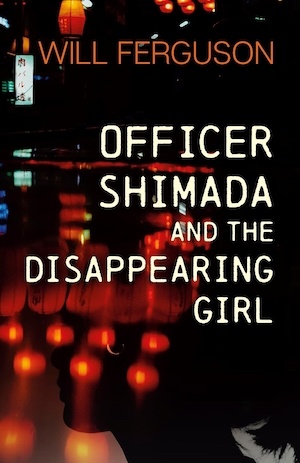
Canadian Will Ferguson’s latest book Officer Shimada and the Disappearing Girl is a literary mystery that also touches on other genres that Ferguson has written in, namely travel and humour. He has won Canada’s Leacock Medal for Humour multiple times, and an Arthur Ellis Award for Crime Fiction along with the Giller Prize for 419, a thought-provoking novel about international cyber crime. He also co-writes the cosy Miranda Abbott Mystery series with his brother, Ian.
This novel is set in various locations around southern Japan, where Ferguson lived for five years. His familiarity with the area and Japanese customs give the book a great sense of authenticity. Ferguson has said that the novel was inspired by a visit he made to Hateruma 30 years ago, a small island policed by just one officer. This led him to wondering how the officer would react if one of the 400 residents committed a crime.
The book opens with the arrival of Superintendent Kaito via ferry at Hateruma. His youth, height and vitality make him stand out from the other passengers. He is greeted by Officer Shimada who is short and one year away from retirement. Shimada may be slowing down physically but his mind is still sharp.
Shimada realises there is something odd about a celebrated officer like his new boss being posted to the most remote district. It appears that Kaito’s promotion is really a demotion. It’s not long before Kaito brings up one of Shimada’s old cases. A factory manager was killed inside an elevator. Shimada resolved the case before the investigators arrived on the island. In spite of his quick resolution, he is very modest about his actions.
Both men are very formal with one another initially. An unfortunate fire on a fishing vessel delays Kaito’s scheduled departure. The two men have very different responses to the fire, reflecting their individual approaches to policing.
Shimada invites Kaito to stay at the police residence, as there are limited places for him to stay on the island. There is a steady flow of alcohol during dinner with Shimada’s wife, Nami. Kaito becomes more aggressive in his questions about the elevator murder that Shimada solved. He ends up challenging Shimada to solve another elevator case – a girl stepped into an elevator but didn’t exit it and was never seen again.
Over the course of the night, Kaito drunkenly shares details of Chie, his older sister’s disappearance. She was homesick at the Catholic boarding school she attended. Her father swore to disown her if she left the school. She did not want to be disowned when she left school and it is believed that she went to Nagasaki City. There were rumours of her working at a bar called the Blue Moon on the third floor of a building in the entertainment district.
Fifteen-year-old Kaito was sent by his father to bring his sister home. He went to the Blue Moon and called the bar from a pay phone outside. The manager passed on his message. Chie was apparently coming down in the elevator but when the doors opened she wasn’t there. Kaito ran upstairs to find she was no longer in the Blue Moon either.
Chie’s disappearance left Kaito carrying a ton of guilt. Over time her absence destroyed his relationship with his father.
You can imagine Kaito’s surprise after he returns home from Hateruma and Shimada shows up at his door while on vacation. Kaito has no recollection of inviting him but doesn’t want to be rude. He must return the hospitality that Shimada and Nami showed him on Hateruma.
While they are walking down a street, they encounter a man doing the old cup-and-pea con. Shimada is fascinated by the game as he enjoys a good puzzle. In some ways this story is structured like a cup-and-pea con. You will feel that you know how to find Chie but every time you expect her to be found, she’s not there.
Their search will keep you reading late into the night. These two men are dual protagonists with fully developed characters. Both of them are needed to track down the truth. The themes of family, religion and the regrets we carry captured my interest along with the interwoven smaller plotlines. There are moments that will break your heart and others that will bring a smile to your face as you vicariously travel around southern Japan.
Another North American author who writes crime novels set in Japan is Michael Pronko. For more on his work, click here.
Goose Lane Editions
Print
£20.00
CFL Rating: 5 Stars