

Jean Thesquare is the pen name for the anonymous New York-based crime author behind The Sultryverse – a publishing company and a literary universe where they explore themes a lot of authors won’t touch. Their protagonists are intelligent women in control of their lives, stories and desires, and who use their power in a ‘consent-forward’ manner. As such, The Sultryverse is resonating with readers around the world, and they too are a part of the overall concept.
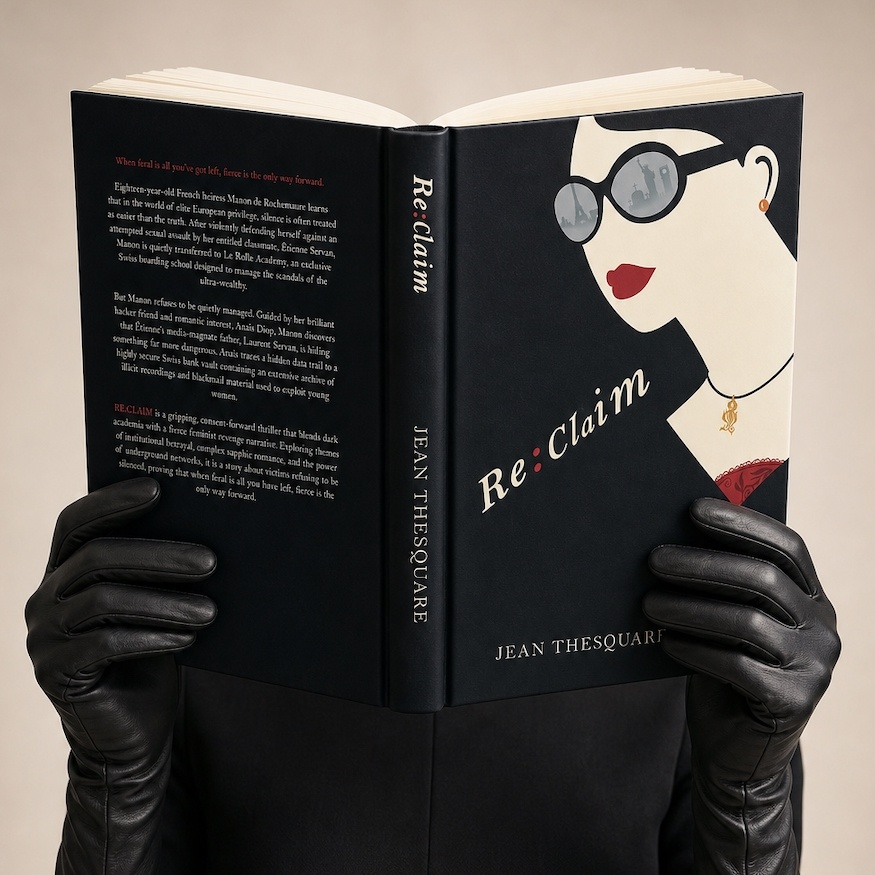
Re:Claim is the second Sultryverse novel, and is a prequel to the first, AcClaim, which came out in 2025. Here we discover how protagonist Manon de Rochmaure’s outlook was formed in a fascinating tale with all sorts of facets to it. Essentially, after defending herself against an assault by a wealthy male heir, she has been silenced through exile to a posh school in the Swiss Alps. Teaming up with a group of fellow misfit pupils, Manon channels her rage into taking revenge on her attacker, his wealthy family and the institutions that protect and perpetuate their abuses.
This means they’ll try to break into a Swiss bank vault and take blackmail material the family has hoarded there. But what will exposing them really mean for Manon and other victims? Female rage is a theme many readers are interested in at the moment, but Re:Claim is about plenty more than that. It’s dark academia, there’s a heist, it’s a revenge thriller and it’s also an adult novel that is explicit in places.
Jean already has plans for further books in 2027, 28 and 29, where they will reveal more about some of the other key characters in The Sultryverse. Working as a journalist, the author has contributed to some leading publications. We decided to find out more about Re:Claim, how Jean built the Sultryverse, and what inspires their writing…
First of all, what are crime fiction lovers going to love about Re:Claim?
While it covers the usual secrets, conspiracies and heist mechanics of many fiction books, the moral problems at the core of the book may be what sticks with readers.
Re:Claim has elite institutions protecting their own, a media empire built on blackmail, an offline archive hidden in a Swiss bank vault, and a group of unlikely co-conspirators trying to steal it and yet the central mystery isn’t that. It’s who has benefited from it, whom the characters can trust, and how they can expose crimes without further exploiting the people who were harmed.
Then of course, there are the characters in the book but I can’t tell too much about that. I’d rather readers discover them.

The Sultryverse sounds fascinating – what is it?
The Sultryverse is both a connected fictional world and the reader community growing around it. The books move across genres, but they share a central idea: intelligent women reclaiming authorship of their lives, their desire, and their power in a consent-forward manner.
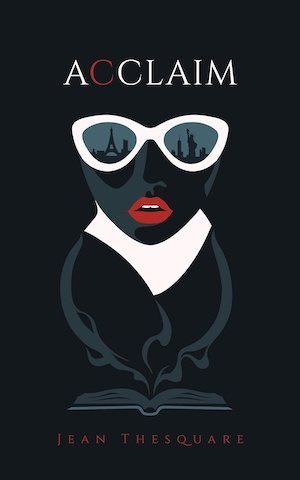
The first book I wrote, AcClaim, was a glamorous story of private psychological revenge and how elite men may feel that being rich means they are above any need for consent. It was initially a standalone but fans and characters kept asking for more of this world.
So as I sat down to write down Manon’s backstory, I set out on building a wider arc across all characters to better understand their motivations. This has developed into a five- to seven-book universe, at least, of interconnected stories exploring power dynamics through different lenses.
Re:Claim, my new one, is an institutional thriller about transforming survival into collective action.
The books share characters and consequences, but each is an independent story and can be read first. The larger world gives me room for adult stories about complicated women – including bisexual and sapphic women – without forcing every character or relationship into the same narrative shape. It also allows me to explore the edges of genres and hopefully subvert them in ways that are as exciting to the reader as they were to me as a writer.
Who is Manon de Rochemaure? What inspired this character and how have you developed her?
Readers first met Manon in AcClaim as Beatrix’s formidable ride-or-die best friend: an heiress and fashion figure who understands that image, reputation and sensuality can all be weapons. She entered that story already knowing how power works.
Her story, though, was born out of the fans. It may be that subconsciously, I loved Manon much more and they saw that and kept asking for more of her.
Re:Claim began with my wanting to know how she learned those things. Here, she is 18 – privileged but not protected, fearless but not invulnerable. After she is punished for defending herself against an attempted assault, she refuses to accept the respectable silence arranged for her.
What interests me about Manon is that she isn’t a perfectly behaved survivor. She is angry, impulsive, vain, loyal, funny and capable of making dangerous mistakes. Her development comes from learning that rage can start a rebellion, but it cannot provide the ethical architecture needed to sustain one.
What did she get up to in your first novel, AcClaim, and how has it led into Re:Claim?
In AcClaim, Manon is Beatrix best friend, former lover and partner in crime. When billionaire Dorian Wolker turns Beatrix’s desire, career and reputation against her, Manon is the person who remains beside her. Together, they transform public humiliation into a calculated comeback.
Re:Claim moves backward chronologically. It shows Manon meeting the girl then known as Beatrice at Le Rolle Academy, and how Beatrice ultimately comes to become Beatrix. More importantly, it reveals the origins of their loyalty and the first time they learn to use story, reputation and collective action against powerful men.
AcClaim may have been published first but new readers can either read them independently or start with Re:Claim. The same will be true with my next book, which continues backwards with a character you’re meeting in Re:Claim.
What is she up against?
The immediate antagonist is Étienne Servan, the entitled classmate who attempts to assault Manon and then uses his family’s influence to rewrite what happened. Behind him is his father, Laurent Servan, a media magnate whose power depends on illicit recordings, blackmail and institutions willing to protect him.
Manon’s enemies are therefore not only individual men. They are schools, banks, families and respectable adults who know how to make crimes disappear administratively.
The main antagonist becomes a system that values conservative covers for guilty men. So she does what any reasonable heiress facing an international blackmail operation would do: she plans to break into a Swiss bank vault.
Who are some of the other interesting characters we’ll meet?
Some characters are returning from AcClaim: Beatrice (later Beatrix) is Manon’s sharp-witted American roommate, an emerging writer who can turn language into both camouflage and ammunition. Noa is a security expert who keeps reminding the group that anger is not evidence and revenge is not an operating system. Lucian Moreau is a banker’s son with access to the world they need to penetrate and a conscience that makes that access complicated. And a couple of other essential characters but I don’t want to break a surprise there.
The newest player in the group is Anaïs Diop, Manon’s brilliant hacker friend, first love and ethical counterweight. She understands systems, but she also understands that access is not permission. There is a lot more to her than people see and we will see her again in the future.
We love a good heist. What gave you the idea behind the bank vault of secrets, and Manon’s plan to steal them?
I was fascinated by the idea that, for powerful people, information can be more valuable than money. We imagine modern secrets floating somewhere in the cloud, but the most dangerous archive would probably be offline, physically controlled and protected by very old systems of wealth and discretion.
A Swiss bank vault allowed the old and new forms of power to collide: inherited privilege, physical security, hard drives, digital investigation and information being treated as an asset. Putting it in the same country as an elite boarding school made sense.
The vault also gave the heist an ethical complication. The drives contain evidence, but they also contain victims’ pain. Manon cannot simply leak everything without repeating the original violation. The real challenge is not only stealing the truth; it is deciding who has the right to use it.
Tell us about the setting and its role in the dark academia aspect of the story?
Paris provides the polish and social pressure. Le Rolle Academy, the fictional Swiss boarding school, provides the claustrophobia. Geneva and its financial world provide the physical machinery of secrecy.
Le Rolle is beautiful: old libraries, immaculate uniforms, alpine light, the lake, inherited rituals and students carrying names that open doors before they arrive. But the school is not simply an atmospheric backdrop. It’s also an island of misfits, where powerful families have sent their troublesome heirs to be indoctrinated into which truths matter, which scandals can be managed, and whose reputation deserves protection.
That is the darkness beneath the academia. The beauty is real, but it is also camouflage. Although the novel uses a boarding-school setting, Re:Claim is adult fiction with adult themes and there’s a queerness element that infuses LeRolle in a different way.
What are some of the bigger themes you wanted to explore in Re:Claim, and why?
The largest is the difference between consent and control. I also wanted to explore institutional betrayal, ownership of one’s story, the politics of evidence, bisexual and sapphic desire, female rage, and the point at which revenge risks becoming another kind of violation.
We often talk about exposure as though revealing everything automatically creates justice. But what happens when the evidence contains another person’s body or trauma? Who has the right to publish it? Can you destroy a system without turning survivors into content?
That is why Les Louves adopt the principle ‘We publish proof, not pain.’ The women are not merely trying to punish powerful men. They are trying to build something more ethical than the system they are fighting.
The second one is reputation as currency. Old families exist because they have figured how to manage their fortune but also their image. For example, if you look at the British crown, it could be considered as an aberration to have kings and queens still ruling over a democratic world. But the family has managed to turn their privilege and power into an image (more recently challenged) and a set of icons that become embedded into a country’s identity. However, every time an issue pops up, it’s a question of how they will manage the reputational impact. And are there some people out there weaponising reputation. In the aftermath of the Epstein files releases (and some of the ones not released), there are interesting questions around this.
Which other crime books and/or authors have inspired you, and what are you reading at the moment?
Patricia Highsmith is an obvious touchstone for psychological tension, hidden desire and the danger inside apparently civilised rooms. Her books even make a brief appearance as an identity marker in Re:Claim.
Like many people I know, I’ve read a lot of Agatha Christie as a kid. While some of it could be seen as problematic these days, they are still delightful mysteries to me.
I’m currently reading A Pound of Flesh by Sydney Hunter, which is dark, funny, disturbing and yet thoroughly enjoyable. I just finished Cool Machine by Colson Whitehead, which is absolutely amazing and gives me something to aspire to as a writer.
I also admire Umberto Eco’s ability to make institutions and ideas feel suspenseful, Carlos Ruiz Zafón’s atmosphere, and William Gibson’s understanding of systems and technology. My influences aren’t exclusively crime writers – Gabriel García Márquez, Zora Neale Hurston, Toni Morrison and Percival Everett have all shaped how I think about voice, character and power.
Re:Claim is available now and you can grab a copy using our buttons below, or find out more about The Sultryverse by visiting the website here.